

Scientists have developed a new method for planning routes to near-Earth asteroids—one that requires significantly fewer computational resources and is more energy-efficient than traditional approaches. This is discussed in a study by Alessandro Beolchi of Khalifa University of Science and Technology and his co-authors.
Two approaches in one
The researchers combined two physical models. Near Earth, they use the so-called circularly restricted three-body problem (CR3BP)—a model that accounts for the simultaneous gravitational influence of the Sun and our planet.
It is precisely this interaction that gives rise to Lagrange points—locations in space where gravitational forces balance each other out and a probe can effectively “park” while waiting for an asteroid to pass by. Further from Earth, the model switches to the classic two-body problem—the Sun and the spacecraft—where the planet’s influence is no longer taken into account.
Gravitational “highways”
Each Lagrange point has what are known as invariant manifolds—invisible trajectories along which a spacecraft can travel away from Earth with almost no fuel consumption. The new method allows the spacecraft to “travel” along such a trajectory via point L1 and return via the symmetrical point L2 on the opposite side of the planet—as confirmed by a simulation involving asteroid 1991 VG, which once temporarily became Earth’s “mini-moon.”
Another innovation is the adaptation of the method for Solar Electric Propulsion (SEP). Unlike chemical rockets, which produce a short, powerful burst of thrust, SEPs generate thrust comparable to the pressure of a sheet of paper against the palm of your hand—but continuously, for months on end. Previous algorithms modeled only instantaneous changes in speed. The new code accounts for slow but sustained acceleration.
80 asteroids and two million routes
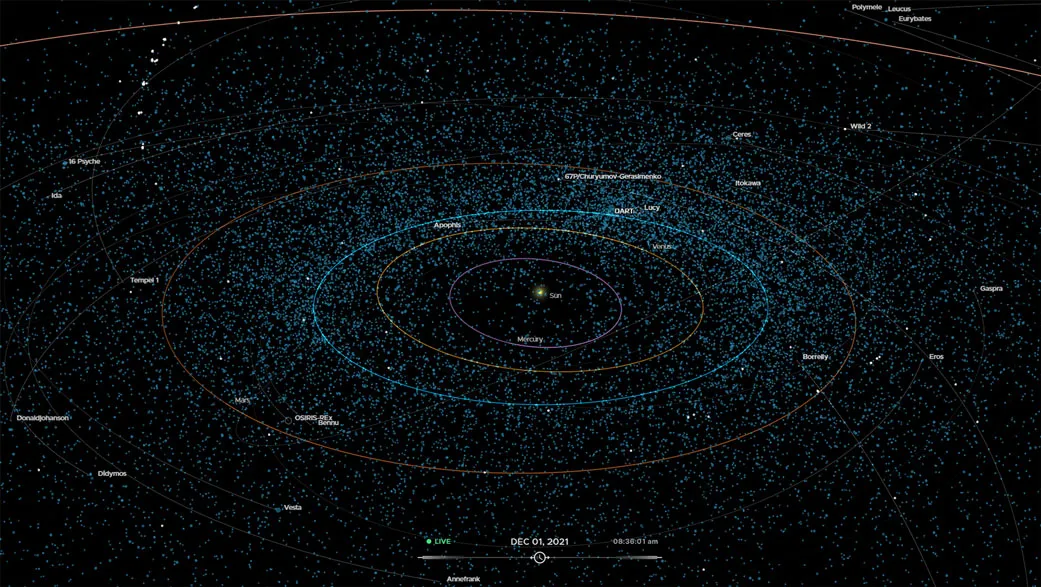
The team tested the algorithm on 80 real asteroids with relatively flat orbits. The result: over two million different viable round-trip routes.
The researchers also tested Apophis—an object with a noticeably elongated and inclined orbit. According to the researchers, the algorithm was able to handle this complex case as well.
Cheaper and safer
Compared to standard trajectories from NASA’s NHATS (Near-Earth Object Human Space Flight Accessible Targets Study) database, the new method yields similar values for delta-v—the total velocity change required for the mission—but significantly reduces the launch energy. In other words, the launch will cost less.
In addition, the return flights turned out to be slower: the spacecraft enters the atmosphere at lower speeds and requires lighter thermal protection.
According to universetoday.com

