
In addition to the isolated gravitational waves that detectors sometimes record, there is also an almost constant background that is quite difficult to detect. Recently, scientists have suggested that its source is events involving billions of black holes at the centers of galaxies.
How are gravitational waves formed?
Scientists at the University of Colorado at Boulder may have solved an urgent mystery about the gravitational background of the Universe. This is the name given to waves in space and time that constantly move through the cosmos and “shake us almost like jelly,” according to Julie Comerford, an astrophysicist at the University of Colorado at Boulder.
A study published in The Astrophysical Journal reveals new insights into the evolution of the Universe, specifically how smaller galaxies may have merged over billions of years to form larger and more complex galaxies such as the Milky Way.
Comerford explained that at any given moment in the Universe, countless galaxies are in the process of merging.
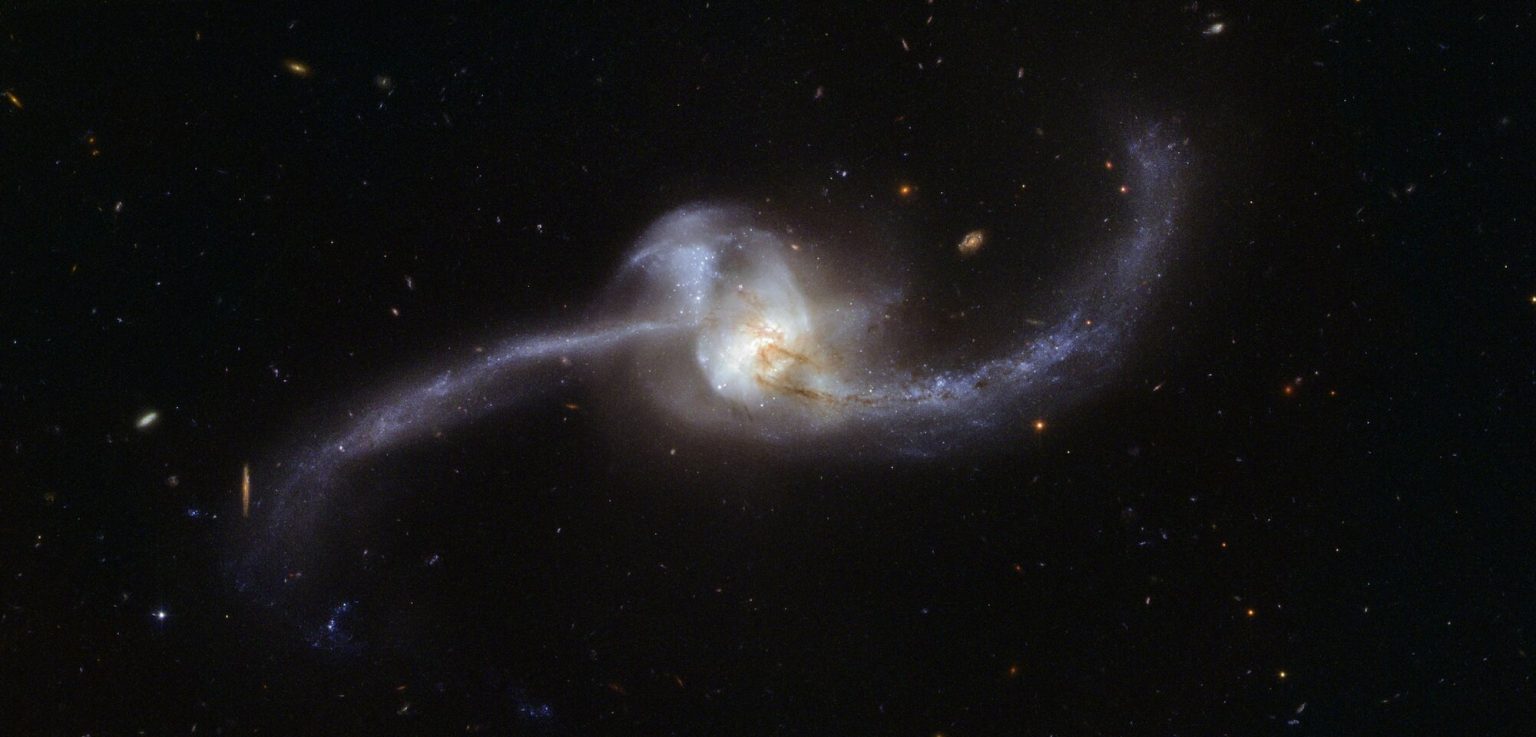
Each of these galaxies has a supermassive black hole at its center, with a corresponding name. When galaxies merge, these black holes spin around each other, circling until they eventually collide. The collisions create waves in space and time that are so weak that humans can never feel them.
“Imagine a large number of people in a swimming pool,” said Comerford, lead author of the new study and professor in the Department of Astrophysical and Planetary Sciences at the University of Colorado Boulder. “They all create their own waves, and these waves overlap. That’s what the gravitational wave background looks like.”
Mystery of the gravitational wave background
In 2023, several international collaborations, notably the North American Nanohertz Observatory for Gravitational Waves (NANOGrav) experiment, reported that they had detected the gravitational wave background for the first time.
There was only one caveat: according to the measurements of these groups, these waves were much larger than scientists had estimated. No one knew why.
In a new study, Comerford and his co-author Joseph Simon, a former postdoctoral fellow at the University of California, Boulder, may have found an explanation. Using observations of real galaxies and computer simulations, the team discovered something that researchers had not taken into account: when a smaller supermassive black hole merges with a larger one, the smaller black hole appears to gain significant mass.
“We had a prediction for what the gravitational wave background should be, and what NANOGrav found was larger than expected,” Comerford said. “It was a surprise and a fun new puzzle to figure out.”
The uneven growth of black holes
Supermassive black holes, like galaxies themselves, come in a wide variety of sizes. Some of these celestial objects are truly gigantic, with masses equal to billions of Earth’s suns. Others are still large, but slightly smaller, with masses millions of times greater than the Sun. For many years, most scientists studying the gravitational wave background did not believe that these smaller black holes were significant, Comerford said. They were thought to be too small to make a significant contribution to the gravitational wave background.
This is partly because galaxy mergers can be complicated. When two galaxies come together, gas from those galaxies starts to rush toward the supermassive black holes at their centers. This gas forms a doughnut-shaped cloud outside the black holes, spiraling around each other. Some of this gas returns to the black holes, making them larger in the process.
But previous simulations have revealed something surprising: black holes in a merging pair may not grow at the same rate.
“The more massive black hole is closer to the center of the doughnut, where there is less gas,” Comerford said. “The smaller black hole is farther away, so it’s closer to where the gas is.”
Simulation of gravitational background
This difference in growth rates, or what scientists call “predominant accretion,” can be significant.
In the current study, scientists developed a detailed set of equations capturing the physics of galaxy mergers. The team then adjusted these equations so that smaller black holes grew 10% more than larger ones.
This single adjustment was sufficient to make the estimates of the gravitational wave background match the measurements from the NANOGrav experiment.
“They start out little, but because the little ones grow the most, they shouldn’t be discounted,” Comerford said. She said the effort is part of a broader quest to understand some of the most fundamental questions about the Universe. This includes how “primitive” galaxies at the dawn of the Universe, which were tiny and consisted mainly of gas, could have created the giant black holes that exist today.
According to phys.org

