

At the very beginning of the Universe, even before the formation of the first stars, the first chemical reactions were already taking place in clouds of neutral hydrogen. Recently, scientists have succeeded in reproducing it in the laboratory.
The beginning of the Universe
On Earth, we constantly deal with chemical reactions. And many of them can only occur because our planet exists. However, in space, there are also many transformations of one substance into another.However, what was there at the very beginning of the Universe, when even stars did not yet exist? Was there already some kind of initial chemical reaction at that time?
Scientists from the Max Planck Institute for Physics say they know what it was like — and have even recreated it in their laboratory. However, further clarification is required here. Immediately after the Big Bang, when matter had already separated from radiation, only two types of atoms existed: hydrogen and helium.
At the same time, when the Universe was 380,000 years old, they remained completely ionized, meaning that the electrons were separated from the nuclei. It was only later that atoms became normal, which, however, marked the beginning of the dark ages — a period that lasted until the first stars appeared tens of millions of years later.
First chemical reaction
And now scientists claim that the first complex molecule existed even back then and, accordingly, reactions of its formation and decay were taking place.
Later, these molecules began to break down and be replaced by the neutral molecular hydrogen familiar to us.
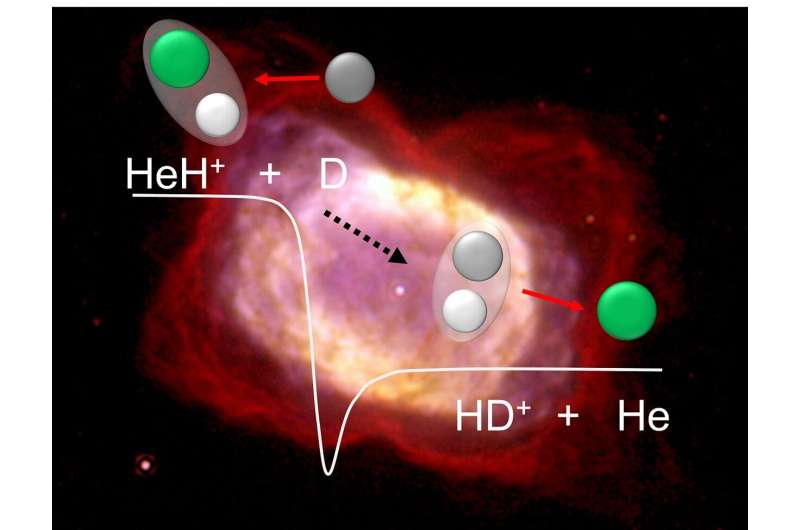
Researchers at the Max Planck Institute for Nuclear Physics (MPIK) in Heidelberg have successfully reproduced this reaction for the first time under conditions similar to those in the early Universe. They investigated the reaction of HeH⁺ with deuterium, an isotope of hydrogen containing an extra neutron in the atomic nucleus next to the proton. When HeH⁺ reacts with deuterium, an HD⁺ ion is formed next to the neutral helium atom instead of H₂⁺.
The experiment was conducted on the Cryogenic Storage Ring (CSR) at MPIK in Heidelberg — a unique instrument for studying molecular and atomic reactions under conditions similar to those found in space. To do this, HeH⁺ ions were stored in a 35 m diameter ion storage ring for 60 seconds at a temperature of several kelvins (-267 °C) and were superimposed with a beam of neutral deuterium atoms. By changing the relative speed of both beams, scientists were able to track the frequency of collisions depending on energy, which, in turn, was directly related to temperature.
According to phys.org

