

Scientists have discovered an explanation for the recently discovered waves in Jupiter’s magnetosphere. They are caused by transitions from one type of oscillation to another.
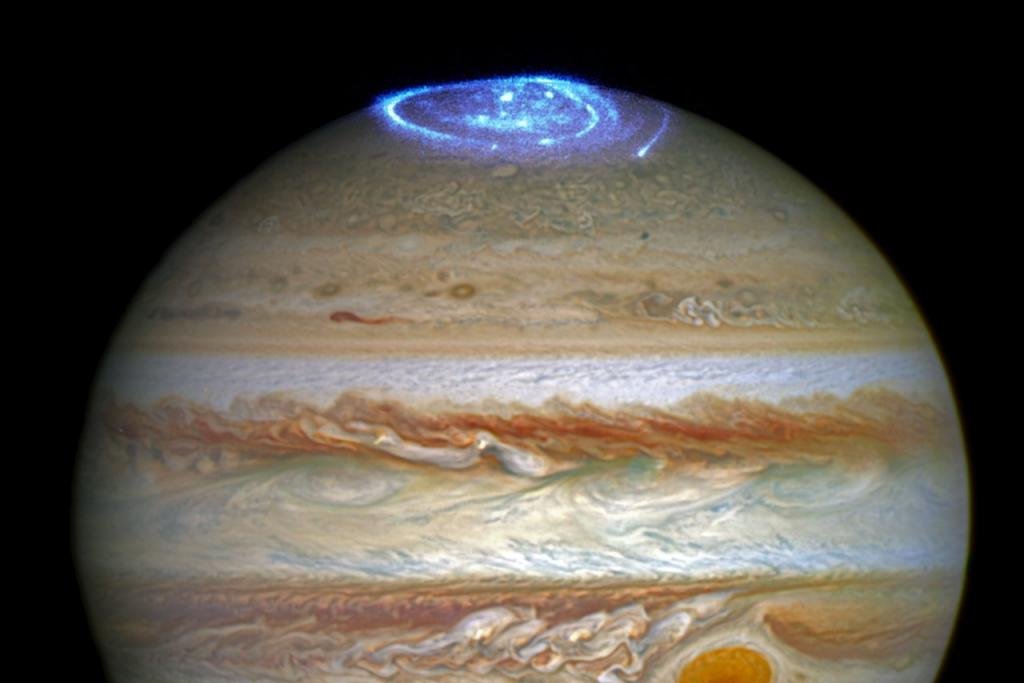
Plasma waves in Jupiter’s magnetosphere
Some time ago, the Juno spacecraft observed mysterious plasma waves above Jupiter’s poles. Their appearance has not yet been explained by standard theories of planetary magnetic fields. However, it is possible that the publication in Physical Review Letters contains an explanation for this phenomenon.
Its authors view the planet’s magnetic field as an ocean, a specific environment in which waves can occur. Although Jupiter’s magnetic field is significantly stronger than Earth’s, it is structured in the same way, and scientists know a great deal about our magnetic field.
In particular, it is known that two types of oscillations occur in it. The first concerns electrons, which are very light particles and therefore fly quite freely throughout the entire volume. They experience rapid high-frequency oscillations that occur parallel to the magnetic field lines. These are called Langmuir waves.
Ions, molecules from which electrons have been removed, behave completely differently. They usually remain attached to the magnetic field lines and orbit around them. This phenomenon is called Alfvén waves.
Wave transformation
The idea presented by the authors of the new study is that conditions exist in Jupiter’s atmosphere near its magnetic poles for the transition of Alfvén waves to Langmuir waves. They suggest that this metamorphosis may be catalyzed by another unusual phenomenon previously observed by Juno in 2016: powerful upward beams of electrons, whose packing energy approaches 100,000 electron volts.
Researchers note that their results indicate the existence of a new type of plasma wave mode that arises under unusual conditions of high magnetic field strength and low plasma density at high latitudes and low altitudes in Jupiter’s magnetosphere.
According to phys.org

