

Transitional periods occur not only in humans, but also in planetary systems. One of them, TOI-2076, which consists of four known planets, was recently studied by astronomers. They were particularly interested in whether the primary atmospheres of these worlds had dissipated.
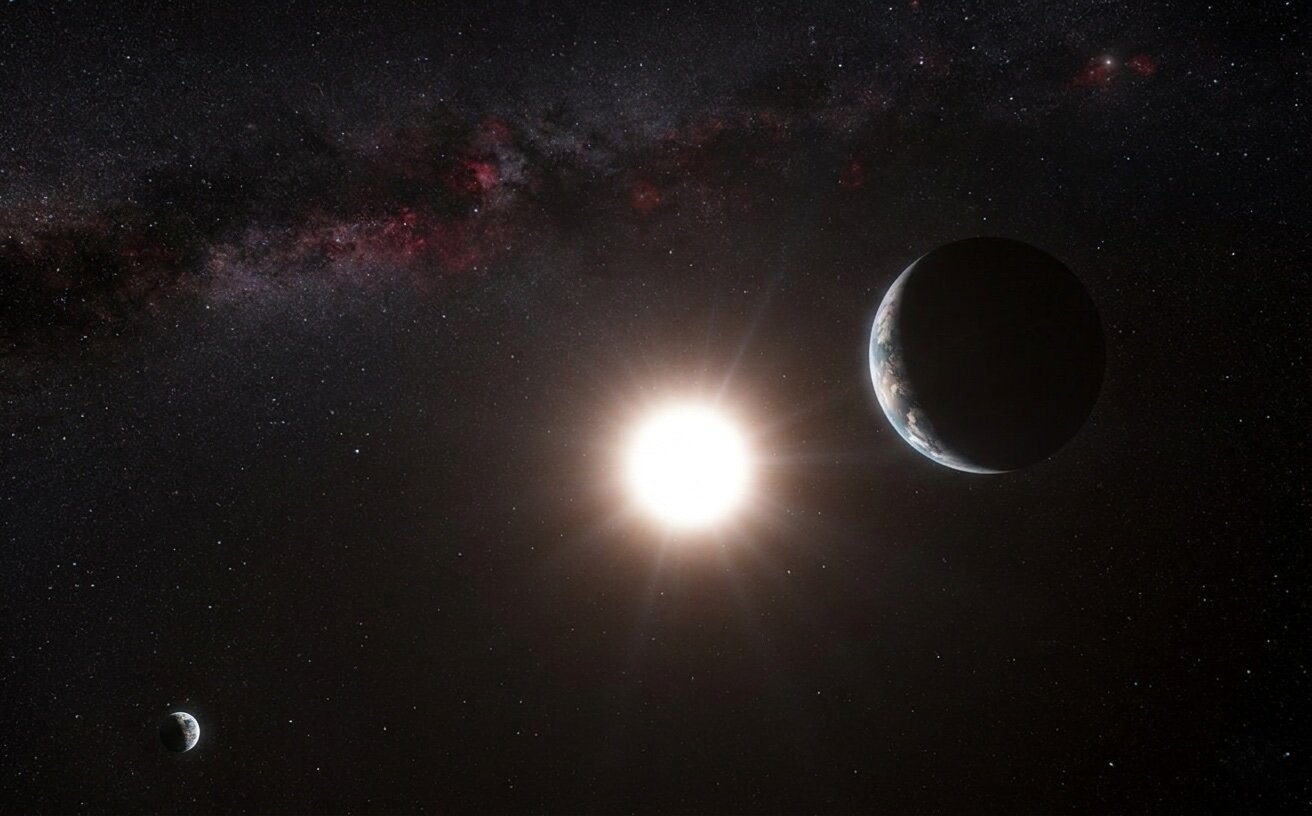
TOI-2076 system
The TOI-2076 solar system is considered mature. It is several billion years old, and its planets have settled into stable orbits and undergone a long evolutionary process. Most other planetary systems we see are far from young. That is why astronomers devote so much time to studying newly born star families.
However, a considerable amount of data has already been collected on such systems, where protoplanetary disks have not yet completely dissipated in some places, and planets are literally making their way through them. Much more mysterious are transitional objects: planets that appear to have already formed, but whose orbits are either still unstable or, conversely, demonstrate excessive regularity.
It was precisely one such system that astronomers led by Howard Chen of the Florida Institute of Technology observed. It is called TOI-2076 and consists of four planets. It was discovered back in 2020, but now scientists have published new research in the journal Nature Astronomy.
What the research showed
The main source of information about the TOI-2076 system was NASA’s TESS satellite. Thanks to this, scientists learned that the system is 210 million years old. It is at the stage when giant asteroids were still falling on Earth en masse.
What is even more interesting is that in the case of TOI-2076, the planets are quite close together and rotate in near resonance. That is, their periods of rotation are related as integers. This is very interesting, considering that the star itself is an orange dwarf. It is smaller than the Sun, but still not the size of Jupiter.
However, scientists were most interested in the atmospheres of planets. In the early stages of their existence, the gas envelopes of all worlds consist mainly of hydrogen, which they obtain from the protoplanetary disk. Then it gradually dissipates and is replaced or not replaced by certain gases.
No one knows how long this process takes. The TOI-2076 system has shown that it takes about 100 million years. It is quite likely that similar time frames are characteristic of other similar systems.
According to phys.org

