

An international team of astronomers has discovered the first tidal disruption event producing bright radio emissions outside the center of a galaxy. The discovery was made using the ALMA radio telescope array.
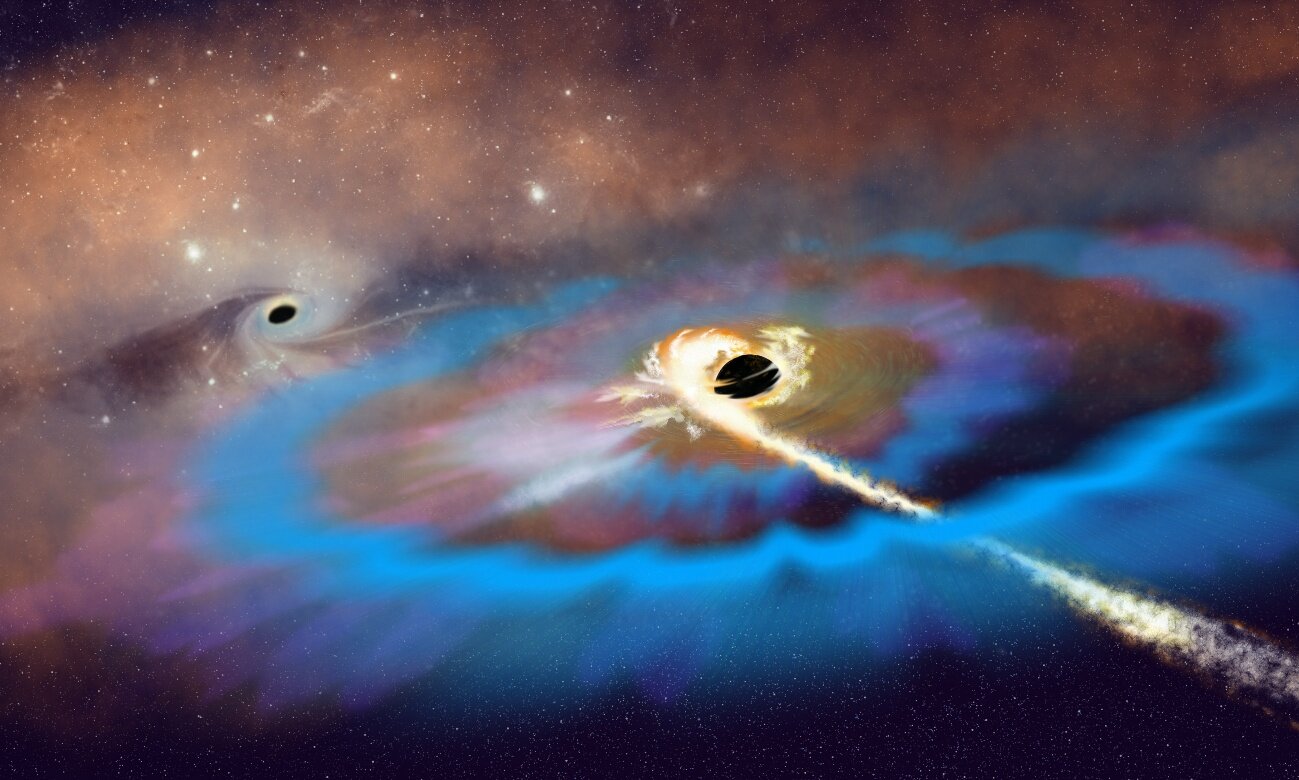
Tidal disruptions occur when a star gets too close to a massive black hole and is torn apart by its gravity, releasing a large amount of energy. As a rule, such events occur in galactic centers, where supermassive black holes are located.
However, the tidal disruption event, designated AT 2024tvd, was very different from typical ones. It demonstrated the fastest radio emissions ever observed, caused by the destruction of a star by a black hole. However, it did not occur in the center of the galaxy, but approximately 2,600 light-years away from it. This suggests that supermassive black holes may be hiding in unexpected places.
This discovery was made possible by high-quality observations conducted using several of the world’s leading radio telescopes, including ALMA, VLT, and AMI-LA. They revealed an unusually rapid evolution of radio emission—a distinctive feature of this phenomenon and an important clue to understanding its physical nature.
The data showed two distinct radio bursts developing faster than any previously observed tidal disruption events. These results indicate that powerful streams of matter were ejected from the vicinity of the black hole not immediately after the star’s death, but several months later, which indicates a delay and complexity in the processes occurring after the destruction.
Detailed simulations indicate at least two separate emission events occurring several months apart—clear evidence that black holes can episodically “wake up” after periods of apparent inactivity.
“This is truly an extraordinary phenomenon,” commented Dr. Sfaradi, lead author of the study, on the discovery. “We have never before seen such bright radio emissions from a black hole tearing apart a star far from the center of the galaxy and evolving at such a rapid pace. This changes our understanding of black holes and their behavior”.
Earlier, we reported on a greedy black hole eating from two spiral arms at the same time.
According to Phys.org

