

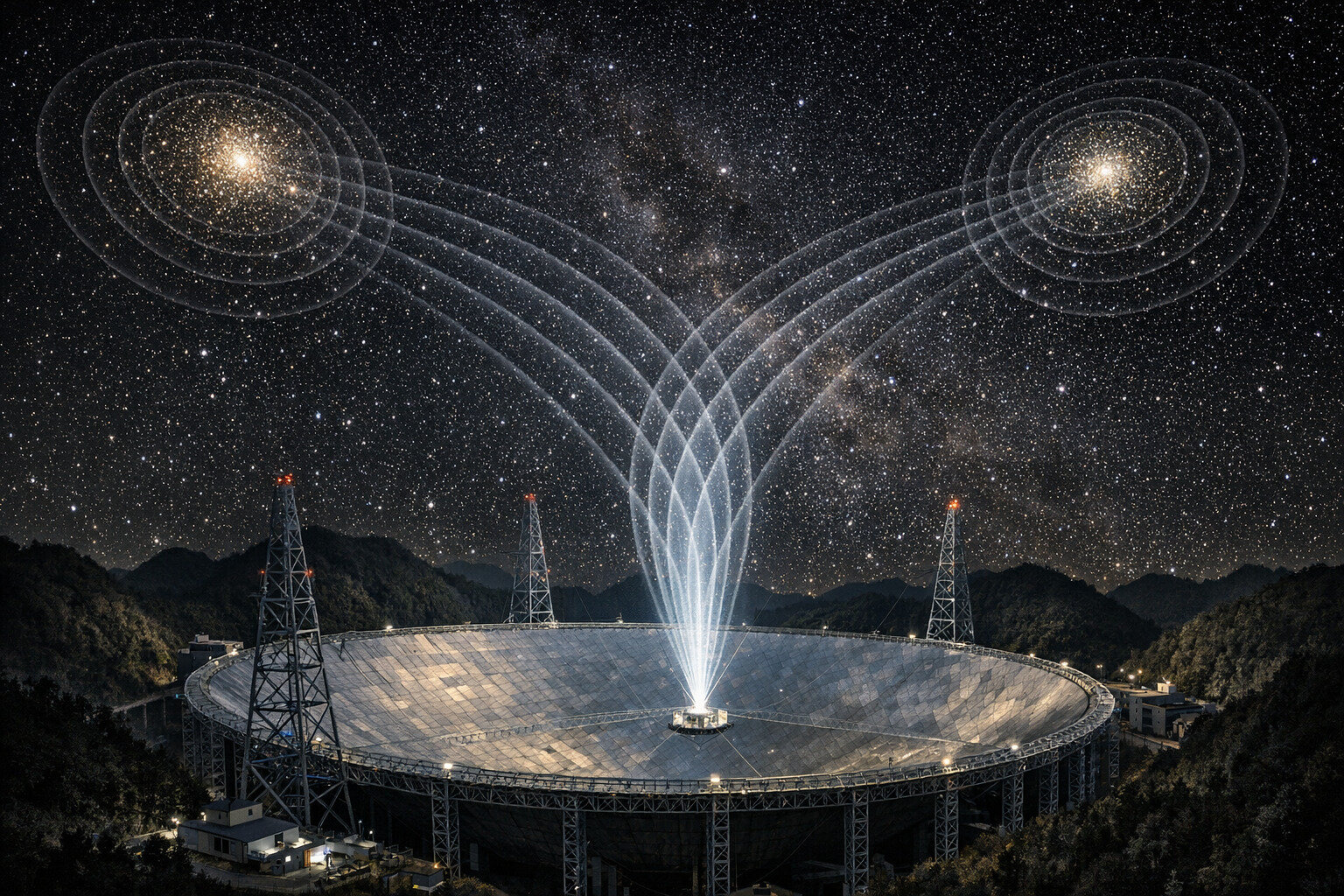
Chinese astronomers have discovered six new millisecond pulsars in two globular clusters in our galaxy—NGC 6517 and NGC 7078.
What are millisecond pulsars?
The discovery was made possible by the 500-meter FAST (Five-hundred-meter Aperture Spherical radio Telescope) and an unconventional data processing method. The results were published in April 2026 on the arXiv preprint server.
Pulsars are ultra-dense neutron stars with powerful magnetic fields that rotate and emit a narrow beam of radio waves, much like a lighthouse. Those that complete a full rotation in less than 30 milliseconds are called millisecond pulsars (MSPs).
It is believed that they “spin up” in binary systems—when a neutron star absorbs matter from its nearby companion star. However, the most interesting thing is that all six of the newly discovered objects are isolated: there are no nearby companions.
Why them?
A team led by Yinfeng Dai of Beijing Normal University analyzed FAST’s archival data on NGC 6517 and NGC 7078 (also known as Messier 15). These are the only globular clusters with collapsed cores that the telescope has observed.
In such objects, gravitational collapse draws stars closer together, which, according to observations and dynamical modeling, contributes to the formation of a large number of isolated MSPs. The analysis covered the observation period from June 2019 to March 2024 for NGC 6517 and from September 2019 to February 2024 for M15.
Methods and Results
Previously, these objects went unnoticed: their signals are too weak to be detected by standard searches within individual observations. Dai and his colleagues used a “stacking” technique—combining the power spectra from multiple sessions—which significantly improves the signal-to-noise ratio for faint sources.
Four new pulsars have been discovered in the NGC 6517 cluster (with rotation periods ranging from 3.68 to 6.02 milliseconds), and two more in M15, where the fastest one completes a full rotation in just 4.83 milliseconds.
What does this change?
Thanks to this discovery, the number of known pulsars in NGC 6517 has increased by a quarter (27%) at once, and in NGC 7078—by nearly a fifth. In total, more than 60 such objects have already been discovered in 16 clusters of our Galaxy as part of the GC-FANS survey using FAST.
New findings confirm that even among clusters that have already been “well studied,” there are still objects that simply await more sensitive detection methods.
According to phys.org

