

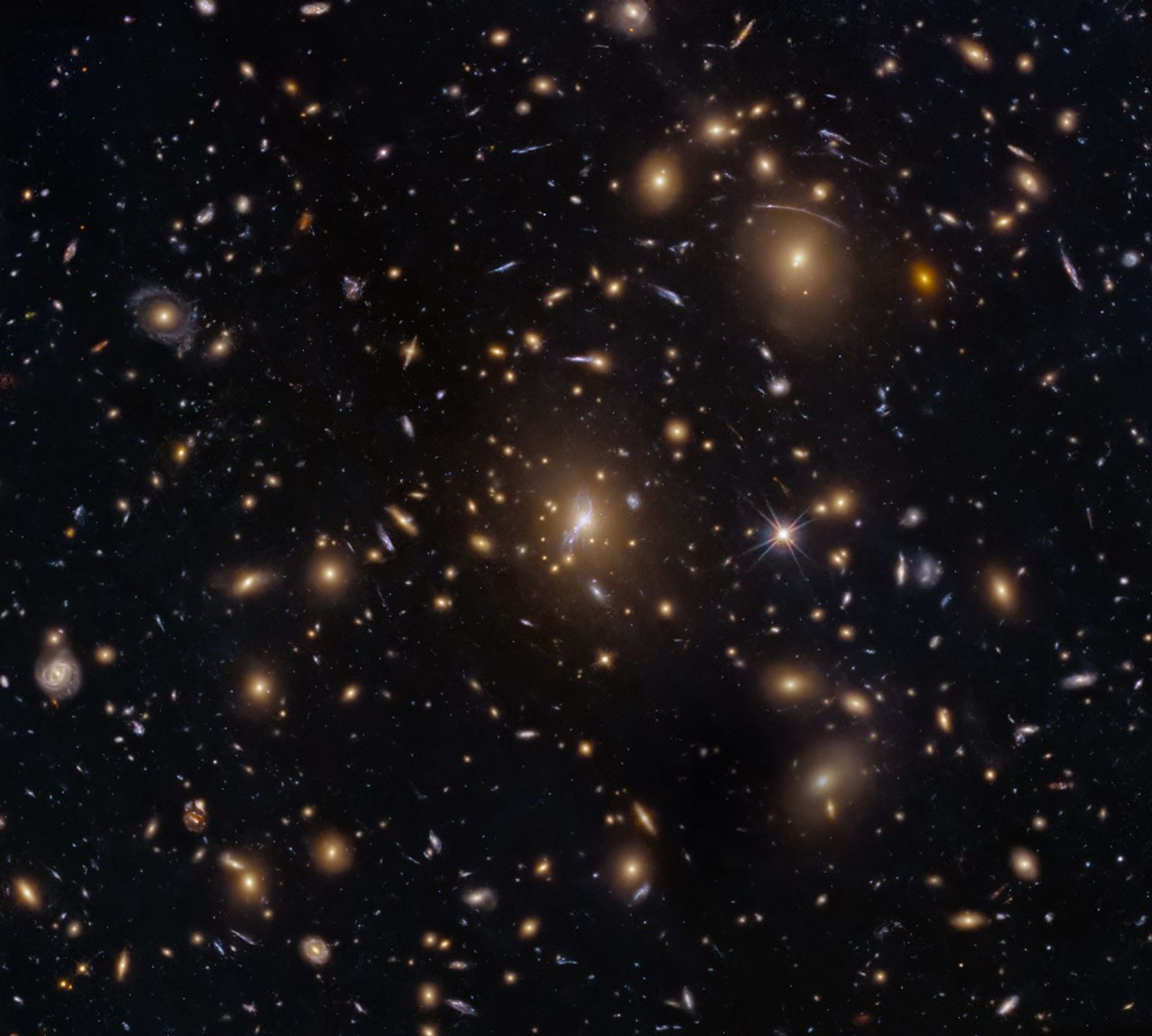
The Hubble Space Telescope captured a unique image while observing galaxy clusters that are bright in the X-ray spectrum. The image shows elliptical, spiral, and lenticular galaxies, as well as distant galaxies appearing as arcs due to gravitational lensing.
What can you see in the frame?
The MACS0329-0211 cluster contains galaxies of various types. The image shows large, oval-shaped elliptical galaxies, thin spiral and lenticular galaxies viewed edge-on, as well as spiral galaxies with their characteristic arms seen in full face-on view.
Their light was bent and amplified by the cluster’s gravity, which acts as a natural gravitational lens. The largest arc is visible above the bright elliptical galaxy at the top of the frame.
Curves intersecting at the center
In the center of the image, several bright white curves can be seen intersecting to form a distorted figure-eight. According to the researchers, this may be yet another distant galaxy whose light has been repeatedly bent by the cluster’s gravity.
Gravitational lensing occurs when a massive object between the observer and the light source bends and amplifies the light rays due to its gravity. This makes it possible to observe galaxies from the early stages of the universe’s existence that would otherwise be out of reach.
Two Hubble instruments
Two of the telescope’s main instruments were used for the observations: the Advanced Camera for Surveys (ACS) and the Wide Field Camera 3 (WFC3) in the visible and infrared wavelengths.
Hubble’s ability to operate across a wide range of wavelengths makes it a valuable tool for studying the nature of galaxy clusters. Clusters such as MACS0329-0211 serve as important landmarks in the history of the formation of the Universe’s large-scale structure.
According to science.nasa.gov

