

Scientists have studied radio relics associated with certain galactic clusters. These enormous clouds of ionized gas lie beyond their boundaries and are sources of massive radiation. Scientists have managed to detect traces of shock waves from the collision of these colossal structures.
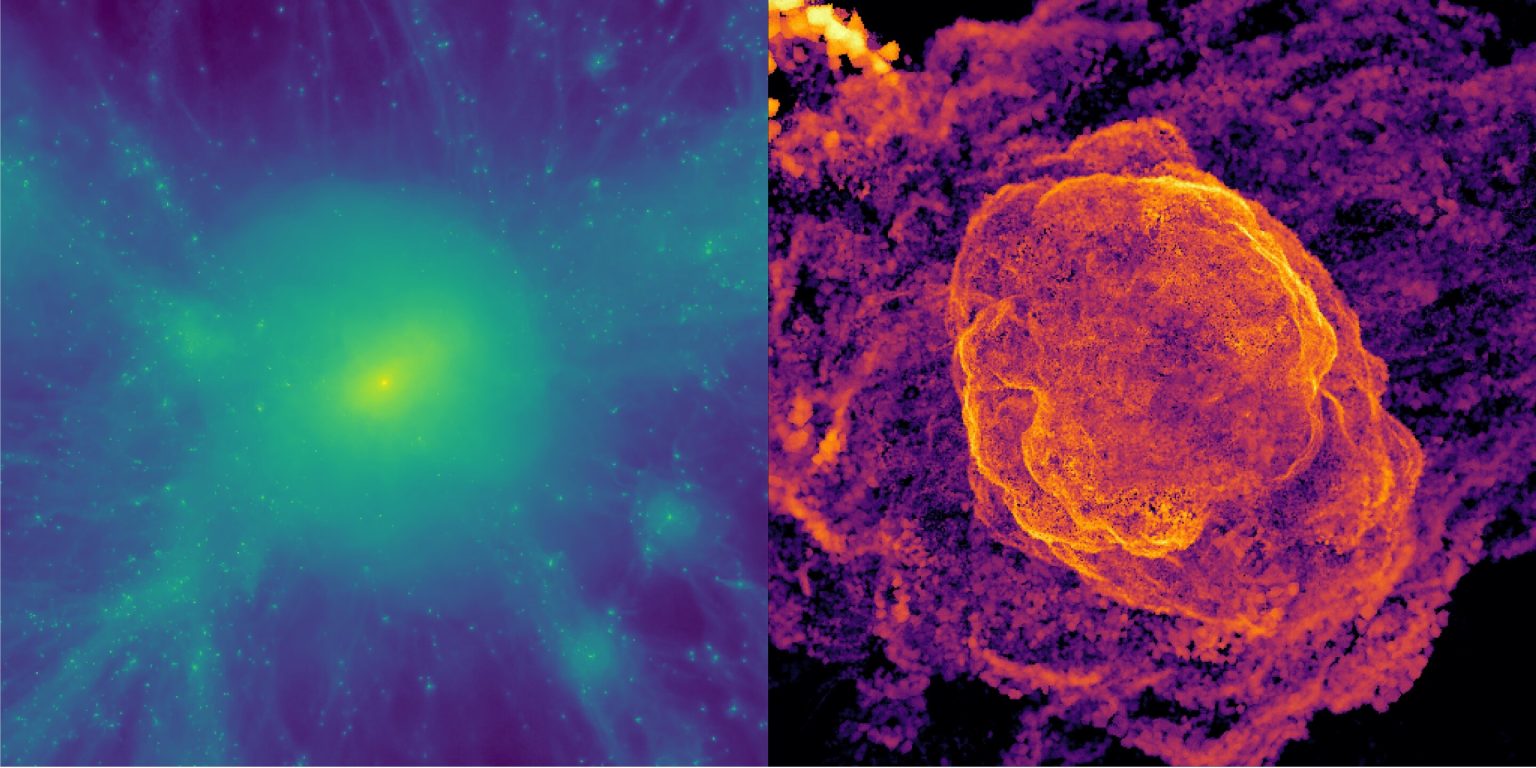
Shock waves from galaxy clusters
Galaxy clusters are the largest gravitationally bound structures in the Universe, each containing hundreds or even thousands of galaxies. When two of these giant structures collide, they send powerful shock waves to each other, releasing energy on a scale not seen since the Big Bang.
Shock waves pass through electrons, charging them with energy and causing them to emit radio waves as they spiral around magnetic field lines. The result is a “radio relic”: a huge arc of radio emission that can extend more than 6 million light-years, or about 60 to 70 Milky Way galaxies lined up in a row.
However, in recent years, the mysteries surrounding radio relics have only intensified. First, when observers measure the strength of the magnetic field in a relic, they find that its value is inexplicably high. Equally interesting is that the strength of the main shock wave seems to vary depending on whether it is observed using radio waves or X-rays.
Finally, and perhaps more alarmingly, X-ray data suggest that many of the shock waves that power radio relics are actually too weak to properly excite electrons. This puts these results at odds with the very existence of radio relics.
New approach by scientists
However, researchers at AIP were finally able to solve these problems using an innovative multiscale approach.
Dr. Joseph Whittingham, a postdoctoral researcher at AIP and lead author of the study, explains: “We first traced how shock waves form in cosmological simulations, before replicating what we saw in a more idealized setup, with significantly better resolution.” In the final stage, the authors mapped the evolution of energetic electrons and the resulting radio emission based on first principles. Thus, their model links the physics of galaxy clusters to processes occurring on scales trillions of times smaller than the orbit of an electron.
Physics of shock waves
Researchers have discovered that when shock waves reach the edge of a galaxy cluster, they collide with other shock waves formed by cold gas falling inward. This process compresses the surrounding material, forming a dense layer of outward-moving gas where it collides with other gas clusters. “The whole mechanism generates turbulence, twisting and compressing the magnetic field up to the observed strengths, thereby solving the first puzzle,” says study co-author Professor Christoph Pfrommer.
In addition, when the shock wave passes through the gas cluster, part of the shock front becomes stronger, amplifying the radio emission. In contrast, X-ray emission continues to reflect the average, generally weak shock force, thus explaining why the data for the two types of radiation usually do not match, thereby solving the second mystery.
Finally, since the vast majority of radio relics are formed only by the strongest parts of the shock wave front, the lower average values derived from X-ray data are not a problem for the theory of electron energization during shocks. “This success motivates us to build on our study to answer the remaining unresolved mysteries surrounding radio relics,” says Whittingham.
According to phys.org

