

An article on Mercury’s contraction was published in the journal AGU Advances. Its authors proposed a new method for assessing how much the planet’s size has decreased.

What do a freshly baked pie and Mercury have in common? They both shrink as they cool down. Available data indicate that since its formation approximately 4.5 billion years ago, Mercury has been continuously contracting as its interior loses heat. This process causes its crust to crack. Images taken by spacecraft show numerous faults and folds covering the planet’s surface.
By studying how faults have lifted parts of Mercury’s surface, researchers can determine how much it has contracted since its formation. However, until recently, the assessments of different researchers varied considerably. This is because they used a method based on the number of fractures. As a result, depending on the sample used, estimates of Mercury’s contraction varied between 1 and 7 km.
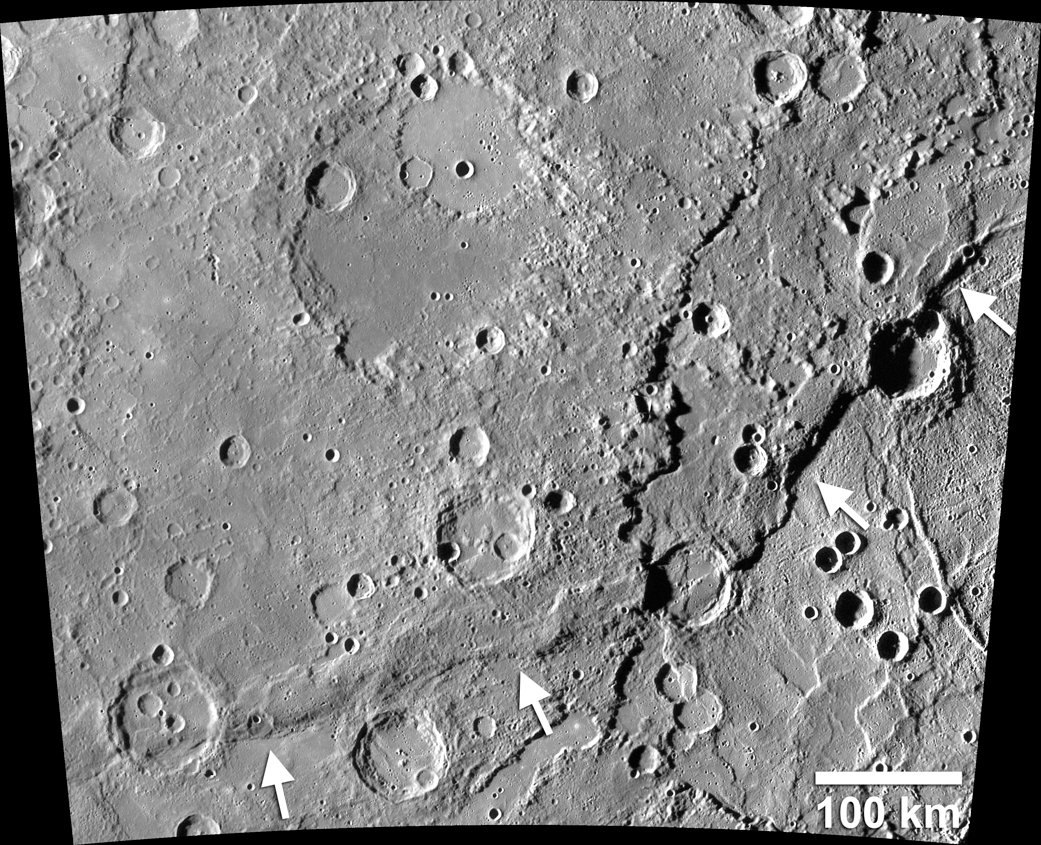
To eliminate this discrepancy, scientists Stephan Loveless and Christian Klimczak used an alternative method independent of the total number of faults. Instead, they measured the contribution of the largest fault and then scaled this effect across the entire planet to estimate its overall subsidence.
The researchers used a new approach to analyze three different datasets: the first included 5,934 faults, the second included 653 faults, and the third included only 100 faults. They found that regardless of which dataset was used, their method estimated the shrinkage to be approximately 2–3.5 kilometers.
Combining their results with previous estimates of additional shrinkage that could have been caused by cooling processes other than faulting, the researchers concluded that Mercury’s radius could have shrunk by a total of 2.7–5.6 kilometers since the planet’s formation.
The new assessment may help deepen our understanding of Mercury’s long-term thermal history. According to the authors of the study, their methodology can also be used to study the tectonics of other planets in the Solar System, such as Mars.
Earlier, we reported on the findings of Swiss scientists. They concluded that at least some of Mercury’s faults may be caused by the tidal forces of the Sun.
According to Phys.org

