

Although dark matter makes up most of the matter in the Universe, it remains one of the greatest mysteries of modern physics. It cannot be seen directly because it does not emit or absorb light. However, a group of scientists led by Tel Aviv University has proposed a new, ingenious way to “hear” it. They suggest searching for faint radio signals that have reached us from the earliest era of the cosmos — the so-called Dark Ages.

How can we capture the invisible?
The Dark Ages in the history of space is the period 100 million years after the Big Bang, when there were no stars or galaxies in the Universe yet. Space was filled with hydrogen gas and mysterious dark matter. Computer simulations conducted by Professor Rennan Barkana showed that dark matter already formed dense clusters at that time. They attracted hydrogen, causing it to emit radio waves at a specific wavelength.
The problem is that Earth’s atmosphere is impervious to these ancient signals. Therefore, scientists propose placing radio telescopes in space, with the Moon being an ideal location for this. Its far side is always protected from radio interference from Earth, making it the quietest place in the Solar System for such research.
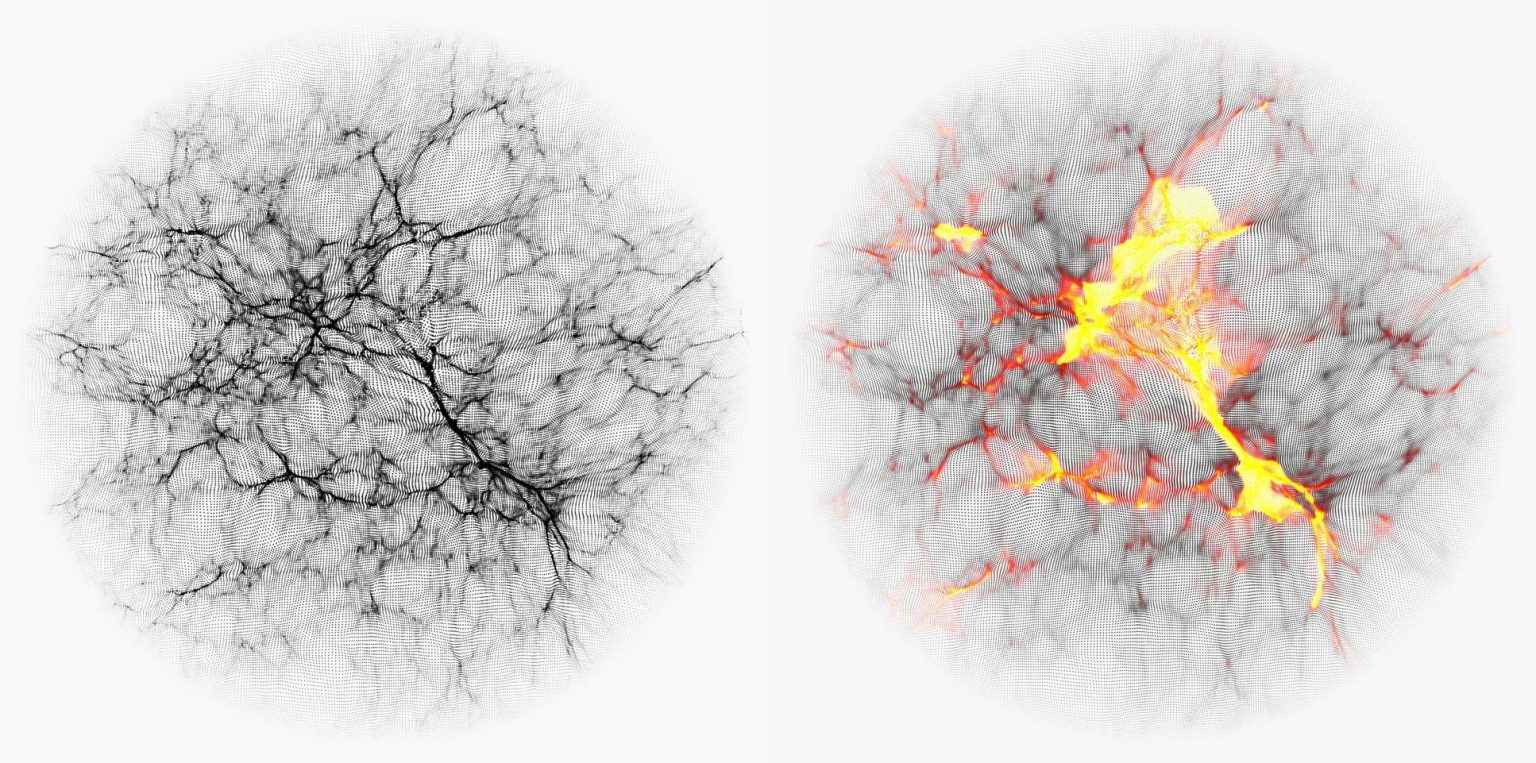
The essence of the discovery is as follows: clusters of dark matter, depending on their properties, had different effects on hydrogen gas. This affected the intensity of radio emissions. Thus, by measuring the average intensity of radio signals from the Dark Ages, scientists will be able to understand the structure of dark matter clusters and, consequently, learn about its nature.
“The holy grail of physics is discovering the properties of dark matter,” explains Professor Barkana. “Astronomers are eager to start tuning into the cosmic radio channels of the early Universe.”
An ambitious task in the search for truth
Although the signal from the Dark Ages is weak, the technology to search for it is already developing. Building a lunar radio telescope is an ambitious task, but active exploration of the Moon by countries such as the US, China, and India is making it increasingly realistic.
In addition, powerful ground-based observatories, such as the future Square Kilometre Array (SKA), can be used to study the later era of the “Cosmic Dawn,” when the first stars appeared. It will attempt to create a complete map of radio waves in the sky, revealing the patterns that hide clusters of dark matter.
This research opens a new window into the past of the Universe, offering an innovative way to unravel the main mystery of space—the nature of dark matter.
We previously reported on how dark matter changes the color of light.
According to Sci Tech Daily

