

Scientists have discovered a significant amount of the radioactive isotope plutonium-244 on the ocean floor. It is not the result of human activity, but arrived on our planet from space. Its origin is believed to be a kilonova—that is, the collision of two neutron stars.
Dating the cosmic explosion and its causes
More than 100 million years after a massive cosmic explosion, space debris is still falling to Earth. The conclusion was reached by an international team of scientists in a study published this week in the journal Nature Astronomy, based on measurements of rare isotopes in slowly formed ferromanganese crust extracted from the depths of the Pacific Ocean. The research was led by Dr. Dominik Koll and Professor Anton Wallner at the Helmholtz-Zentrum Dresden-Rossendorf (HZDR) in Germany, with HZDR collaborating with ANSTO and ANU in Canberra.
A distinctive feature of this cosmic explosion is the detection of just a few hundred atoms of the longest-lived radioisotope, plutonium-244—which has a half-life of 81 million years—found in a single kilogram of the Earth’s crust.
“The absence of the curium radioisotope Cm-247 (half-life 16 million years), which was also produced in the explosion, tells us it happened a very long time ago. But not more than about 1 billion years ago—otherwise the Pu-244 would also be undetectable,” said Dr. Michael Hotchkis, who conducted the measurements at the Vega accelerator at the ANSTO Centre for Accelerator Science and is a co-author of the article.
What kind of cosmic explosion was it? Most likely, it was the merger of two neutron stars, which triggered a kilonova—one of the brightest objects in the galaxy at the time of the event. It is believed that neutron star mergers may be the source of about half, and possibly most, of the chemical elements heavier than iron that exist in the Universe today.
A key factor in reaching these conclusions was the development of the world’s most sensitive instrument for detecting rare isotopes of heavy elements, particularly plutonium and curium, which were analyzed in this study.
Analysis of the oceanic crust reveals the presence of plutonium-244
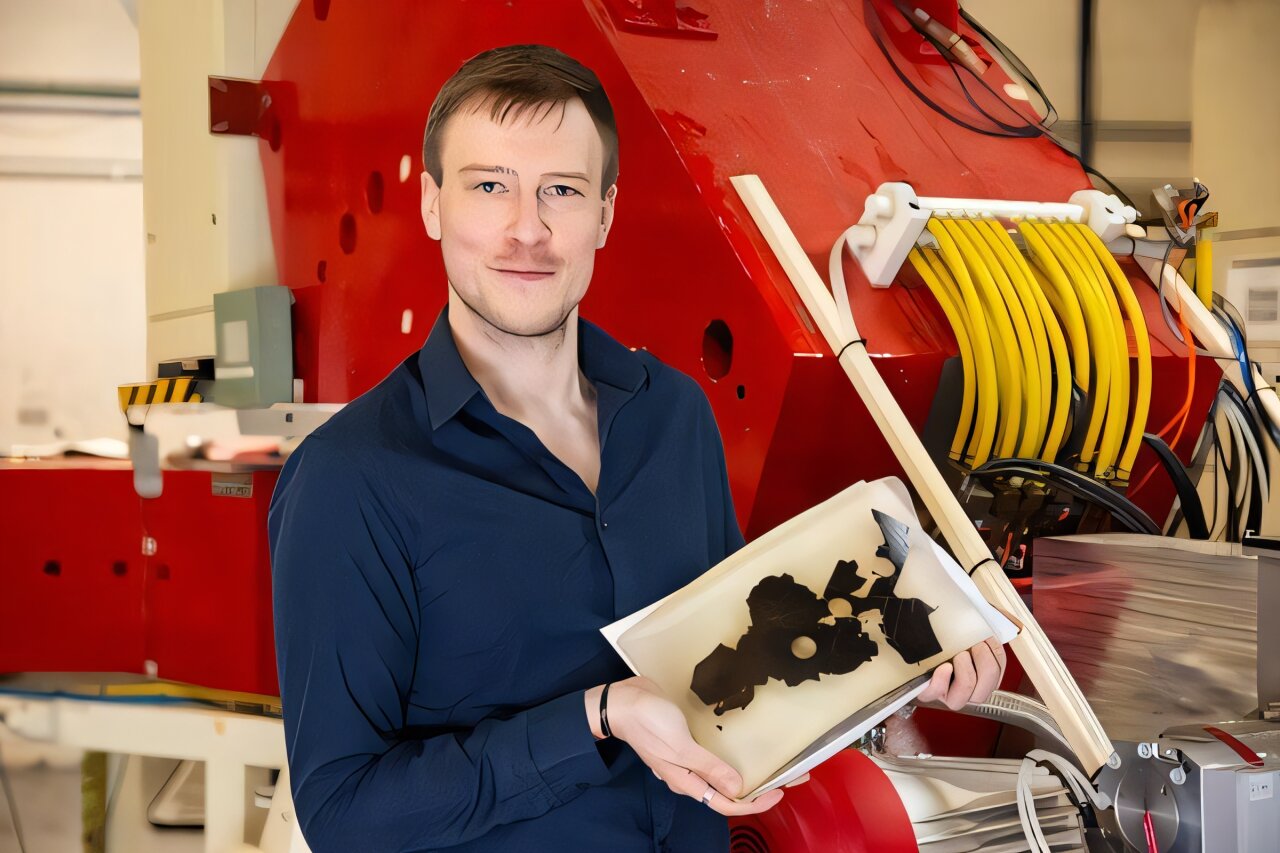
In 1976, a 1.9-kilogram piece of ferromanganese crust was recovered from the bottom of the Pacific Ocean at a depth of 4,830 meters.
Three cores were extracted, allowing for the creation of age and depth profiles at three points in the Earth’s crust. They were dated using the beryllium-10 isotope (half-life: 1.5 million years). In one of the cores, the iron-60 isotope was also measured using the HIAF accelerator at the Australian National University (ANU) in Canberra. The Earth’s crust grows so slowly that each core, up to 3 cm thick, spanned a period of over 10 million years.
The remainder of the bark was imaged using computed tomography and embedded in resin. This made it possible to carefully cut the bark, layer by layer, using a computer-controlled machine to obtain nine 90-gram samples, each representing approximately 1 million years of growth. Based on previous studies, it was expected that even in 90 g of rock in each layer, fewer than 100 atoms of plutonium-244 would be detected.
Each sample was divided into three parts and processed to extract plutonium. These samples were delivered to the Center for Accelerator Science for isotopic analysis of the plutonium. Shortly before the processing was completed, the center’s scientists developed a technique that maximized the sensitivity of their atomic counting method—accelerator mass spectrometry.
An analysis of iron-60 levels has revealed previously known traces of supernovae that occurred 2 and 7 million years ago with unprecedented precision.
Why plutonium and curium changed the picture
Some experts expected plutonium-244 to follow a similar trend to that of iron-60, with peaks at 2 and 7 million years as well. Such a result would have suggested that heavy elements are formed during supernova explosions. However, this is not the case—on the contrary, the few atoms of plutonium-244 that were detected were distributed fairly evenly across all layers. This showed that plutonium reached Earth in a continuous stream, independent of events related to supernovae.
To better understand the significance of this result, Koll returned to the solution samples from which he had previously extracted plutonium. From these samples, he isolated another long-lived transuranic element—curium. The half-life of curium-247 is 16 million years: this is long compared to the age of the core samples, but significantly shorter than the half-life of Pu-244, which is 81 million years.
According to the modern theory of nucleosynthesis (element formation), about half of the elements heavier than iron are formed by the rapid neutron capture process (r-process). Another significant part of such elements is synthesized in stars by the slow neutron capture process (s-process). The r-process is known to occur during kiloton events, extremely powerful explosive events that accompany the merger of neutron stars.
It is worth noting that the actinides (or actinoids), the heaviest naturally occurring elements, including thorium, uranium, plutonium, and curium, are formed predominantly in the r-process. Theories of nucleosynthesis predict that the isotopes curium-247 and plutonium-244 are produced simultaneously during such events, and their ratio can serve as an important indicator of the conditions under which nucleosynthesis occurred.
In search of evidence of kilonova
The curium samples were analyzed at ANSTO. No conclusive evidence was found to suggest that the curium originated from interstellar space.
“The instrument sensitivity was not in question—it is even better at detecting curium atoms than plutonium atoms. The only possible explanation is that the cosmic explosion responsible for the plutonium happened so long ago that the curium has already decayed away to practically nothing,” Hotchkis said.
A thorough analysis of the data revealed that the hypothetical kilonova event occurred more than 100 million years ago. Currently, the research team is trying to learn more. They speculate that ancient rocks may exist somewhere on Earth that confirm this r-process and the presence of dust that entered interstellar space. Or perhaps evidence can be found in dust that has lain on the Moon’s surface for millions of years without undergoing any changes.
According to phys.org

