
In a new study of the center of our galaxy, scientists have learned many surprising things about the objects orbiting the supermassive black hole Sagittarius A*. Some of them, previously thought to be stars or gas clouds, may actually turn out to be stellar-mass black holes.
Research on the Galactic Center
An international research team led by PD Dr. Florian Peissker at the University of Cologne has used the new observation instrument ERIS (Enhanced Resolution Imager and Spectrograph) at the Very Large Telescope (VLT) facility in Chile to show that several so-called “dusty objects” follow stable orbits around the supermassive black hole Sagittarius A* at the center of our galaxy.
Earlier studies had surmised that some of these objects could be swallowed up by the black hole. New data refute this assumption.
New information about dust objects
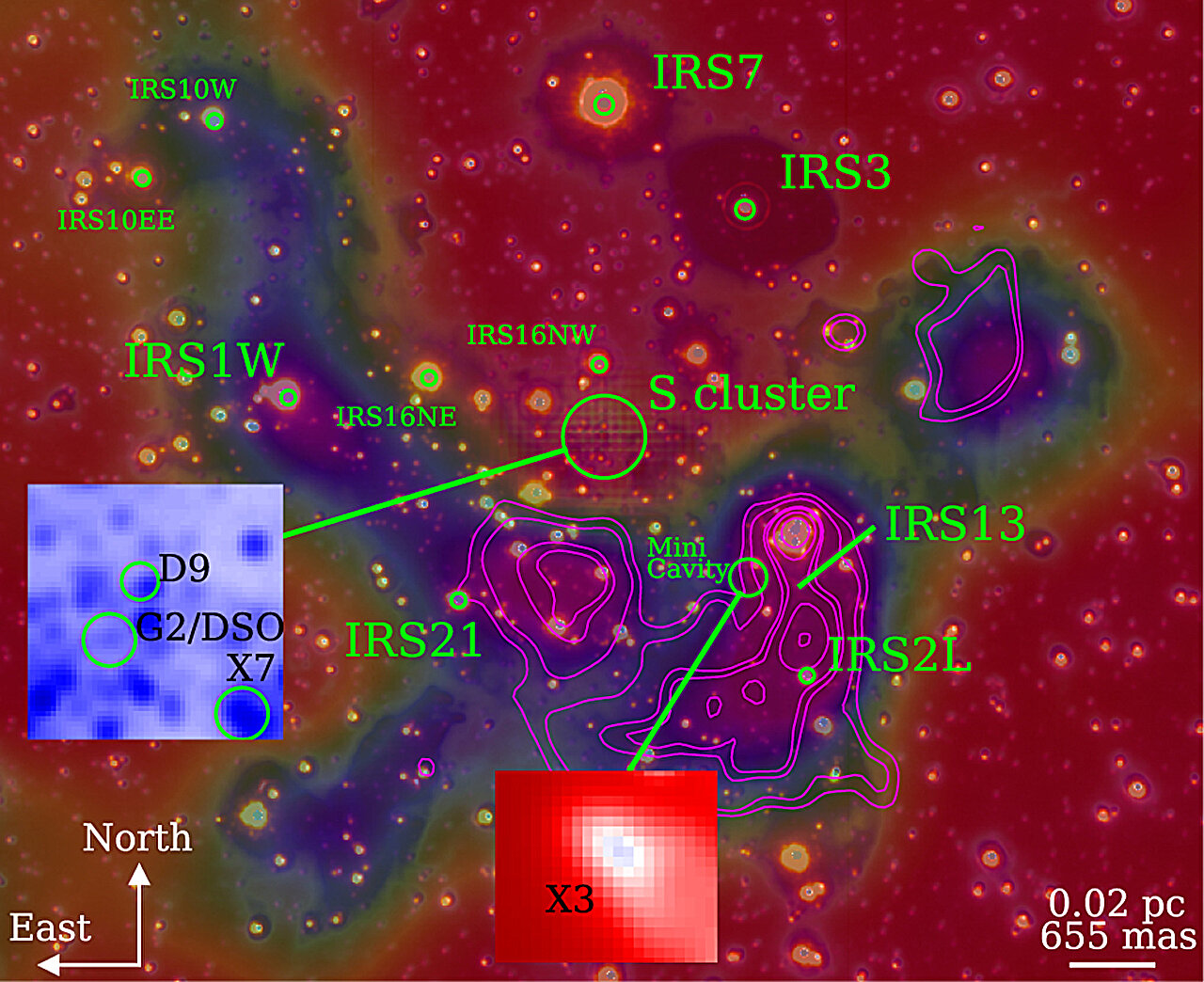
The study focused on four of these unusual celestial bodies, which have been the subject of much discussion in recent years. In particular, G2 was long regarded as a pure dust and gas cloud. It was thought to have been initially elongated by the gravitational pull of Sagittarius A*, a process known as “spaghettification,” before being destroyed.
However, the specific observations made with ERIS, which captures radiation in the near-infrared range, show that G2 follows a stable orbit. This is an indication that there is a star inside the dust cloud. These results confirm that the center of the Milky Way is not only destructive, but can also be surprisingly stable.
Merger of binary star systems
The binary star system D9, which Peissker and his team discovered in 2024, also remains stable despite the enormous tidal forces of the black hole. It is the first known binary star system to be observed so close to a supermassive black hole.
In theory, the stars involved in D9 could merge to form a single, more massive star due to strong tidal forces. However, the ERIS data so far show that D9 remains intact. The same applies to Objects X3 and X7, which also orbit in stable orbits and are therefore less fragile than earlier models had suggested.
Complex processes at the center of the Milky Way
“The fact that these objects move in such a stable manner so close to a black hole is fascinating,” says Peissker. “Our results show that Sagittarius A* is less destructive than was previously thought. This makes the center of our galaxy an ideal laboratory for studying the interactions between black holes and stars.”
The results demonstrate that the processes at the center of the Milky Way are more complex than previously thought. Scientists believe that the supermassive black hole at the center of the Milky Way is not only capable of destroying stars, but can also stimulate their formation or the formation of rather exotic dusty objects, most likely through the merger of binary star systems.
Future observations from the ERIS and the Extremely Large Telescope (ELT) – which is currently under construction – should help to further track the evolution of these objects and to understand how stars can survive even in the extreme regions of the universe.
Provided by: phys.org

