

According to a new study, the interaction between the Large and Small Magellanic Clouds is even more turbulent than previously thought. Due to the influence of its more massive companion, the Small Magellanic Cloud is constantly expanding and remains in a state of gravitational imbalance.
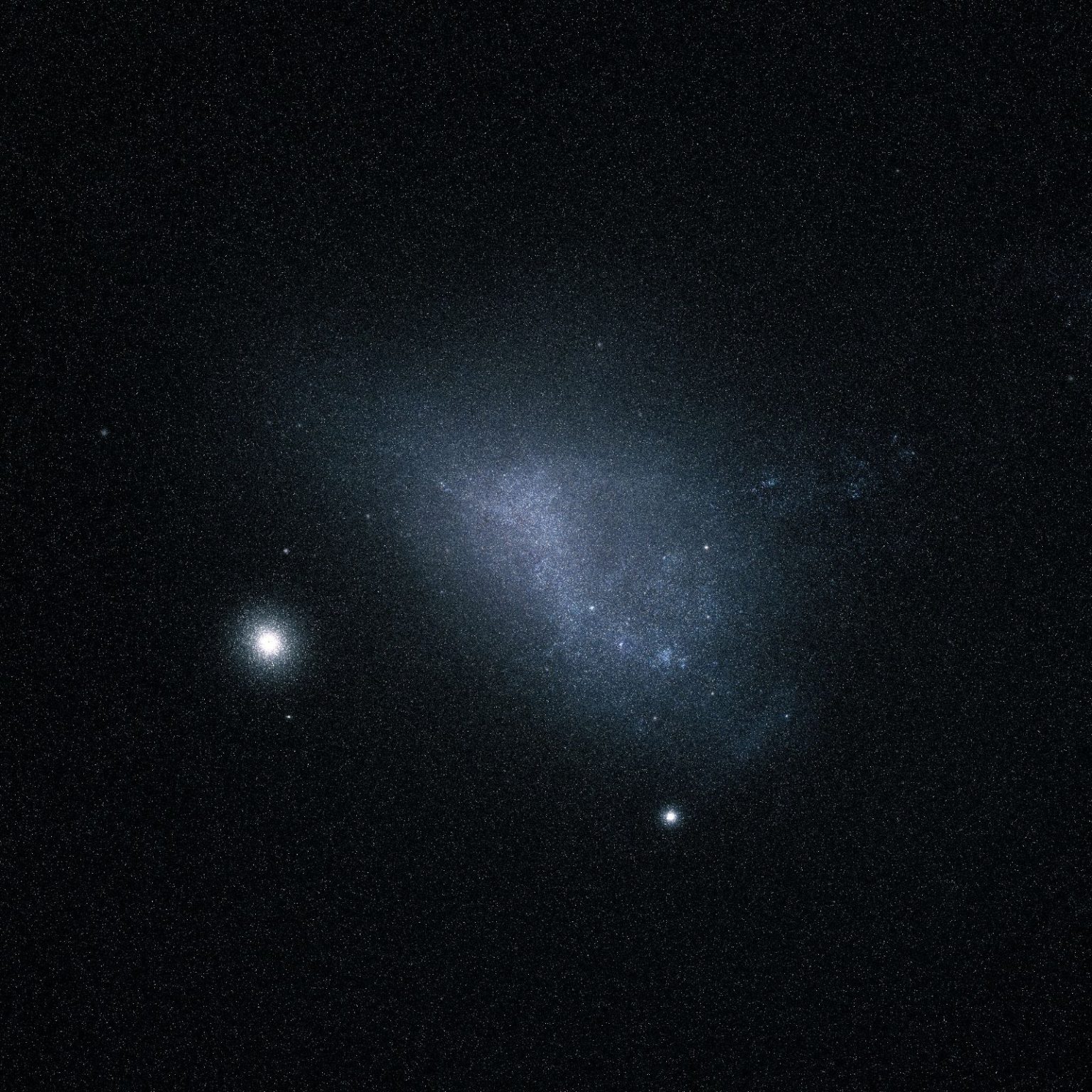
The Magellanic Clouds are the two largest and best-known dwarf satellite galaxies of the Milky Way. And although they are under the powerful gravitational influence of our home galaxy, and will likely be absorbed by the Milky Way in the future, this pair also exerts a gravitational influence on one another.
Scientists were already aware of the existence of a gas bridge between them, where new stars are born. However, a new study, soon to be published in the journal Astronomy and Astrophysics, reveals much deeper implications of their proximity.
VISTA Mission
The study, titled “The VMC Survey. LV. The Coherent Expansion of the Small Magellanic Cloud,” was led by Sreepriya Vijayasree, a doctoral student at the Leibniz Institute for Astrophysics in Potsdam. The abbreviation VMC stands for VISTA Survey of the Magellanic Clouds.
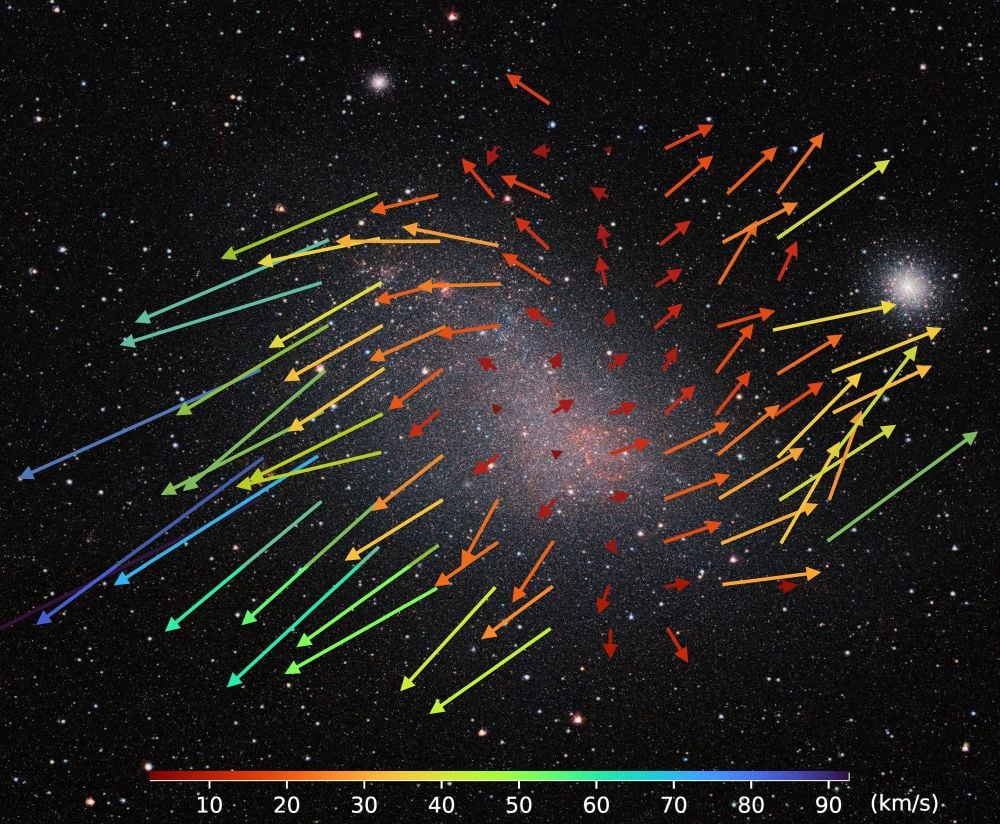
VISTA is an infrared survey telescope located in Chile. It is the world’s largest instrument for observations in the near-infrared range. Since Earth’s atmosphere blocks most infrared light, VISTA uses specific “windows” of transparency to peer into the depths of space.
The VMC project has been tracking the movements of millions of individual stars for years by taking repeated images of the same sections of the sky. According to VISTA’s principal investigator, Professor Maria-Rosa Cioni, by extending the observation period to 11 years and leveraging the telescope’s ability to “see” through cosmic dust, astronomers were able to measure stellar motion with an accuracy three times greater than previous results.
How to determine the true direction of the stars
The Small Magellanic Cloud has an overall systemic motion—meaning it moves through space as a single entity. However, each of its stars also has its own individual direction of motion. To isolate these local movements, scientists had to mathematically subtract the galaxy’s own velocity from the measurements of each star.
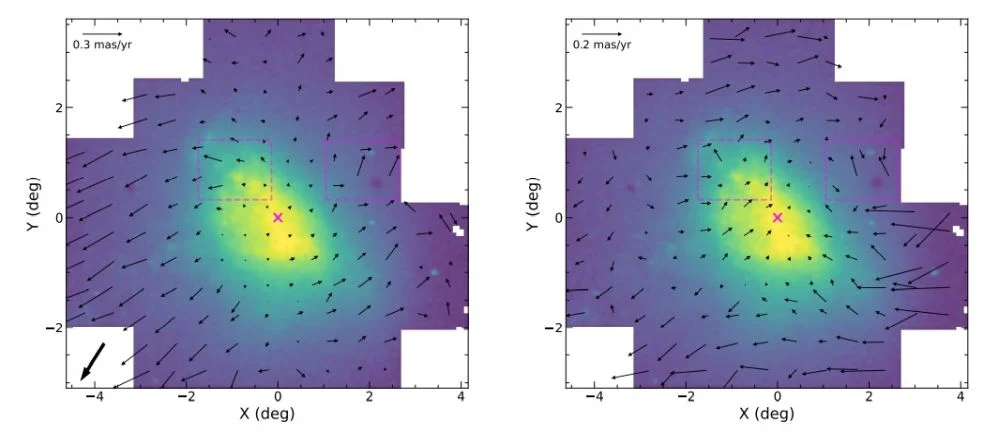
The resulting map of residual velocities revealed something that had previously gone unnoticed. For the first time, it was observed that the galaxy is expanding sequentially in the southeast and northwest directions. This expansion is a direct consequence of tidal forces from the Large Magellanic Cloud, and this disruptive influence can even be traced in the center of the neighboring galaxy.
The End of the “Rotating Disk” Era
Until now, astronomers believed that the Small Magellanic Cloud, despite a certain degree of chaos and “streams” of stars, generally behaves like a typical rotating disk. But the results completely refute this theory.
Until now, astronomers believed that the Small Magellanic Cloud, despite a certain amount of chaos and “streams” of stars, generally behaves like a typical rotating disk. But the results completely refute this theory.

“Our study shows that the internal motion of stars in the Small Magellanic Cloud is driven not by orderly rotation, but by gravitational disturbances caused by repeated collisions with the Large Magellanic Cloud over billions of years,” explains Sreepriya Vijayasree. Study co-author Dr. Florian Niederhofer adds that the level of detail in these ground-based observations is simply phenomenal.
Stars preparing to flee
The stars within the Small Cloud are moving away from the center at a speed of about 17 km/s. For space, this is a modest figure, but for such a light dwarf galaxy, it is critical. The speed required to completely escape its gravity is only 60 km/s. Although the stars are not yet fleeing en masse, over billions of years such movements could ultimately deform the system or lead to the loss of some of its stars.
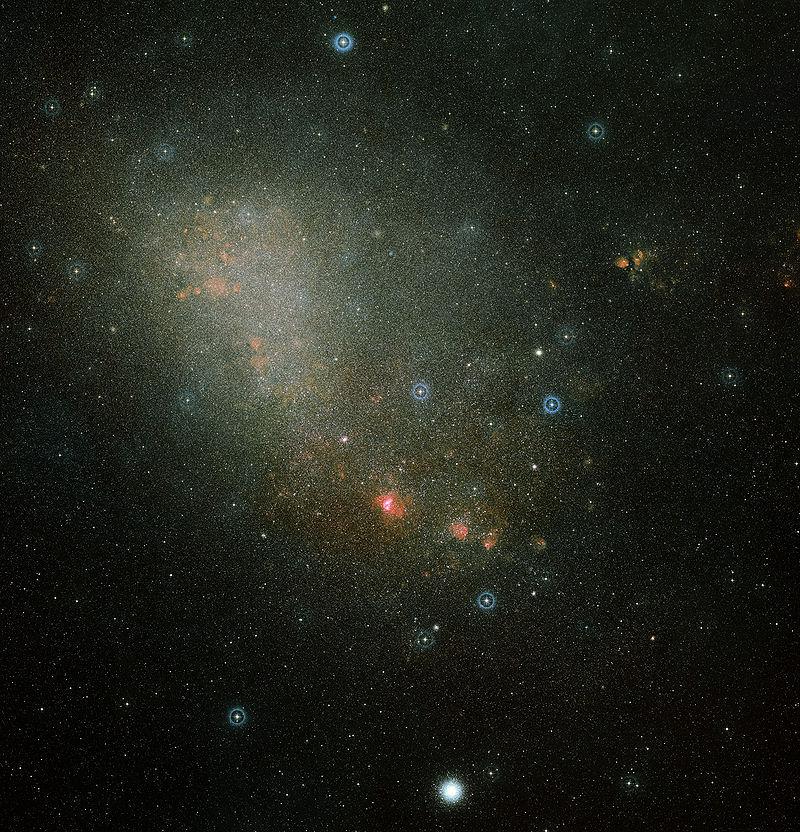
What’s more, different groups of stars behave in completely different ways. For example, old red giants move predominantly northward. This suggests that their direction was set during earlier cosmic interactions. All of this confirms one fact: the Small Magellanic Cloud is an incredibly complex system that is still struggling to survive under the constant gravitational pressure of its giant neighbors.
We previously reported on the calls to rename the Magellanic Clouds.
According to universetoday.com

