

The sun produces not only visible light, but also other electromagnetic waves. Recently, scientists have used data from observations of the most high-energy component of its radiation, gamma rays, to learn more about the magnetic fields on our star.
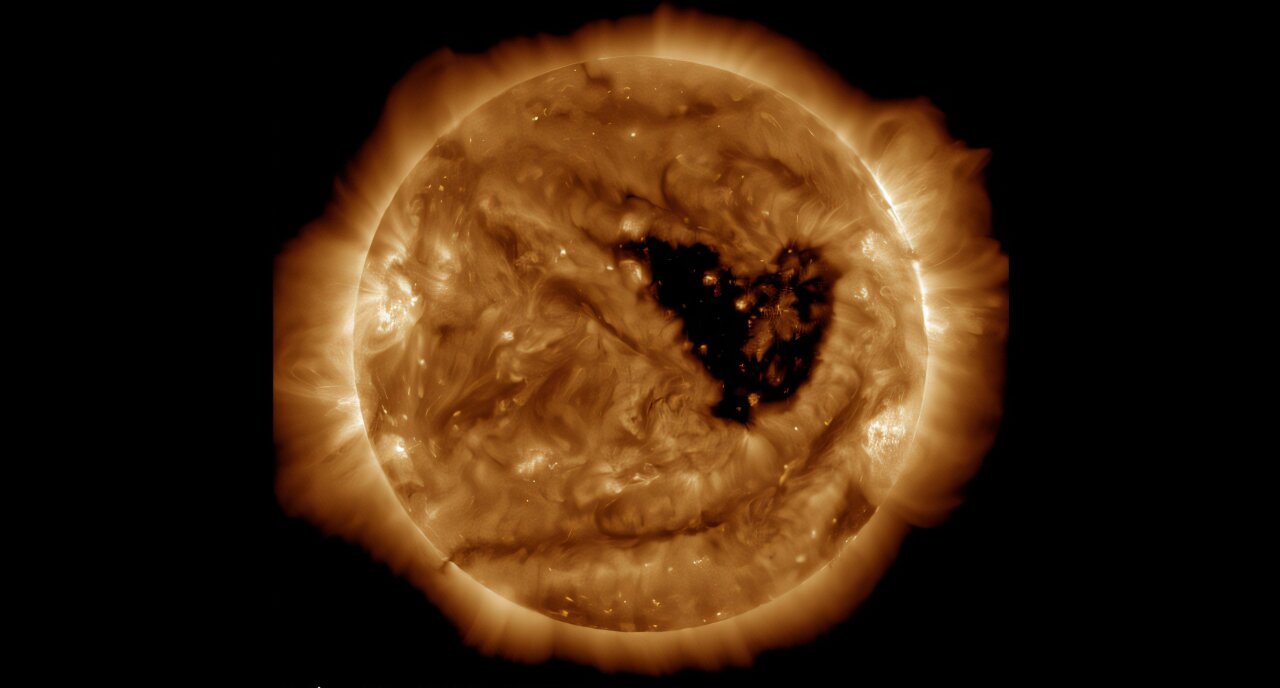
Research on solar gamma rays
New research conducted by an international team of physicists has shown that high-energy gamma rays may hold the key to unlocking the mysteries of the Sun’s magnetic fields.
A study conducted by the Chinese University of Hong Kong, the University of Exeter, and the University of Amsterdam concludes that teraelectronvolt (TeV) gamma rays, which can be observed from specialized facilities on Earth, may be the result of the interaction of this magnetic field with cosmic rays. Researchers say that by studying these TeV rays, it is possible to determine where these fields are located, as their preliminary findings indicate that they are directly beneath the surface of the Sun.
The results of the study are published in the journal Physical Review Letters. “Magnetic activity of the sun is the driver behind space weather and, as a consequence, the effects space weather has on our society,” says Professor Andrew Hillier, one of the authors of the article in Exeter.
However, it is impossible to look beneath the surface of the Sun to study its magnetic field before it manifests itself on that surface. Our research proposes a new method of using cosmic rays to look beneath the Sun.
Relation between gamma rays and the Sun’s magnetic fields
Solar gamma rays are formed when cosmic rays—high-energy particles produced by the death of stars in the galaxy—interact with the solar atmosphere. Traditional methods of studying the Sun rely on visible light, X-rays, or lower-energy radiation, but recently the High Altitude Water Cherenkov Observatory (HAWC) in Mexico was able to detect gamma rays with TeV energy—the most energetic radiation ever emitted.
This means that the Sun has to have strong magnetic fields to redirect cosmic rays, but until now it has not been clear where these fields exist on the Sun or how cosmic rays are able to control them.
Hidden magnetic fields
Their article suggests that strong horizontal magnetic fields just below the Sun (photosphere), hidden from direct observation, may be responsible for this process.
These fields, known as network interaction fields, when they arise, can redirect high-energy cosmic rays, leading to the formation of the TeV gamma rays, observed by HAWC. This discovery not only solves the mystery of the Sun’s gamma radiation, but also makes gamma rays a powerful tool for studying the Sun’s magnetic fields, complementing traditional methods.
Solar magnetic fields control the solar cycle and influence events such as solar flares and coronal mass ejections. These phenomena can disrupt Earth’s space environment, affecting satellite communications, power grids, and space missions. Understanding these magnetic fields is key to improving space weather forecasts, protecting technology, and ensuring the safety of future lunar and deep space missions.
According to phys.org

