

The European Solar Orbiter mission has determined the origin of energetic particles emitted by the Sun. They have two sources associated with different types of solar activity.
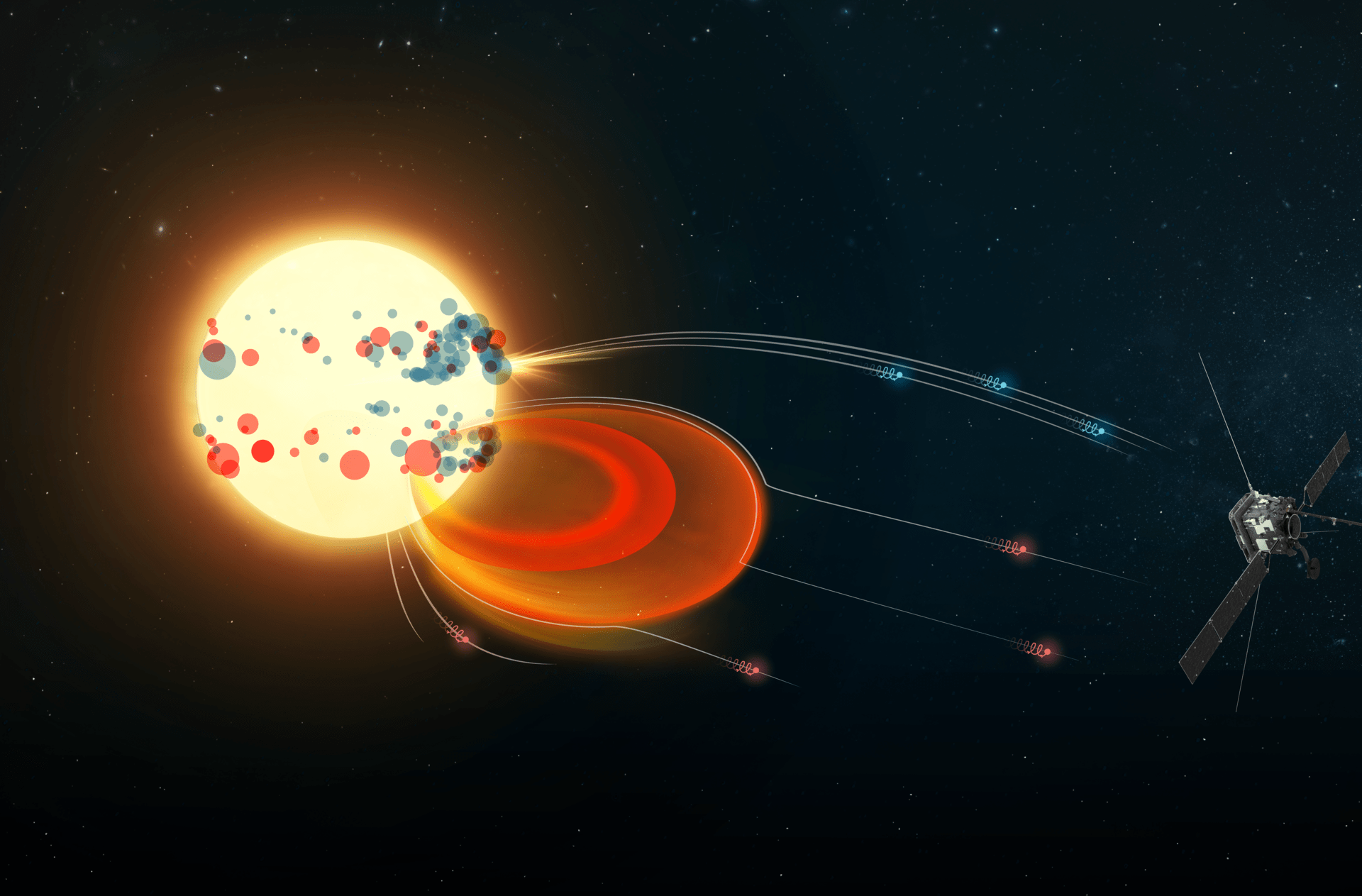
The Sun is the most powerful particle accelerator in the Solar System. It accelerates electrons to nearly the speed of light and ejects them into space, filling the Solar System with so-called “solar energetic electrons” (SEE).
Researchers used Solar Orbiter to pinpoint the source of these energetic electrons. It turned out that they can be divided into two groups. One is associated with intense solar flares (explosions on small areas of the Sun’s surface), and the other with larger eruptions of hot gas from the Sun’s atmosphere, known as coronal mass ejections (CMEs).
Researchers have detected SEE events at various distances from the Sun. This allowed them to study the behavior of electrons as they move through the Solar System, answering a long-standing question about these energetic particles. The fact is that when observing flares and CMEs, there is often a noticeable delay between what we see on the Sun and the release of energetic electrons into space. In some cases, the particles disappear within a few hours.
It turns out that this is, at least in part, related to how electrons move in space — there may be a delay in their emission, but also a delay in their detection. The space between the Sun and the planets of the Solar System is not empty. A stream of charged particles constantly emanates from the Sun, forming a wind. It fills space and affects the movement of energetic electrons. Instead of moving where they want to, they are restricted, scattered, and disturbed by this wind and its magnetism.
This discovery is also crucial for understanding space weather, where accurate forecasting is essential to ensure the operability and safety of spacecraft. One of the two types of SEE events is particularly important: the one associated with CMEs. They typically contain more high-energy particles and therefore pose a much greater threat of damage. Because of this, the ability to distinguish between the two types of energetic electrons is extremely important for accurate space weather forecasts.
Earlier, we reported on how the Solar Orbiter photographed the south pole of the Sun for the first time in history.
According to ESA

