

Researchers analyzed how the solar sail’s thrust would change as the spacecraft accelerated to speeds unattainable by any other current technology. They concluded that under these conditions, this method of accelerating spacecraft faces serious limitations. Once these missions start reaching a significant percentage of the speed of light, they will encounter drag from light itself.
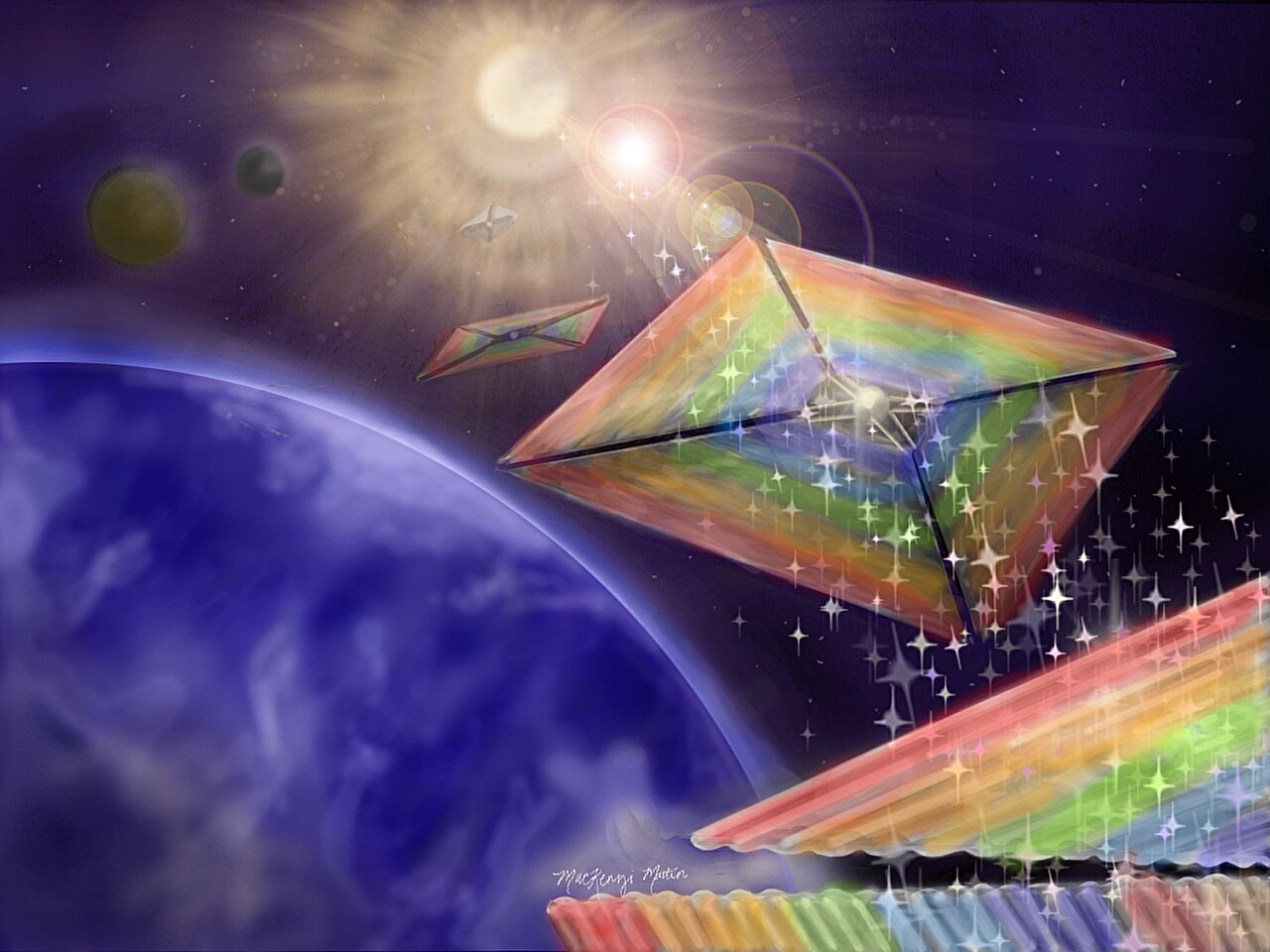
Solar sail
Solar sails are considered one of the best ways to accelerate a spacecraft to truly high speeds, thereby making interstellar travel possible. However, a study by two Chinese researchers recently appeared on the arXiv preprint server, suggesting that there may be some issues with this approach.
The principle behind a solar sail is based on the fact that light particles, or photons, have a small amount of momentum despite having no mass. When they encounter an obstacle, they interact with it. In this process, the greatest amount of momentum is transferred during direct impact; photons that scatter perfectly transfer less momentum; and, finally, those that are initially absorbed by the surface and then randomly re-emitted transfer very little momentum.
Solar propulsion provides only a tiny bit of acceleration. However, when it comes to years of flight, this can be extremely advantageous, since no fuel is consumed at all to achieve this acceleration. Therefore, it can continue until the spacecraft approaches the maximum speed of light possible in our universe.
What happens at relativistic speeds
In a new study, scientists examined what happens to the momentum of photons when the spacecraft begins to reach relativistic speeds. It turned out that the Doppler effect kicks in quite quickly, аs the spacecraft moves away from the light source. Сausing the wavelength of electromagnetic waves to decrease, and with it, all three components of momentum.
The situation becomes even worse when the spacecraft reaches 75% of the speed of light. At this point, relativistic light aberration begins to play a role. The effect of diffuse scattering begins to slow the spacecraft down. The net acceleration becomes very small.
All of this suggests that it is practically impossible to reach the speed of light using a light sail. And in fact, there is nothing surprising about this. It follows even from the theory of relativity. The news is simply that serious problems arise even when approaching that speed.
However, in reality, they will most likely appear even sooner. The authors of the study treated the sail as an ideal mirror without taking into account a host of other factors, such as incoming particles or its heating.
According to phys.org

