

The solar wind contains relatively small plasma filaments with a diameter significantly smaller than that of typical coronal mass ejections. Despite this, they can cause a kind of “space tornado.” However, only spacecraft with solar sails can detect it in advance.
Danger of plasma strings
Solar wind spirals can cause large solar flares and disrupt Earth’s magnetic field, but they are too difficult to detect with our current single-site warning system, according to new research from the University of Michigan.
But a constellation of spacecraft, including one powered by sunlight, could help detect tornado-like phenomena in time to protect equipment on Earth and in orbit. The results of the study were obtained using computer simulations of a massive plasma cloud breaking away from the Sun and moving through the Solar System.
Since the simulation covers features extending three times the diameter of Earth to thousands of miles, researchers were able to determine how smaller tornado-like spirals of plasma and magnetic fields—known as string flows—become potentially dangerous phenomena on their own.
Scientists claim that the magnetic fields in these vortices could be strong enough to cause a geomagnetic storm and create certain real problems on Earth.
Tornado-like vortices
Geomagnetic storms are caused by magnetic fields in the solar wind—a bubble of plasma that moves away from the Sun and envelops the Solar System. Like wind on Earth, solar wind blows in different patterns that make up space weather. Explosions on the Sun create extreme space weather—dense, fast-moving clouds of plasma called coronal mass ejections, stretching an average of 34 million miles. But scientists have observed relatively small magnetic ropes in the solar wind, ranging from 3,000 to 6 million miles wide. These formations are too small for conventional simulations of coronal mass ejections, which could only reproduce objects wider than 7 million miles, but they are also too large for simulations often used to study magnetic fields and plasma particles in the solar wind. The new simulation allows researchers to see these medium-sized formations alongside large coronal mass ejections.
Simulations by the University of Michigan have shown that tornado-like magnetic flux strings form from coronal mass ejections as they move through slower solar wind, throwing off rotating masses of plasma like a snowplow throws snow.
Some tornadoes dissipate, but more persistent vortices can form when collisions occur between neighboring fast and slow solar wind streams. Telescopes pointed at the Sun search for emissions to warn of adverse weather conditions in space, but for magnetic flux strings, according to researchers, this is not enough.
Researchers say that detecting changes in magnetic flux strings is a matter of national security, as they can significantly alter space weather, which in turn is very important for power grid planners, airline dispatchers, and farmers.
Necessity of a constellation of probes
Solar wind can cause geomagnetic storms only when its magnetic field has a strong southward orientation. Spacecraft located between Earth and the Sun are already helping scientists warn of space weather by measuring the speed of the solar wind, as well as the strength and direction of its magnetic field. But a solar flare directed away from Earth or with magnetic fields pointing north can still throw southward-facing magnetic field funnels toward Earth. These tornadoes will go unnoticed if they pass probes located at point L1.
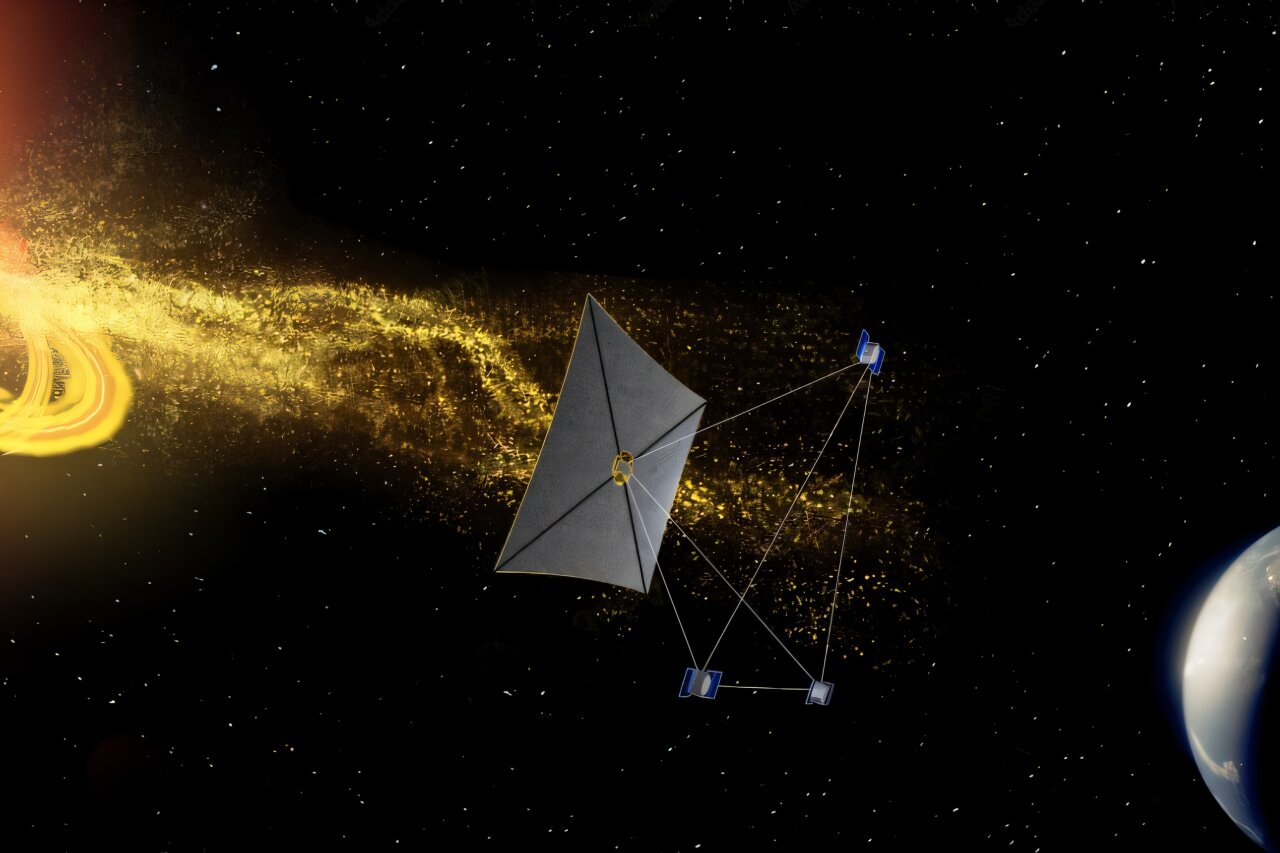
Researchers hope to provide a multi-probe view of solar tornadoes using a group of spacecraft called Space Weather Investigation Frontier, or SWIFT, developed as part of a NASA mission concept study led by one of the research authors, Mojtaba Akhavan-Tafti.
The current proposal calls for four probes to be positioned in a triangular pyramid formation, approximately 200,000 miles apart. Three identical probes will cover each corner of the base of the pyramid, which is in a plane near L1. The final “main spacecraft,” located at L1, serves as the apex of a pyramid pointing toward the Sun. This configuration will give SWIFT the chance to see how the solar wind changes as it heads toward Earth, and its main vehicle, which is closer to the Sun, will be able to warn about space weather 40% faster.
The location of the apex would typically require an unfeasible amount of fuel to counteract the Sun’s gravity, but NASA engineers, as part of their Solar Cruiser mission, developed an aluminum sail that could allow the probe to position at L1. The sail would cover about one-third of a football field, which would allow it to capture enough photons to maintain the spacecraft’s position without consuming fuel.
According to phys.org

