

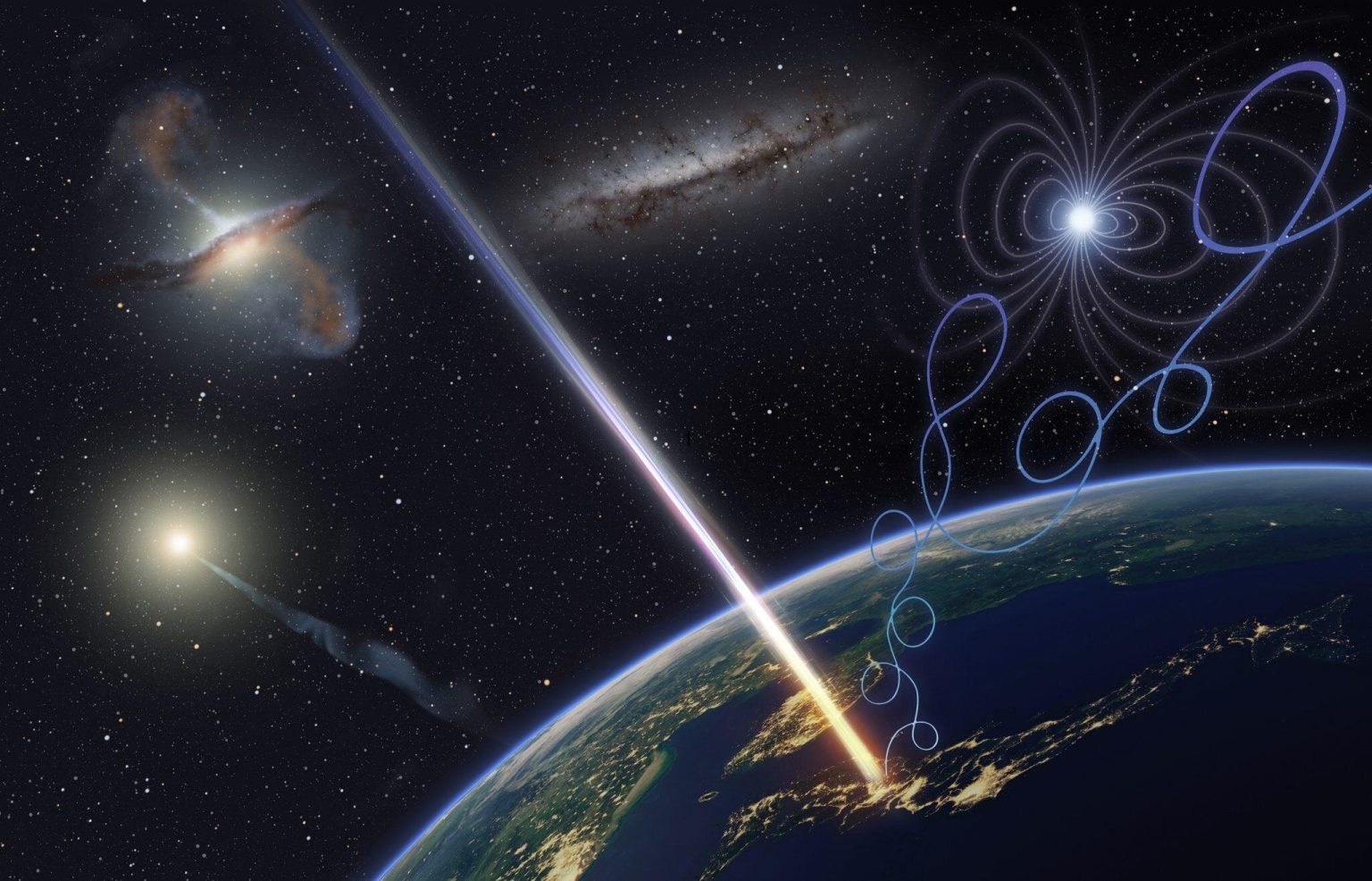
Scientists are trying to unravel the mystery of some of the high-energy particles that once entered Earth’s atmosphere. They believe these may be atoms of elements heavier than iron that are slowly losing their energy in interstellar space.
High-energy particles
The Earth is constantly bombarded by various particles coming from space. Many of these particles possess extremely high energies that are difficult to achieve even with powerful terrestrial accelerators. However, every few years, events are recorded whose energy exceeds anything we can imagine. And it is the mystery behind some of these events that researchers at Pennsylvania State University may have solved.
The article, published in the journal Physical Review Letters, focuses primarily on the Amaterasu particle, which was detected by an array of antennas in Utah in 2021. However, the same conclusions could apply to many other phenomena as well.
It should be noted here that cosmic particles themselves cannot be detected by the antenna. They collide with the upper layers of our planet’s atmosphere and are completely absorbed. However, in doing so, they generate a whole barrage of other particles, which are detected by the sensors. And based solely on these, we can conclude that something truly powerful has struck the atmosphere.
The authors of the new study are cautious in their conclusions. They do not claim that their theory explains all the ultra-high-energy particles that have been detected. However, many of them truly fit this new concept, which holds that they could be atoms heavier than iron.
Heavy atoms and their sources
In physics, the term “particle” refers to a wide variety of units of matter. When it comes to those particles that have no mass of their own, their energy is essentially equivalent to their frequency. However, cosmic rays are often much heavier particles, and therefore their energy is kinetic—that is, it depends on their mass and velocity.
This means that the laws of inertia apply to them as well. No matter how rarefied the interstellar medium may be, it still offers some resistance, which means that particles must lose energy as they travel many parsecs. This means that if the particle is the nucleus of a heavy atom, the process will occur more slowly and it will retain more energy.
The model developed by the researchers confirms that this is indeed possible. Moreover, observations suggest that the sources of ultra-high-energy particle radiation are located somewhere far away from us. That same “Amaterasu” seemed to have come to us from a completely empty part of the sky.
If the highest-energy particles are indeed very important, this greatly narrows down the range of possible sources. These must be supernovae, kilonovae, or some other similar cataclysm. In fact, the photons from these events may have reached us hundreds of years ago, while the heavier particles have only just arrived.
According to phys.org

