

Researchers from Rice University (USA) and Waseda University (Japan) have presented a generalized approach to numerical flow simulation — Space-Time Computational Flow Analysis (STCFA), which allows for more accurate solutions to problems with variable geometry and complex dynamics, which is critically important for modeling loads associated with aerospace design. The idea of a space-time formulation was proposed in 1990 by Tayfun Tezduyar; since 1998, development has been actively in progress at Rice, and in 2007, Kenji Takizawa joined the team. Their book, featuring a selection of unconventional methods and first-of-their-kind solutions, was recently published.

Why is this important? Most simulations consider space and time separately, which limits the accuracy of results in problems involving sudden changes in shape or flow regimes. STCFA combines spatial and temporal representation, maintaining high computational density precisely where it is critically important: in the area of contact between the tire and the road, when closing the heart valve flaps, or when deforming a parachute. The result is a more accurate picture of the flow and forces of interaction.
Applications already cover the aerospace industry, medicine, transportation, and renewable energy. The methodology helped NASA design landing parachutes for Orion, supported personalized modeling of blood flow through heart valves, analysis of thermo-aerodynamics and tire cooling, and assessment of wind turbine wake turbulence, which is important for the safety of UAVs and small aircraft. Parachute cluster of the Orion spacecraft.
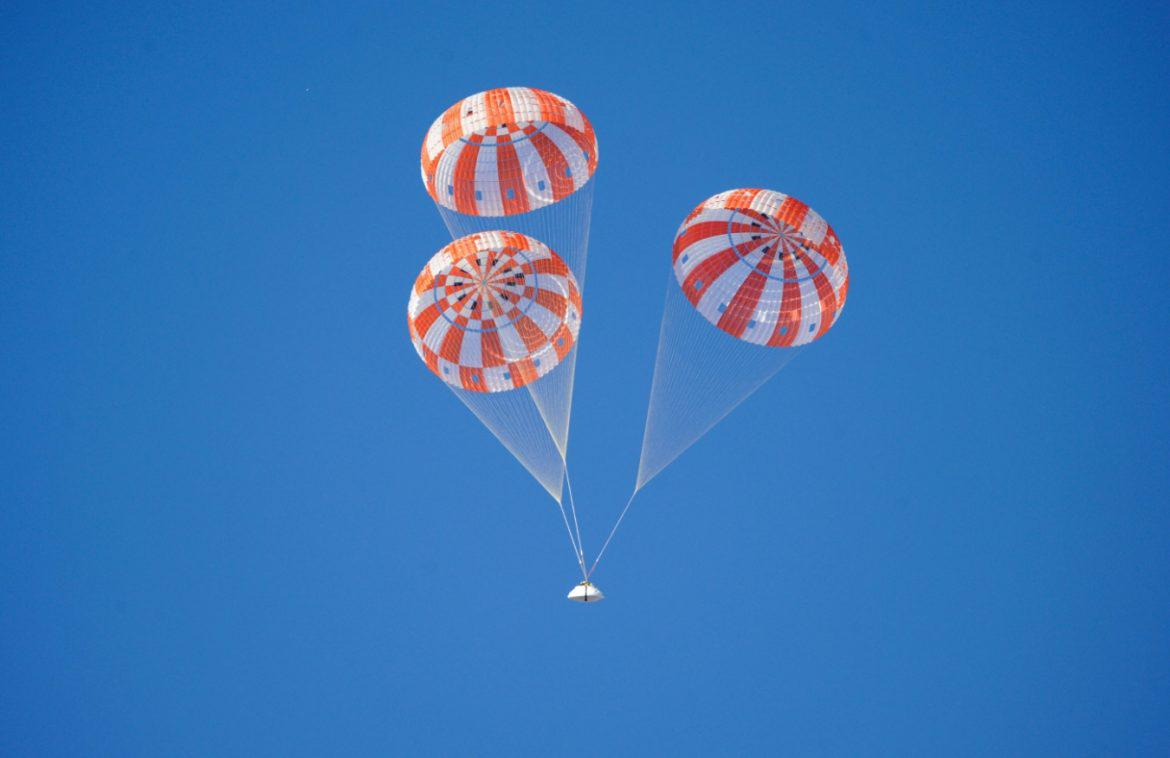
For space technology, STCFA means more accurate pre-launch calculations: from loads and dynamics of parachute canopies during re-entry to aerothermodynamic models during atmospheric entry, deployment of inflatable/foldable structures, and interaction of engine jets with ground dust on the Moon or Mars. Better space-time alignment directly improves reliability and reduces mission risks, allowing engineers to narrow down design options faster and save on stand and wind tunnel testing.
While others are still building mock-ups, SpaceX is already recalculating the next iteration of Starship. How do they do it? The speed of calculations, digital twins, and the continuous “design-simulation-test” cycle reduce months of engineering work to days and hours. In this article, we examine how parallel computing, high-precision aerothermodynamic models, and automated load analysis provide real benefits: lower risk, lower cost per kilogram, and more flights per year. Want to look under the hood of SpaceX’s engineering machine and understand why speed is their weapon? Read our analysis “Inside Starship: How speed of calculations gives SpaceX a competitive advantage” at the link.
According to rice, interestingengineering

