

In honor of the third anniversary of the publication of the first official image from the James Webb Space Telescope (JWST), NASA delighted all astronomy enthusiasts with its stunning new image. It shows the Cat’s Paw Nebula.
Stellar Maternity Hospital
The Cat’s Paw Nebula, also known as NGC 6334, is located in the constellation Scorpio, 4,000 light-years from Earth. It is a stellar maternity hospital — a huge molecular cloud where massive stars are forming right now.
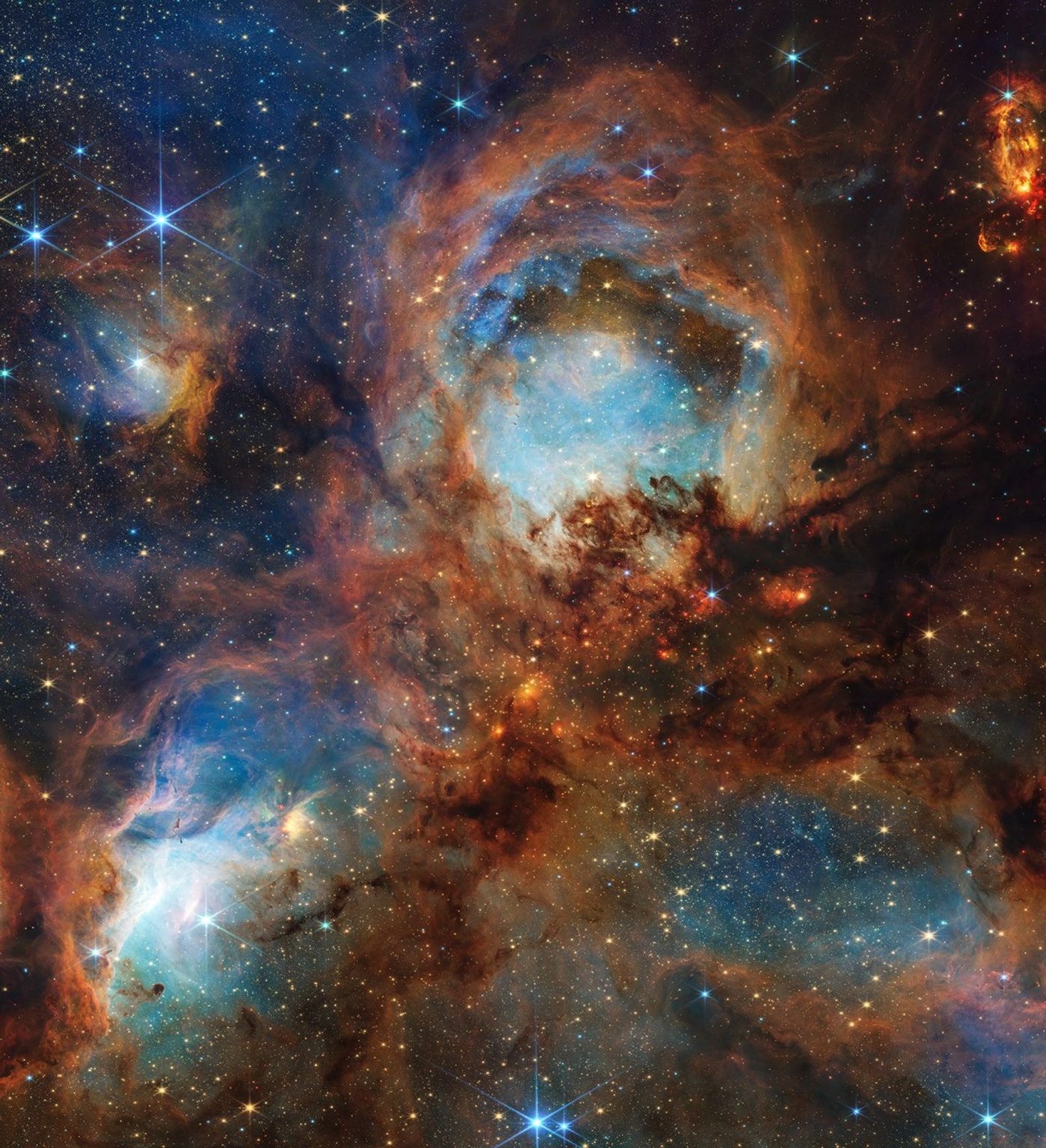
Thanks to its ability to capture infrared radiation, JWST was able to penetrate the dust veil and see previously unseen structures and details of the nebula. They are formed by powerful radiation from newborn stars, which carve away bizarre landscapes in the surrounding clouds. In the future, this will lead to the end of star formation in this region.
The upper central part of the nebula has been nicknamed the “Opera House” due to its round, multi-tiered structure. The main sources of the cloud’s blue glow are most likely located below: either light from bright yellowish stars or from a nearby source still hidden behind thick dark brown dust.
Just below the orange-brown layers of dust is a bright yellow star with diffraction rays. Although it carved away its immediate surroundings, it was unable to push gas and dust over long distances, creating a compact shell from the surrounding material.
The photo also shows small areas where there are fewer stars. These seemingly empty areas indicate the presence of dense dust filaments in the foreground, which are home to still-forming systems and block light from more distant stars.
Forming stars
In the center of the image, small bright red clusters are visible, scattered among brown dust. These glowing red sources indicate areas where massive stars are forming.
Some massive blue-white stars, such as the one at the bottom of the left “finger,” appear clearer than others. This is because any material between the star and the telescope is scattered by the star’s radiation.
At the bottom of this “finger” are small, dense strands of dust. These tiny dust clumps have managed to survive despite intense radiation, suggesting that they are dense enough to form protostars. The small yellow area on the right indicates the location of a massive star that is still hidden but has managed to shine through the intervening material.
One of the most striking aspects of this JWST image is the bright red-orange oval in the upper right corner. The low number of stars in the background indicates that this is a dense region that is just beginning the process of star formation. It contains several visible and still hidden stars that contribute to illuminating the material in the center. Some stars still wrapped in gas and dust cocoons can be detected by traces of their presence, such as the shock wave in the lower left corner. It indicates an energetic emission of gas and dust from a bright source.
According to NASA

