

NASA has released stunning images taken by the Hubble Telescope showing a cloudy “landscape” created by protostars in the Orion Molecular Cloud Complex.
The Orion Molecular Complex, also known as the Orion Nebula, is located 1,300 light-years from Earth and measures several hundred light-years across. It is home to some of the closest regions of active star formation to us. Right now, new stars are forming inside gas and dust clouds. Their powerful radiation and jets of matter affect the surrounding cloud “landscape,” altering it and forming various unusual structures and cavities.
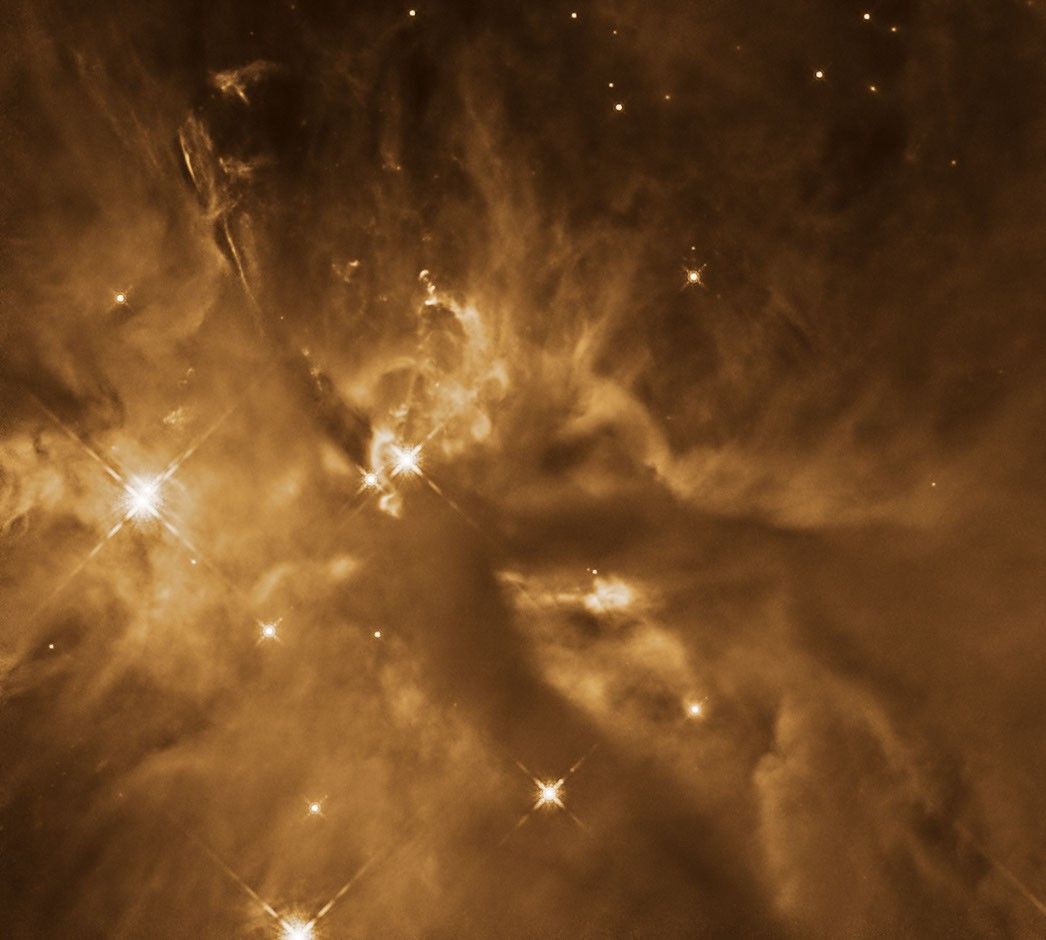
The first image from Hubble shows a small group of young stars amid molecular clouds of gas and dust. Closer to the center of the image, hidden behind dusty clouds, is the protostar HOPS 181. The long curved arc in the upper left corner of the image is formed by a stream of matter emanating from the protostar — probably particles ejected at high speed from the magnetic poles. The light from nearby stars is reflected and scattered by dust grains filling the image, giving this area a soft glow.
In the second Hubble image, the bright star CVSO 188, visible in the lower right quadrant, is the most striking feature. Of greatest interest to astronomers is the protostar HOPS 310, located slightly to the left of center behind the dust. It is responsible for the large cavity with bright walls carved into the surrounding cloud of gas and dust by its jets and stellar winds. One of the protostar’s bipolar jets runs diagonally across the upper right corner. These jets consist of particles ejected at high speed from the magnetic poles. Background galaxies are visible in the upper right corner.
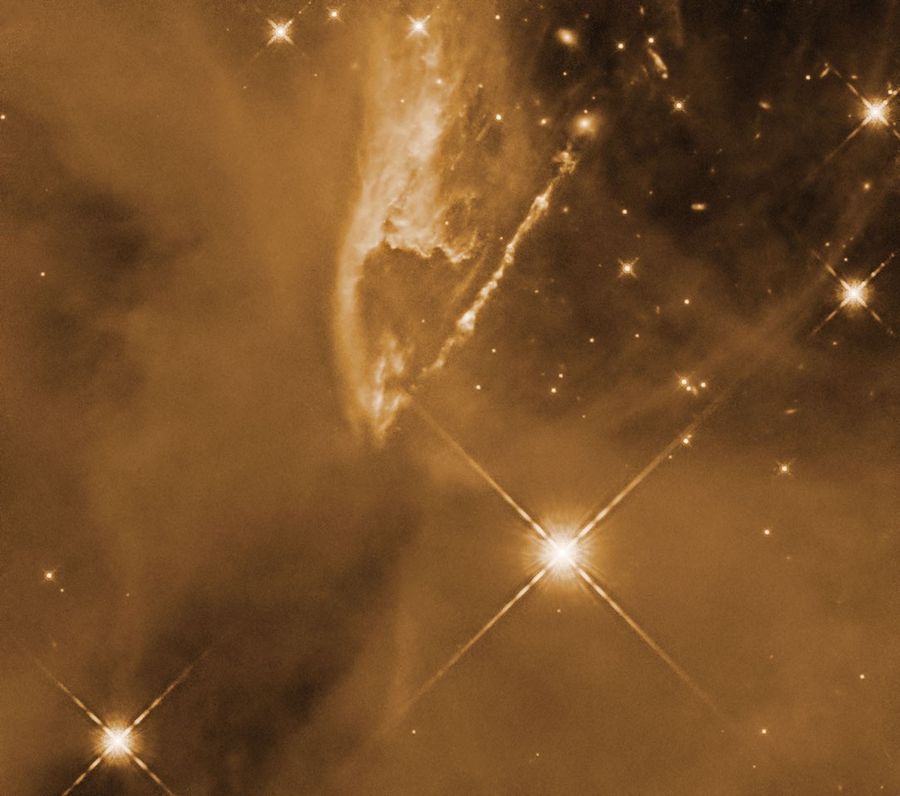
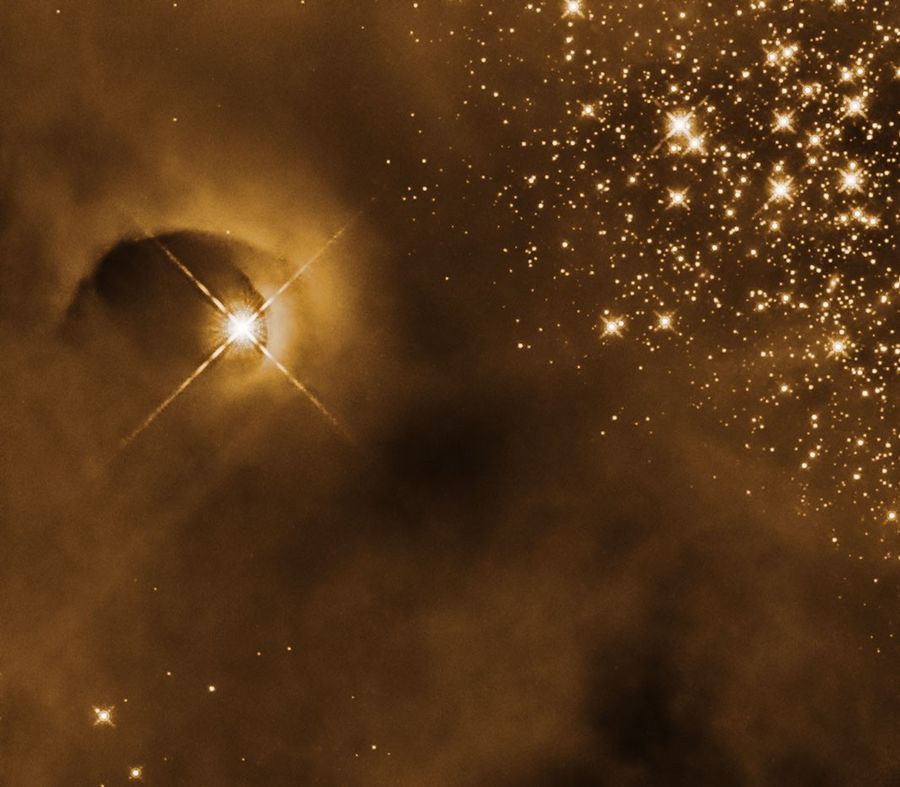
The third Hubble image shows a protostar and a large cavity carved out of the surrounding cloud by its powerful winds. Background stars are visible in the upper right corner.
Scientists used the Hubble telescope to study how protostars affect their surroundings. They found no evidence of cavities growing as protostars evolve. They also found that the decrease in mass accretion onto protostars over time and the low star formation rate in cold molecular clouds cannot be explained by the gradual clearing of the gas and dust cocoons surrounding them.
According to NASA

