

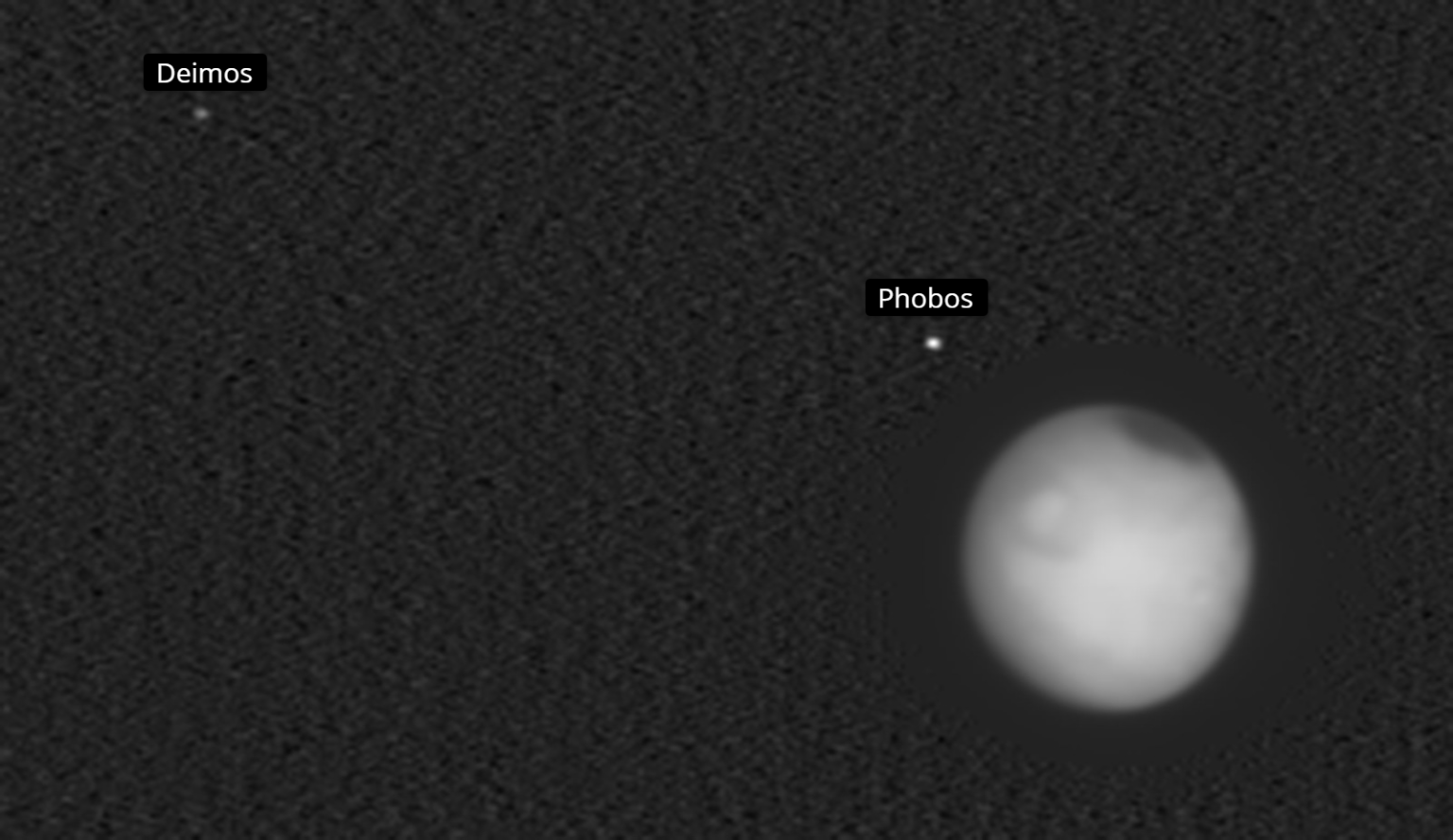
NASA has published an image taken by the Europa Clipper spacecraft. It shows Mars and its two moons, Phobos and Deimos.
The Europa Clipper spacecraft is designed to study Europa, Jupiter’s moon, beneath whose icy surface lies a vast ocean. To reach its destination, the mission has to do a series of gravity maneuvers around other planets. One of these happened on March 1, 2025, when Europa Clipper flew past Mars.
The engineers used this opportunity to test the spacecraft’s instruments. The image shown was obtained by the E-THEMIS infrared camera. It is designed to scan the surface of Europa in search of thermal anomalies that may indicate the presence of geysers and water emissions.
In total, E-THEMIS took 1,100 individual frames in the spectral range from 14 to 28 microns, 200 of which were then combined into a single image. The shooting distance was 900,000 km.
The dark oval at the top of Mars is the planet’s cold northern polar cap, where temperatures reach around minus 125 degrees Celsius. The round feature visible on Mars is the area around Mount Elysium. It is an extinct volcano rising 14 km above the surrounding lava plains.
The faint halo visible around the planet is the result of image processing. Since Mars’ moons are approximately 250 times dimmer, scientists increased their brightness to make them visible. Brightening also increased image noise. The area around Mars in the halo appears relatively dark because it was not brightened.
On the way to its destination, Europa Clipper will perform another gravity assist maneuver near Earth. It is scheduled for December 3, 2026. The spacecraft is expected to reach Jupiter in the summer of 2030.
According to NASA

