

The Moon is increasingly being viewed not only as a destination for manned missions, but also as a future industrial base for space operations. In this context, Elon Musk has reignited the debate over lunar infrastructure: he posted a brief message on X titled “Mass drivers on the Moon!”, effectively supporting the idea of building electromagnetic cannons or catapults to launch cargo from the Moon’s surface.
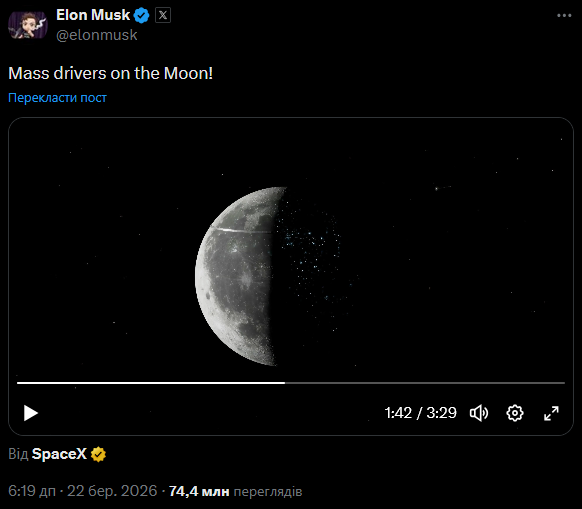
We are talking about so-called Mass Drivers—electromagnetic propulsion systems capable of accelerating a payload without using traditional rocket fuel. This idea didn’t come out of nowhere: as early as February 2, in a corporate update following its merger with xAI, SpaceX explicitly stated that, thanks to an electromagnetic mass driver and manufacturing on the Moon, it would be possible to launch large quantities of satellite computing systems into deep space. On March 22, Reuters reported that Terafab’s new project involves the production of chips for space-based data centers equipped with artificial intelligence.
At the same time, it is important to understand that this is not a confirmed program with a specific budget and timeline, but rather Musk’s public vision. However, the concept itself is not new. It was popularized as early as the 1970s by physicist Gerard O’Neill, who proposed using lunar electromagnetic launchers to send raw materials and cargo into space. Today, interest in this idea is reborn, as the Moon has weaker gravity and virtually no atmosphere—which makes such systems much more feasible than on Earth.
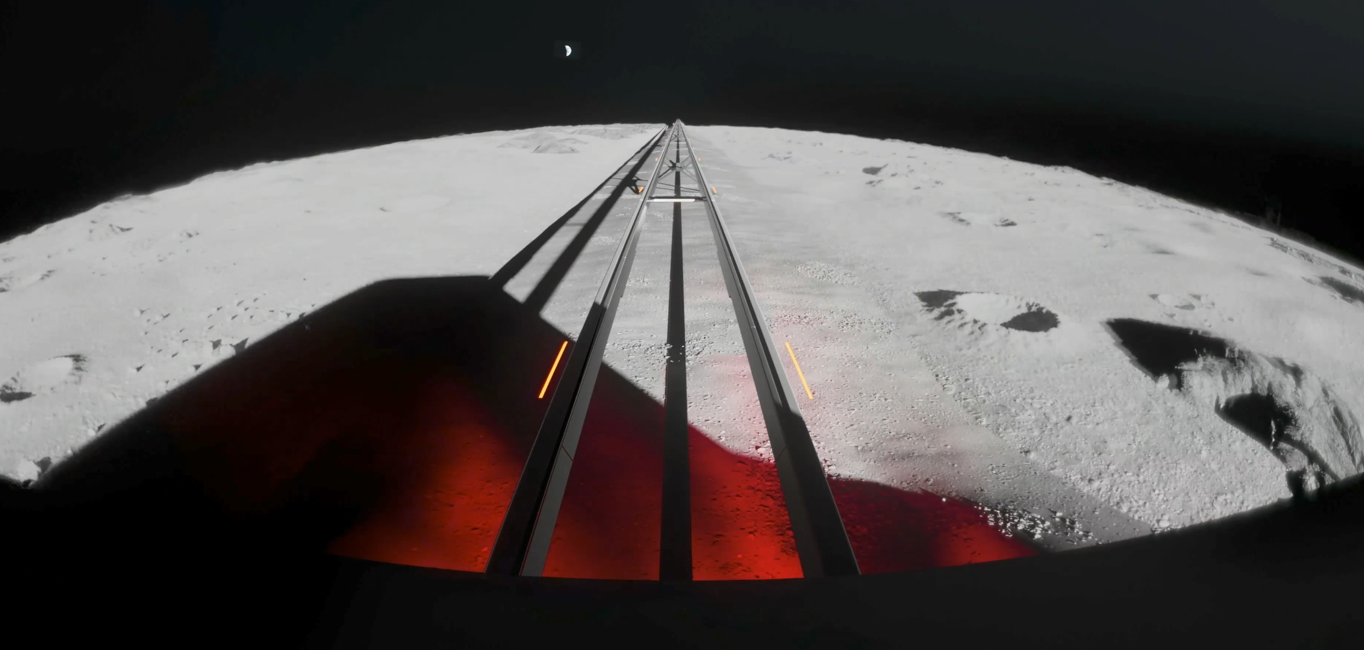
How does it work? Imagine a very long magnetic track. A container carrying cargo is propelled along it, like a mine car, but not by a motor, but by an electromagnetic field. On Earth, such a launch is hindered by the dense atmosphere and strong gravity, whereas on the Moon, these problems are virtually nonexistent. Therefore, the payload can be accelerated to high speeds and literally launched into space without a large rocket. Next, a small engine or orbital system adjusts the trajectory. For a detailed analysis of this technology, read our in-depth overview, “Magnetic catapult: How to save tons of fuel for launching rockets into space.”
Why is this important? For the space industry, such a system could provide a more cost-effective way to transport cargo from the Moon to orbit: fuel derived from lunar resources, structural materials, components for large telescopes, or power platforms. Looking ahead, this means less reliance on costly launches from Earth and the ability to assemble large scientific instruments in space. This is particularly interesting for astronomy, as large mirrors, radio antennas, or solar power systems could be deployed in phases and scaled up at a significantly lower cost.

