

Scientists have never seen a comet or asteroid orbiting another star. They should be there, but all scientists can do now is collect images of protoplanetary disks, such as those taken by the SPHERE space telescope, and analyze them in search of interesting features.
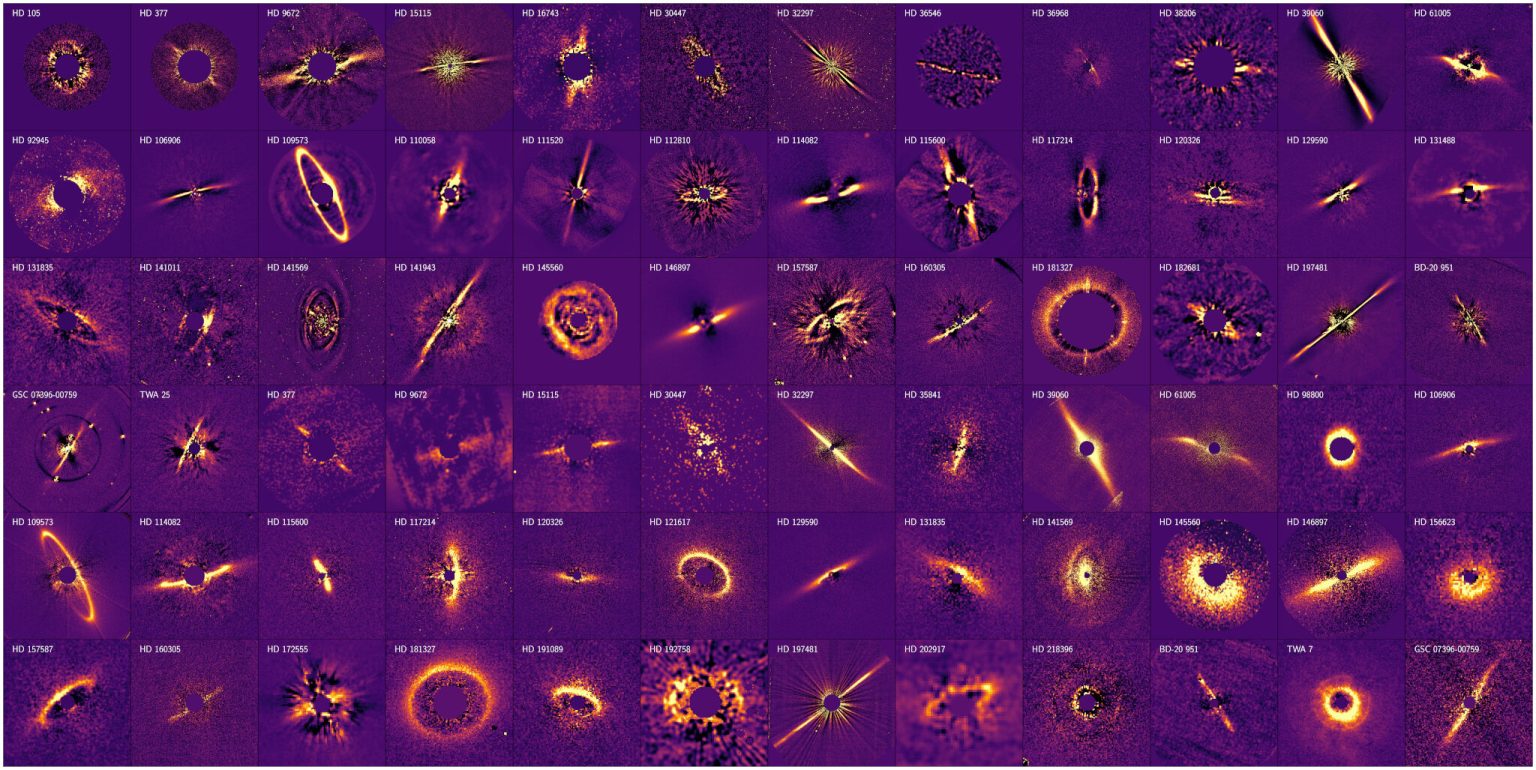
Collection of images from the space telescope
Recently, when it comes to interesting images taken by space telescopes, James Webb is most often mentioned. However, it is not the only one currently operating in space. Now, new interesting results have been obtained from another instrument — SPHERE.
An article published in the journal Astronomy and Astrophysics discusses the results of this space telescope’s observations of 161 young stars located relatively close to the Sun. The result is a gallery of 51 images of protoplanetary disks around these stars.
These images are not of great artistic value, but scientists are eagerly studying them. After all, they not only allow us to see star systems in the early stages of their formation, but can also tell us a lot about the presence of small bodies in them.
Small bodies around other stars
Over the past 20 years, everyone has become accustomed to astronomers discovering new exoplanets almost weekly. However, in reality, out of more than 6,000 worlds beyond the Solar System, they have images of only about 100 objects. The rest have been discovered using indirect methods.
These systems should also contain many small objects, such as comets and asteroids, but it is impossible to see them from the Solar System. They are simply too small. The only time this is possible is during the protoplanetary disk stage.
Throughout the evolution of protoplanetary systems, the total mass of matter in them does not change significantly. However, the smaller the debris, the greater their total surface area. This means that their reflectivity also increases.
That is, as dust particles in the protoplanetary disk stick together, first forming planetesimals and then planets, it dims. However, this happens unevenly, and clear gaps are visible precisely where something large is forming.
This is why scientists are so keenly studying the SPHERE image. Thanks to it, they have already confirmed the well-known pattern that heavier stars usually have larger protoplanetary disks, while smaller stars have smaller ones. Now they hope to learn something else.
According to phys.org

