

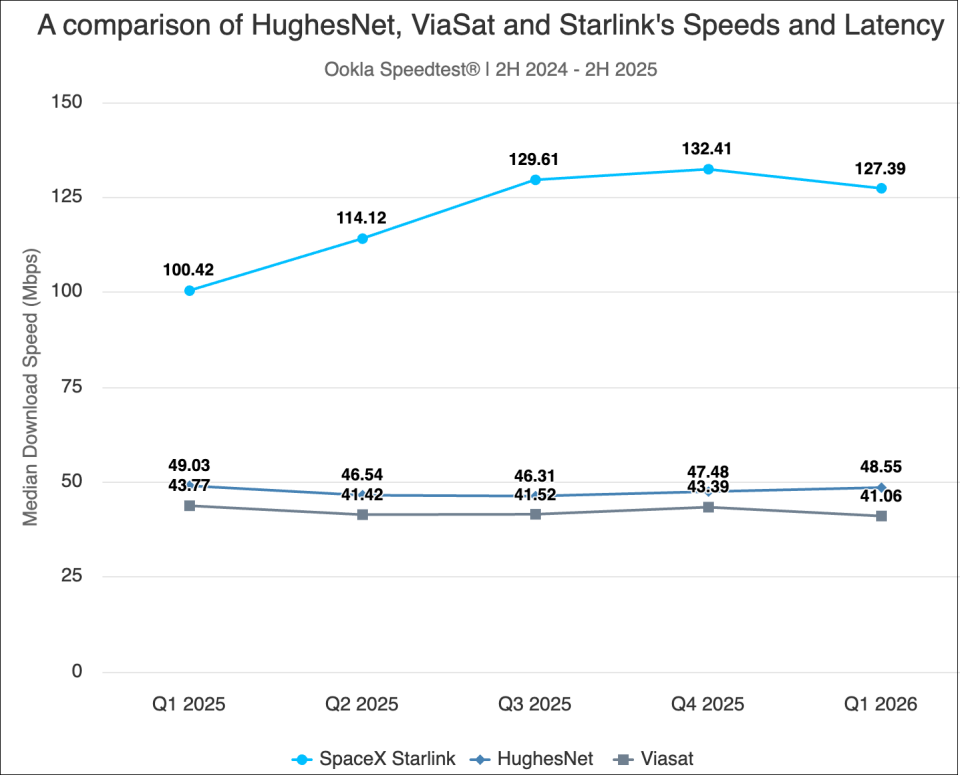
Starlink satellite internet users have noticed some positive changes—the network has noticeably sped up. According to data from Ookla (the creators of Speedtest), the average download speed in North America has comfortably surpassed 100 Mbps.

There was a significant jump in 2025: speeds rose from 100 Mbps in the first quarter to 132 Mbps by the end of the year. And although speeds dipped slightly to 128 Mbps in early 2026, the overall trend is impressive. Technology has evolved: Starlink has gone from being “the internet for remote villages” to a formidable competitor even to traditional broadband. In many regions, download speeds have also increased by 80–90%, consistently remaining above 20 Mbps.
How the orbital fleet overcame the overload
The secret to this success lies in space. More specifically, it lies in the number of satellites in orbit. In 2022, the Starlink network faced a serious congestion crisis. At that point, the average speed dropped sharply from 91 to 63 Mbps, as the infrastructure simply couldn’t keep up with the rapid growth of the user base.
However, SpaceX responded to this with a purely engineering solution—a large-scale expansion of its satellite constellation. To date, the number of Starlink satellites launched into orbit has exceeded 10,000, of which approximately 8,700 are active and in operational orbits. This extensive network made it possible not only to restore previous speeds but also to significantly exceed them. According to Ookla, nearly 45% of users now consistently achieve download speeds of 100 Mbps and upload speeds of 20 Mbps, which is the official benchmark for high-quality broadband service.
Space speeds and earthly finances
Interestingly, this technological triumph has sparked lively political debates on Earth. Back in 2022, the U.S. Federal Communications Commission (FCC), citing a decline in speeds at the time, revoked an $886 million government subsidy for Starlink.
Now, against the backdrop of new records, FCC Chairman Brendan Carr unexpectedly stated that the decision had been a mistake. According to him, cutting off the company’s funding only slowed down efforts to bridge the digital divide. This statement has divided public opinion. Some experts are wondering whether it is possible to recover the grant from the company. Others, particularly analysts in the satellite industry, pose a logical counterquestion: Did the companies really need those millions in government funding to deploy the network, if they managed to accomplish the task so brilliantly on their own through market mechanisms?
Communication brings victory closer
While the financial debate rages on in the U.S., for Ukraine, Starlink remains a technology that is literally saving lives. From the very first days of the full-scale invasion, these terminals have served as a reliable lifeline for the Armed Forces of Ukraine. They enable instant coordination among units, reliable control of reconnaissance and strike drones, and pinpoint artillery strikes—even in areas where the basic infrastructure has been completely destroyed.
The strategic advantage of the Ukrainian defenders became even more pronounced after Elon Musk’s SpaceX helped block internet access for Russian occupiers who were attempting to use illegally purchased or captured terminals. Today, Starlink on the front lines is not just high-speed internet, but a critical digital tool that helps in the fight for freedom.
We previously reported on how Ukrainians pay more for Starlink than the rest of Europe.
According to PCMag

