

The NOIRLab research observatory has published an image taken by astrophotographer Petr Horálek. It shows the Milky Way’s largest satellite, the Large Magellanic Cloud.
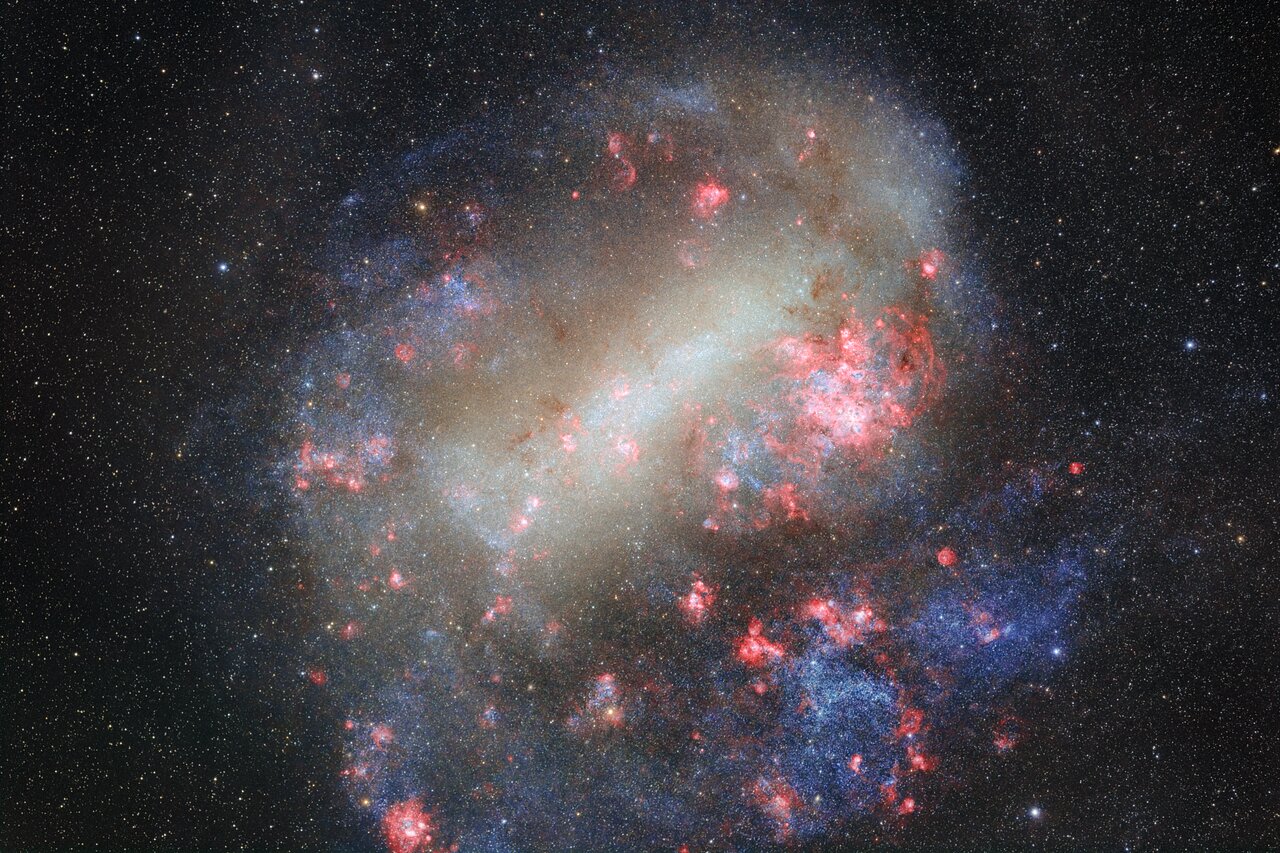
Our galaxy has a number of companions in the form of gravitationally bound galaxies. To date, astronomers have managed to find about 60 such objects. Most of them are quite small in size. The smallest of the Milky Way’s satellites has a diameter of several hundred light-years and a stellar population of no more than a thousand stars.
Against this backdrop, the Large Magellanic Cloud stands out among all the Milky Way’s neighbors for its brightness and size. It has a diameter of 32,000 light-years and contains about 20 billion stars.
The Large Magellanic Cloud is classified as a dwarf spiral galaxy. It has an irregular shape and one spiral arm offset from the center. This led astronomers to conclude that the Large Magellanic Cloud was once a spiral galaxy with a bar like ours. However, its arms were later deformed under the influence of the gravity of the Milky Way and the neighboring Small Magellanic Cloud.
Like most irregular galaxies, the Large Magellanic Cloud is actively forming new stars. It is home to the most active star-forming region among our nearest galaxies – the Tarantula Nebula. This is a giant cloud of ionized hydrogen, whose length exceeds a thousand light-years. It is home to some of the brightest and most massive stars known to science. Among them is the blue hypergiant R136a1, whose mass exceeds that of the Sun by 200 times.
The high activity of the Large Magellanic Cloud can be partly explained by “theft.” The galaxy “steals” gas and stars from the neighboring Small Magellanic Cloud. Astronomers have discovered an intergalactic gas bridge connecting the two. When matter from the Small Magellanic Cloud collides with matter from the Large Magellanic Cloud, it creates pressure and concentrates the gas, which significantly increases the likelihood of star formation.
Provided by NOIRLab

