

Astronaut Don Pettit posted an amazing photo taken during his stay on the ISS. It shows the lights of Earth at night and the North Pole.
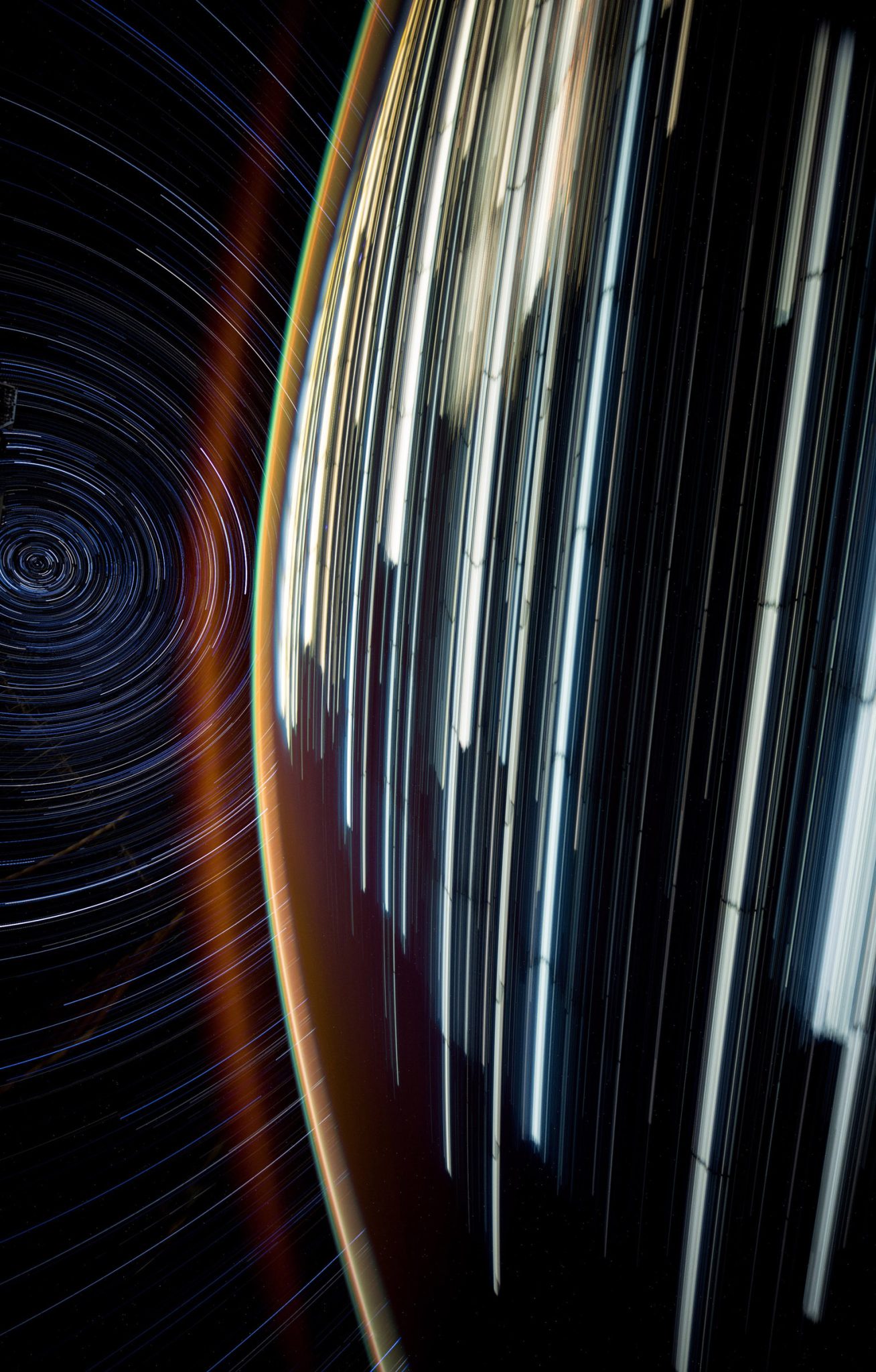
The photo was taken when the ISS was flying over the night side of Earth, and both city lights and stars could be seen through its window. The photo was taken with a long exposure. As a result, the lights of night cities and stars turned into glowing lines.
It is worth noting that the star tracks form a kind of “vortex.” It points to the so-called celestial pole. This effect is because our Earth rotates around its axis, which creates the effect of daily rotation of the stars. They describe circles around the point where the axis of rotation of our planet passes in the sky. This point is called the pole of the world and coincides with the direction of true north/south. In the northern hemisphere, the stars move counterclockwise, and in the southern hemisphere, they move clockwise.
If you look closely, you can see another interesting phenomenon in the photo – a bright band above the horizon. It is called the atmosphere’s own glow.
The glow occurs during various processes taking place in the upper layers of our planet’s atmosphere. These include the recombination of ions formed during photoionization under the influence of solar radiation during the daytime, luminescence caused by cosmic rays passing through the upper layers of the atmosphere, and chemiluminescence, which is mainly associated with reactions between oxygen, nitrogen, and hydroxyl radicals at an altitude of several hundred kilometers.
This optical phenomenon means that the night sky is never completely dark, even if we exclude the light from stars and the scattered light from the Sun on the daytime side. During the day, the sky glows 1,000 times more intensely than at night, but we cannot see it because of the bright light from the Sun.
Earlier, we talked about another photo by Don Pettit, in which you can see flashes created by Starlink satellites.

