

Scientists have created the most accurate three-dimensional map of star-forming regions in our Milky Way galaxy based on data obtained by the Gaia space observatory. This map will allow us to learn more about these regions and the hot young stars forming within them.
It is very difficult to map and study areas in space where stars are formed. They are usually hidden from us by thick clouds of gas and dust, the distance to which cannot be measured directly.
The Gaia observatory, which recently ceased operations, could not see these clouds directly, but it could measure the position of stars and what percentage of their radiation was blocked by dust. Based on this, ESA scientists were able to create a three-dimensional map showing where ionized hydrogen is located — a clear sign of star formation.
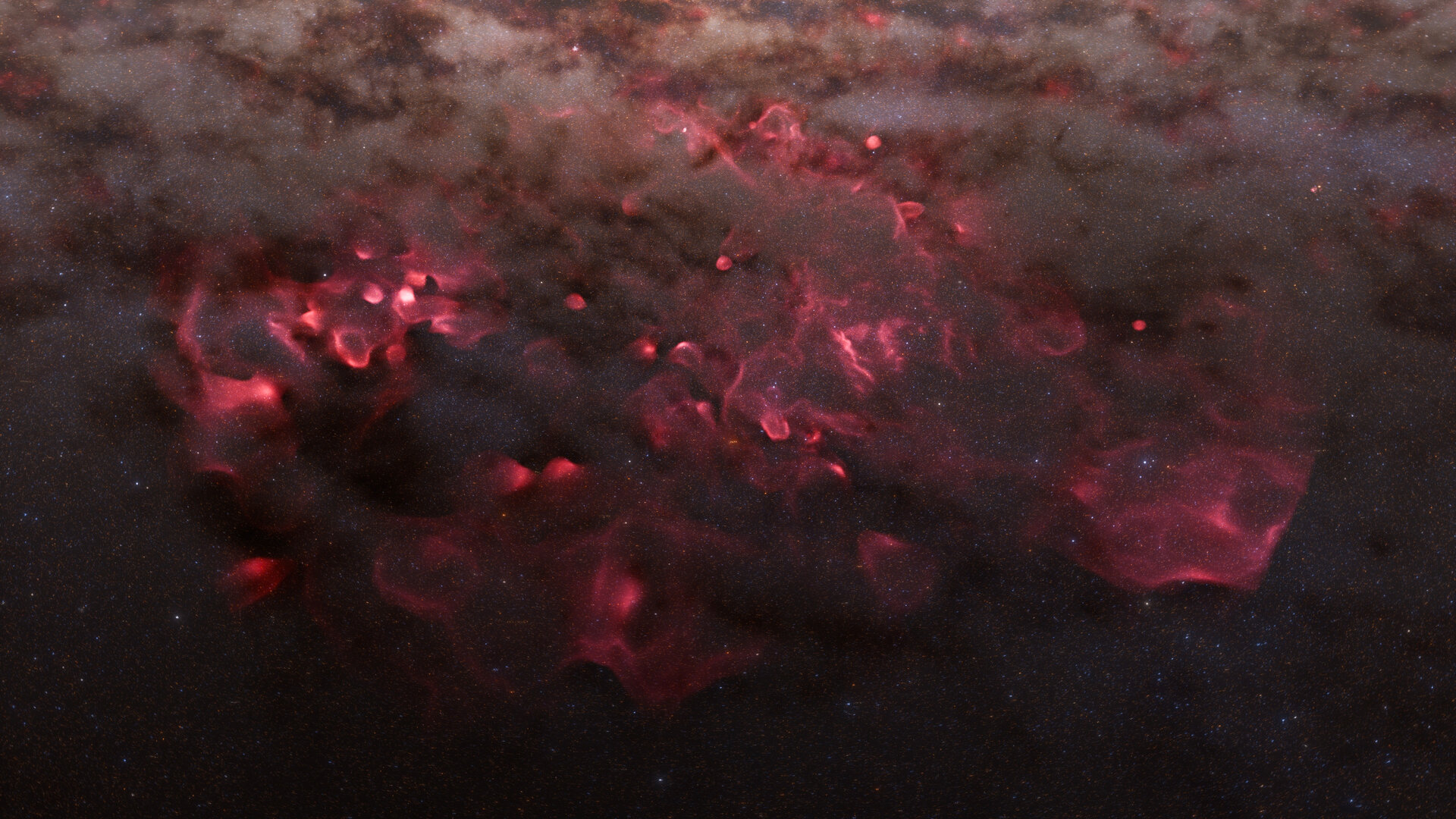
The map published by ESA contains data on 44 million ordinary stars and 87 stars of spectral class O. It covers an area 4,000 light-years wide with the Sun at its center.
The brightest stars in the Milky Way
O-type stars are very rare. They are the most massive and brightest stars in the Universe, emitting powerful ultraviolet radiation. It ionizes the surrounding gas clouds, causing them to glow. This is one way for astronomers to identify areas in space where stars are born.
With the help of the map, scientists will be able to learn more about how giant O-type stars affect gas in our galaxy and how far their influence extends. In particular, they are capable of creating huge cavities in it, one of which can be seen at the beginning of the visualization. The Gaia map will provide a more detailed picture of the processes that shape our local galactic environment. Studying them will help researchers better understand the interaction between the warm and cold components of our Universe.
The Gaia map also provided astronomers with another unique opportunity. We cannot leave the Milky Way and photograph it from above. But the new map contains data that allows us to draw conclusions about what our galaxy looks like. It includes 3D images of the Gum Nebula, the North America Nebula, the California Nebula, and the Orion-Eridanus Superbubble. The map enables you to “fly” around, through, and above these regions containing stellar nurseries.
According to ESA

