

Scientists want to find out what can be observed during the merger of neutron stars. For this purpose, they utilized the Japanese supercomputer Fugaku to simulate all stages of this process.
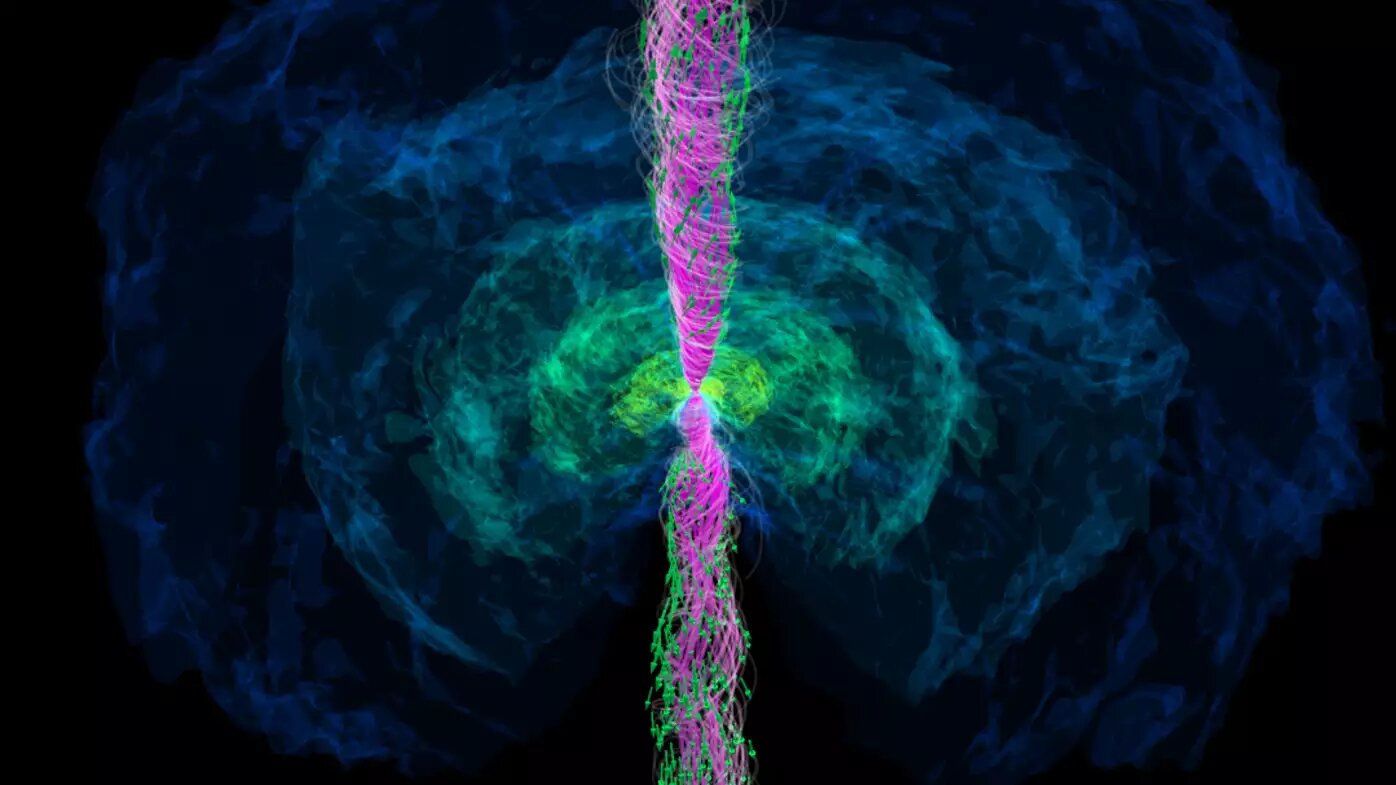
Merger of neutron stars
The merger of neutron stars is an extremely important and complex process that can tell us a lot about the physics of the universe around us. Until now, it has only been observed using gravitational wave detectors, which cannot tell us much about this process. However, new research suggests how we can learn more about all this.
Scientists have long known that the key to understanding neutron star mergers lies in multispectral astronomy, i.e., observing these events across a range of different wavelengths. However, these are fairly short-lived events, and in order to learn anything about them, you need to know in advance what exactly to look for and what to expect.
The fact is that the theory of relativity has a strong influence on the processes involved in the collision and merger of black holes. Because of this, until recently, scientists only had very limited models of such processes — they are too complex for calculation. However, thanks to the Japanese supercomputer Fugaku, researchers were able to conduct the longest and most detailed simulation of such events to date.
What the simulated event showed
In fact, the entire simulation takes only 1.5 seconds, and it required approximately 130 million processor hours of work. At the same time, from 20 to 80 thousand individual processors were loaded at different stages.
In just 1.5 seconds, simulated neutron stars with masses of 1.25 and 1.65 solar masses manage to make five orbits around each other, moving in a spiral and gradually losing energy. Next, gravitational waves are emitted and the stars merge into a black hole.
After the merger, a disk of matter forms around the residual black hole. In the disk, the magnetic field is amplified by the winding of the lines of force and the dynamo effects. Interaction with the rapid rotation of the black hole further strengthens the magnetic field. This creates an energy outflow along the object’s axis of rotation, which ultimately generates a gamma pulse.
Now scientists know exactly what range to look for black hole mergers in, and what the signal accompanying these events should look like.
According to phys.org

