

Supermassive black holes have long been considered destroyers. They swallow up gas, dust, and anything that comes too close. But new research suggests that they also play the opposite role. Perhaps these objects are the most prolific planet-forming regions in the universe.
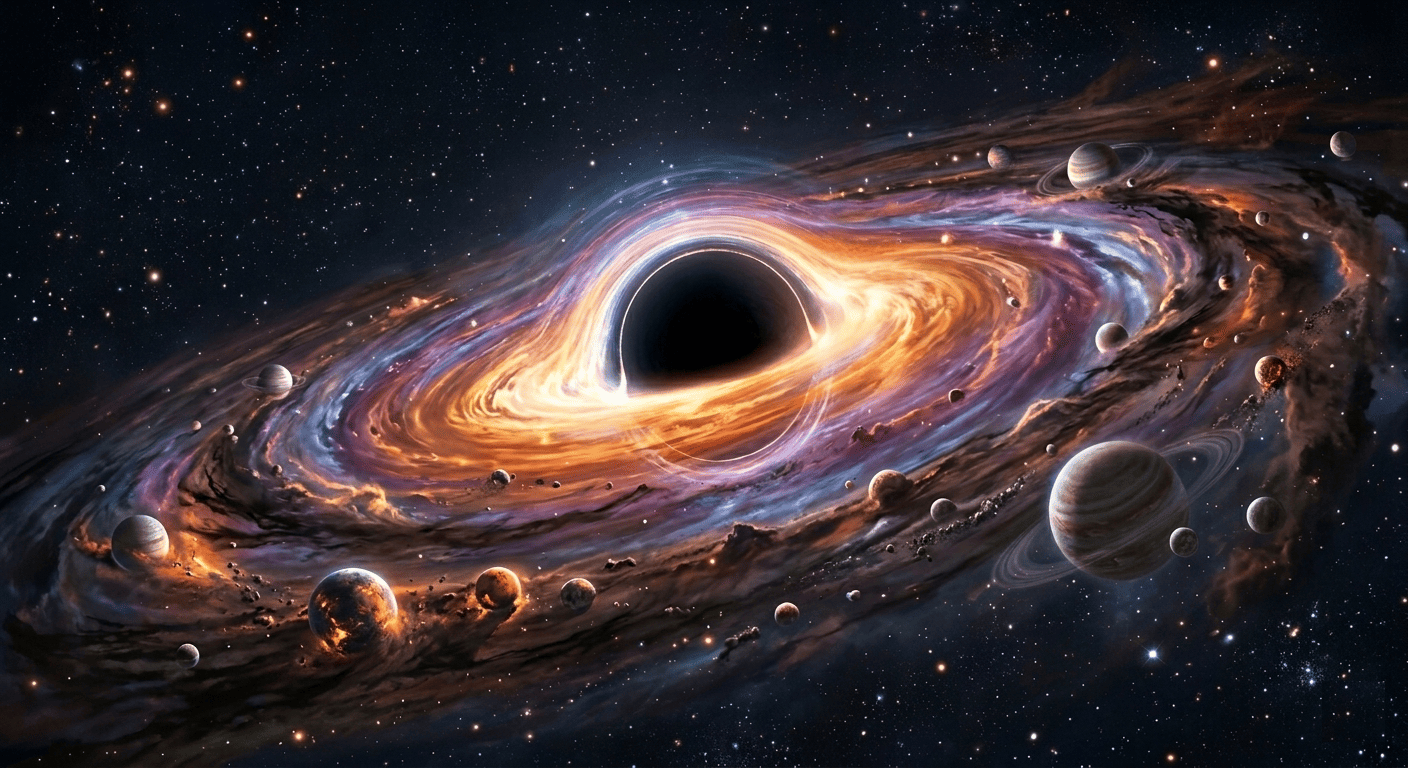
Where planets are born
Planets typically form in disks of gas and dust that orbit young stars. Similar gas-dust structures of colossal scale exist around supermassive black holes at the centers of active galaxies (active galactic nuclei – AGN).
The outer regions of such disks have temperatures and physical conditions similar to those observed in protoplanetary disks around stars. This means that dust particles there can persist long enough to coalesce and gradually form solid bodies.

What the model showed
Researchers led by Barry McKernan of the City University of New York fed data on the temperature and composition of the gas from the outer region of torus into a computer model of a black hole’s magnetized disk. The calculations covered the rate of dust accretion, the final sizes of the planets, and how much additional material these bodies could absorb from their surroundings over millions of years.
The results showed that planet formation under such extreme conditions is not only possible but may also occur on a massive scale. The authors note that, according to their simplified model, the outer regions of active galactic nucleus tori may be the largest planet-forming regions in the universe.
Planets larger than Jupiter
The intense gravity and high density of matter in the environment of active galactic nuclei allow young planets to rapidly gain mass, potentially reaching sizes significantly larger than Earth’s and even larger than Jupiter’s. Some of them may accrete so much gas and dust from their surroundings that they will evolve into new stars.
The authors also suggest the possible formation of exotic massive objects composed primarily of dust, with no known counterparts in existing planetary systems. All of these conclusions require observational confirmation.
According to phys.org

