

In April 2024, astronomers made a unique discovery. Just 26 hours after detecting the supernova SN 2024ggi, they pointed the Very Large Telescope (VLT) in Chile at the object. This allowed them to capture the very first moments of the explosion, when a powerful shock wave literally tears the star apart, for the first time in history. The object is located nearby by cosmic standards — only 22 million light-years away in the galaxy NGC 3621.
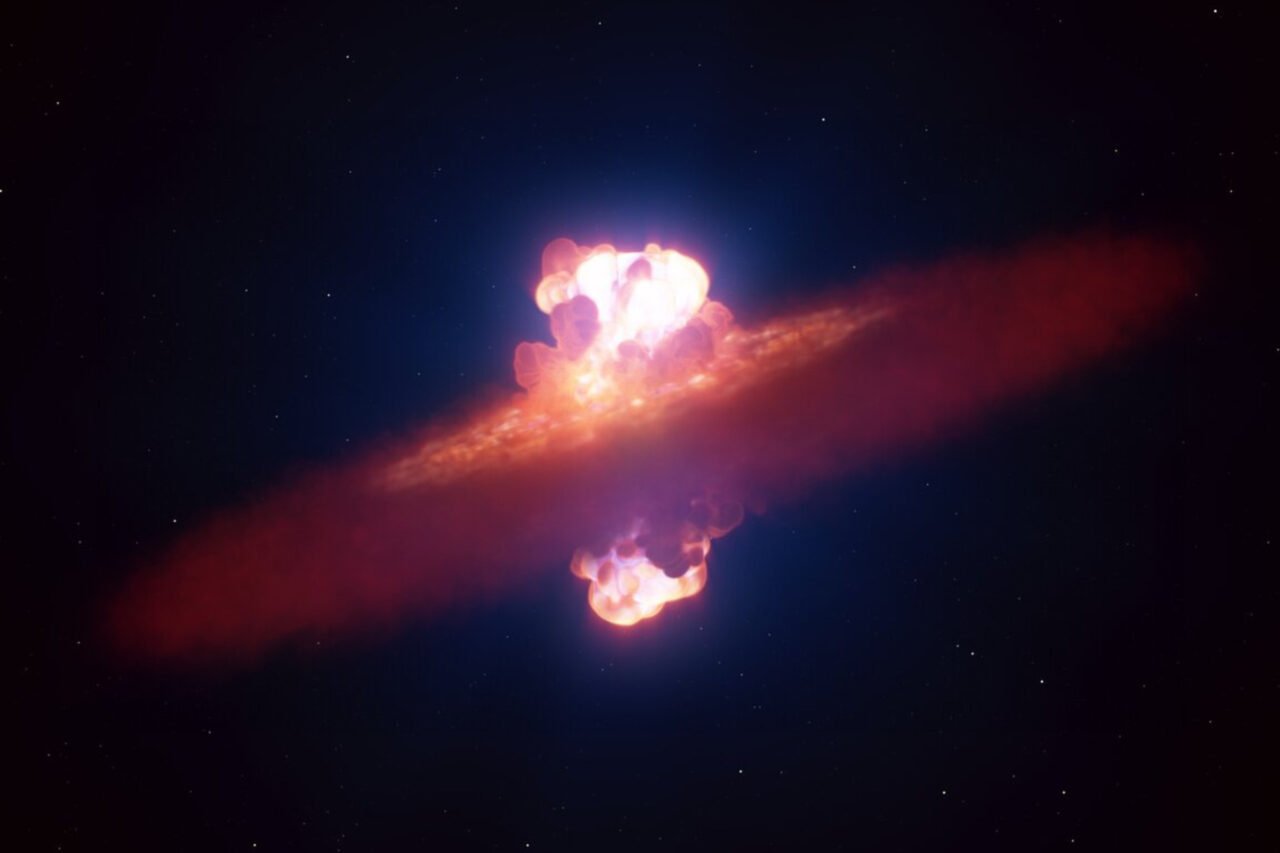
Before its dramatic end, it was a red supergiant star with a mass 12-15 times greater than the Sun and a size 500 times larger than our own luminary. It is precisely such massive stars that end their lives as supernovae. But the details of this process remained a mystery, as astronomers usually only encountered the remnants of the explosion.
Magic of spectropolarimetry
How was it possible to detect the shape of an explosion that looked like nothing more than a bright spot from such a distance? Spectropolarimetry technology came to the aid of astronomers. It allows them to analyze the polarization of light—a property that indicates its vibrations in a certain plane.
In simple terms, this method allows them to “see” the shape of the luminous object. It is similar to how we can determine the shape of the water surface by the glare of the sun. The researchers did not obtain a conventional photograph, but by studying the polarization of light from the supernova, they were able to recreate its three-dimensional shape.
Olive-like explosion
The analysis of the data revealed an incredible result. It turned out that the initial explosion that broke through the surface of the star was not spherical, but elongated, olive-shaped. When this shock wave spread outward and began to interact with the matter ejected by the star earlier, it flattened slightly but retained the same axis of symmetry.
“These findings point to a common physical mechanism that causes many massive stars to explode,” explained astronomer Yi Yang of Tsinghua University. This sheds light on one of the major mysteries of astrophysics—how exactly the shock wave that destroys a star is formed and propagated.
This fundamental discovery now allows scientists to discard a number of modern supernova models and refine others. For the first time, we have direct evidence of the shape of the explosion in its earliest, fleeting stage, which opens a new chapter in the study of the death of stars.
Also read our article for interesting facts about supernovae.
According to Space

