

Interstellar space continues to amaze scientists with the presence of complex chemical compounds. From protein precursors to components of cell membranes, these massive gas clouds hold countless secrets. Recently, researchers took another fundamental step toward understanding how life on Earth might have originated: for the first time, they detected a four-carbon sugar in the interstellar medium.
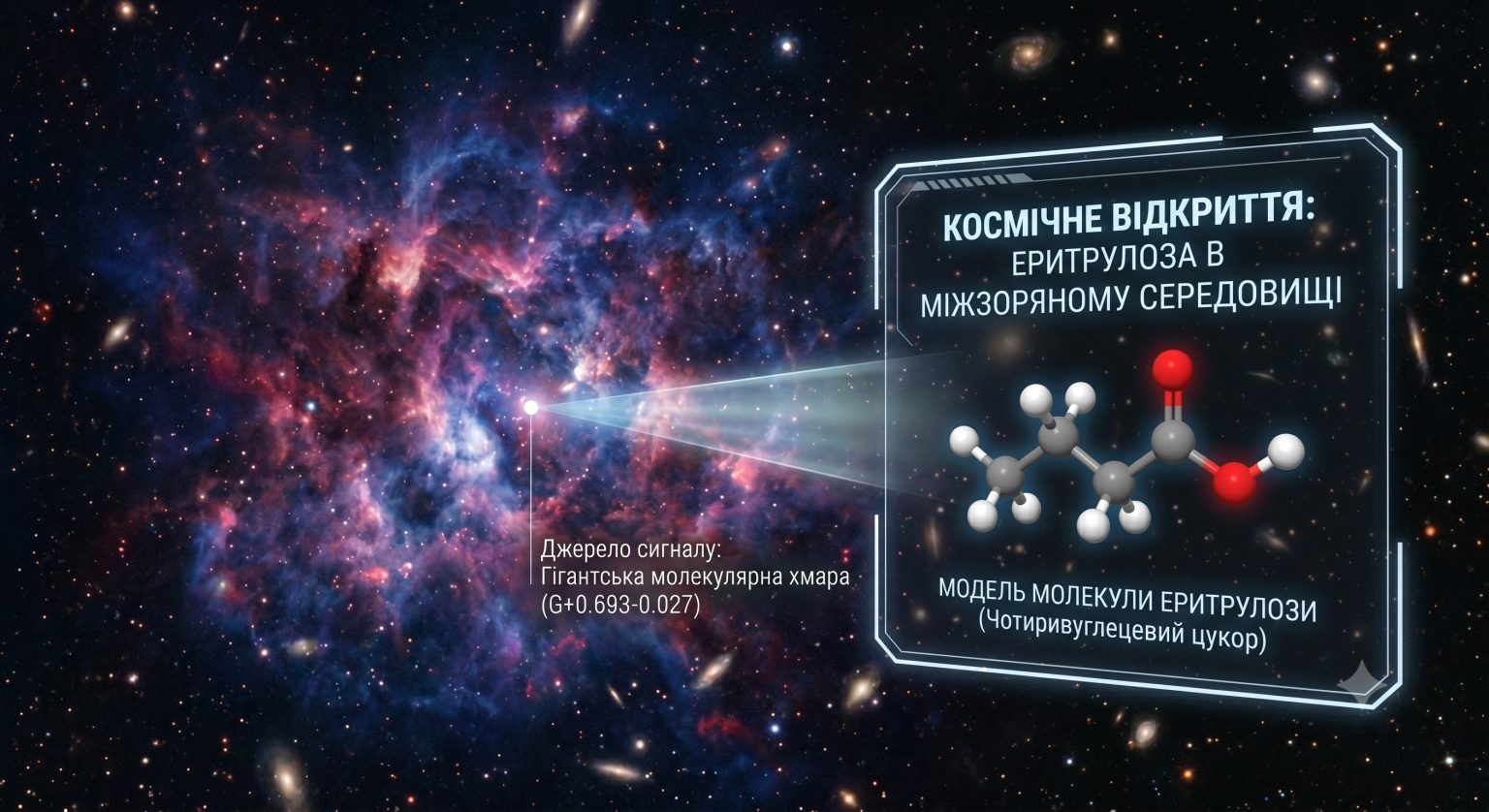
The molecule in question is erythrulose (C4H8O4)—a type of ketose sugar with a chain consisting of four carbon atoms. Astronomers have detected this molecule in a chemically rich molecular cloud known as G+0.693-0.027. This discovery required the combined power of two modern radio telescopes: the 40-meter Yebes and the 30-meter IRAM. Scientists carefully analyzed the cloud’s dense spectral lines and identified the compound they were looking for with a probability of a random error of just 0.2%.
Paradox of the missing predecessors
What proved most interesting was not the discovery itself, but the absence of the expected accompanying chemical elements. Scientists found no traces of three-carbon sugars, such as glyceraldehyde, in the cloud. Erythrulose was at least eight times more abundant than its simpler counterparts. This raised a logical question: how could a more complex four-carbon sugar form without the “building blocks”?
Quantum-chemical models and computer simulations helped provide the answer. It turns out that erythrulose is not formed through the gradual addition of carbon atoms one by one. The process occurs directly on the icy surfaces of cosmic dust, where two-carbon fragments (glycolaldehyde and ethylene glycol) combine. Constant bombardment of molecular clouds by cosmic rays and atomic hydrogen creates radicals that trigger this reaction, bypassing the stage of three-carbon precursors.
Cosmic foundations of Earth’s biology
The presence of erythrulose in space is of immense importance for understanding the origin of life. Modern DNA and RNA are based on a five-carbon sugar—ribose. However, under the conditions of early Earth, it was extremely difficult to synthesize it. Astrobiologists hypothesize that the first genetic polymer was threonine nucleic acid, which is based on a four-carbon sugar.
In the presence of liquid water, erythrulose can easily be converted into sugars such as threose. In other words, the sugar found in the interstellar cloud is a direct chemical link to a likely precursor of the genetic code.
Delivery to early Earth
Scientists believe that a vast quantity of these complex cosmic sugars reached our planet during the Late Heavy Bombardment, when the young Earth was constantly being struck by asteroids. By the time the primordial oceans had cooled sufficiently, they already contained the necessary supply of chemical elements to trigger biological processes.
The discovery of a complex four-carbon sugar—erythrulose—in the interstellar medium is a strong argument that some key organic molecules may have formed in molecular clouds before the birth of stars and planets.
The study still leaves some questions unanswered. The discovery suggests that complex organic molecules could have formed before the formation of planets. But it doesn’t explain how life arose. The study suggests that potential precursors to life’s building blocks are actively and continuously forming deep in space. All that’s needed is a mechanism to deliver them to a habitable planet and a little bit of luck for evolution to take its first step.
We previously explained panspermia theory.
According to universetoday.com

