

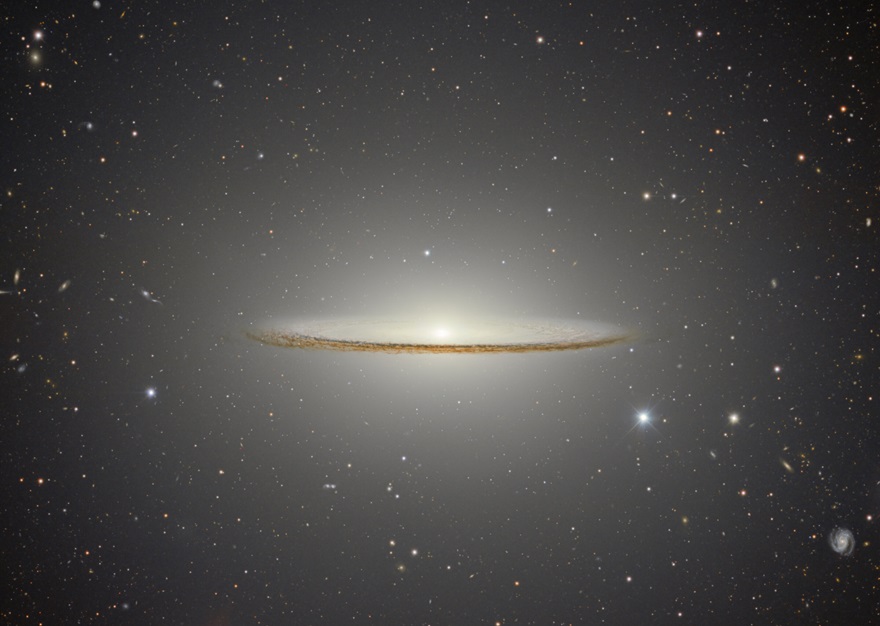
M 104 is a galaxy located 30 million light-years away from us, which is nicknamed Sombrero because of its shape. However, like any large galactic system, it consists not only of a dense core but also of a less dense structure surrounding it. This structure is called a halo, and scientists have recently been able to study it in detail.
Greatness of the Sombrero Galaxy
The Sombrero Galaxy (Messier 104) is a galactic masterpiece that captivates both scientists and amateur astronomers alike. Its complex system of globular clusters provides insight into stellar populations, while the supermassive black hole at its center intrigues astronomers. Thanks to its distinctive visual characteristics and relative brightness, it has become a favorite among amateur astronomers. The fascinating story of its discovery, which involved three renowned astronomers, has secured its place on one of the most important lists of deep-sky objects. Today, it is one of the most famous galaxies in the night sky.
Messier 104 is located approximately 30 million light-years from Earth in the constellation Virgo. With an impressive diameter of 50,000 light-years, it is one of the largest objects in the Virgo Cluster. Despite its grandeur, it appears relatively faint in the night sky—just below the threshold of visibility to the naked eye, though it can be observed with a small telescope or binoculars.
What can be seen in the new image?
This image was captured using the 570-megapixel DECam camera. DECam’s incredible resolution allows us to see the striking features of the Sombrero Galaxy. At its center lies a bright core surrounded by a swarm of about 2,000 globular clusters. A thin, dark band of cold dust and hydrogen gas stretches along the edge of the disk, where most of the galaxy’s star formation takes place. The name “Sombrero Galaxy” comes from its striking resemblance to a sombrero, with a prominent central bulge and a dark dust trail that resembles the tall crown and wide brim of a traditional Mexican hat.
This image also shows the galaxy’s enormous, glowing halo, which appears to extend over a distance three times the width of the Sombrero Galaxy itself. This may be the first time a halo has been captured in such detail and on such a large scale. Thanks to the DECam camera’s incredible sensitivity, it was also able to capture a sprawling stellar stream extending from the southern side of the galaxy. The halo and stellar stream are populated by stars torn from their home galaxies, suggesting a past merger between the Sombrero Galaxy and a smaller companion galaxy.
Fascinating story of the discovery of M104
The history of the discovery of Messier 104 is closely linked to the work of several distinguished astronomers. It was first spotted by the French astronomer and comet hunter Pierre Méchain in 1781, when he was a colleague of the famous comet hunter Charles Messier. At that time, Messier was compiling a list of non-cometary celestial objects, now known as the Messier Catalog, to help other astronomers distinguish these objects from passing comets.
Interestingly, Messier 104 was not included in the original publication of the Messier catalog. However, it was later discovered that Messier had added it by hand to his personal copy. Regardless, in 1784, the renowned astronomer William Herschel also stumbled upon this remarkable galaxy and designated it H I.43.
Only after French astronomer Camille Flammarion confirmed that these two independent discoveries referred to the same object, Messier 104 officially took its place in the Messier catalog in 1921. Thus, thanks to the combined efforts of these astronomers from different eras, the Sombrero Galaxy has enriched our understanding of deep-space objects.
Its striking visual characteristics, combined with the fact that it can be observed using amateur equipment, contribute to the popularity of Messier 104 among amateur astronomers. Amateur astronomers often enjoy observing and photographing the Sombrero Galaxy, making it a prime target for citizen science projects and science outreach initiatives. This is a wonderful opportunity to share the miracles of the universe with the public and encourage interest in astronomy and science.
According to phys.org

