

A new Chinese project: the Yuxing-3 06 commercial satellite (also known as Xiyuan-0) has successfully completed in-orbit testing of a flexible robotic arm designed for complex manipulations in space. These technologies are part of solutions that will enable the repair, refueling, and maintenance of spacecraft directly in orbit.
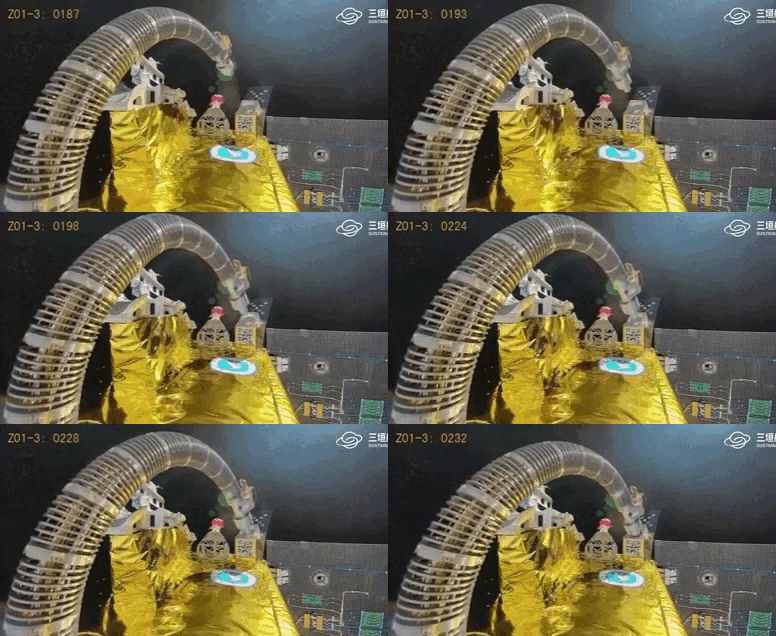
The mission’s main achievement was testing the flexible manipulator’s performance in several modes. During the tests, the system performed a software-controlled simulated refueling, a remotely controlled simulated refueling, approach and docking, as well as a force compliance control test, in which the manipulator used force sensor data to perform precise movements resembling the drawing of geometric shapes. This should confirm the technology’s suitability for future operations involving the maintenance of orbital objects.
The developers note that the flexible arm is designed as a hollow, continuous-flex manipulator with a rear cable drive. Unlike rigid robotic arms, this design is better suited for working in narrow and hard-to-reach spaces, reduces the risk of damaging objects upon contact, and could potentially be used for refueling, repairs, component replacement, and even for dealing with space debris. The manipulator was developed jointly by Sanyuan Aerospace and the Shenzhen International Graduate School of Tsinghua University, and the satellite is described as China’s first commercial spacecraft of its kind.
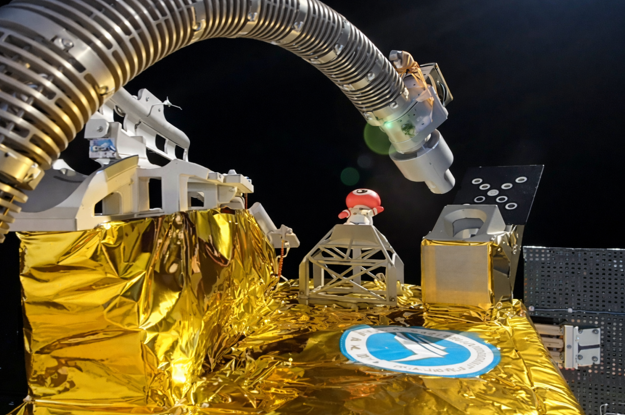
How does it work? Imagine not a rigid metal arm, but something more like an elephant’s trunk or a tentacle—something that can bend, twist, and extend smoothly to reach the desired hatch or connector. Cameras and sensors help the system determine the exact location of the target, while a program or an operator on the ground adjusts its movement. Thanks to its flexibility, the manipulator does not strike the surface with force but makes gentle contact with it, which is particularly important during docking or when working near sensitive parts of the satellite.
Why is this important? Such robotic systems can significantly extend the service life of satellites and scientific instruments: instead of launching a new, expensive spacecraft, it will be possible in the future to refuel an old one, adjust its orbit, or even replace a specific component. This is particularly important for space science, as orbital telescopes, scientific platforms, and Earth observation satellites often become inoperable not because they are completely unusable, but because they have run out of fuel or due to minor technical limitations. In addition, such manipulators can assist in the assembly of large structures in space and in reducing the amount of space debris.

