

Space often amazes us with its eternity — galaxies, stars, and planetary systems have existed for billions of years. But sometimes it throws scientists real lightning-fast puzzles: fleeting flashes of energy that are too distant and instantaneous to study in detail. Among them are mysterious fast X-ray transients (FXTs), whose origin has long been a mystery.
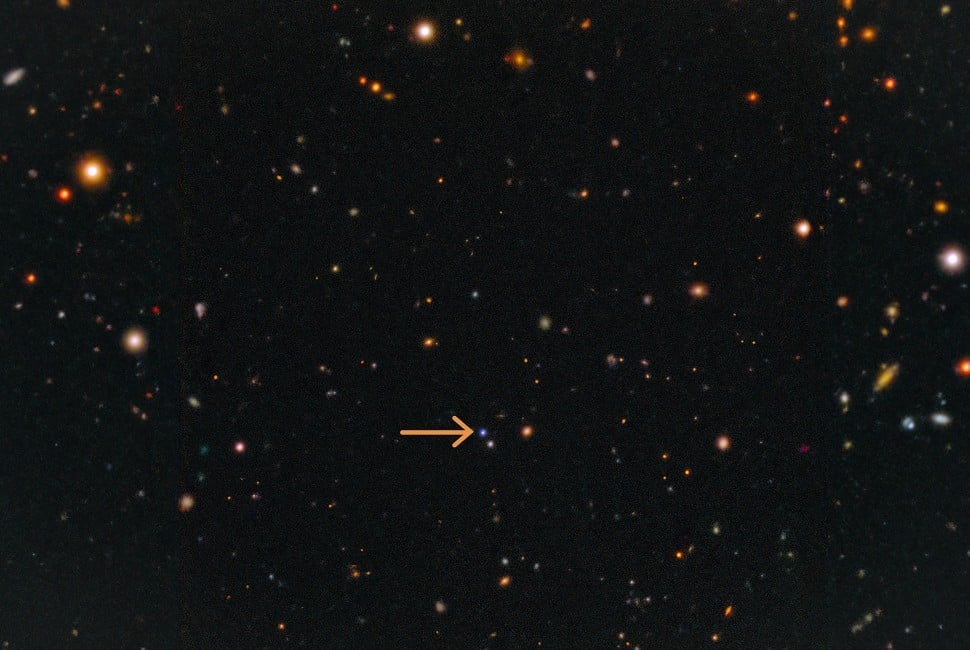
Astrophysicists have recently been fortunate. They recorded an FXT called EP 250108a, which turned out to be unprecedentedly close to Earth — only 2.8 billion light-years away — and lasted slightly longer than similar phenomena. The results of the study have been prepared for publication in The Astrophysical Journal Letters.
“Failed” jet from the depths of disaster
The study indicates that the source of the burst was likely a failed gamma-ray burst jet. Such a burst occurs when a massive star dies in a supernova explosion, collapses into a black hole, and some of the matter that failed to fall into it escapes in the form of incredibly powerful jets. But in this case, the outer layers of the exploded star, similar to an onion, created an extremely strong gravitational barrier.
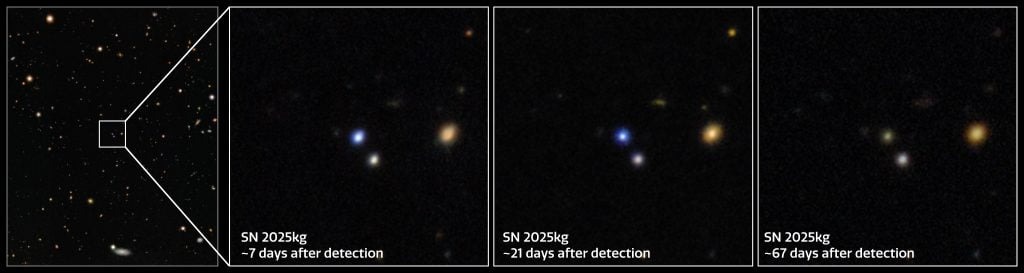
“s the jet is being launched, the excess material interacts with it, preventing it from breaking through the outer layers,” explains Jillian Rastinejad, head of research. Only tiny particles of energy were able to escape, giving rise to a weaker but visible X-ray transient, EP 250108a. This is the first substantial evidence of at least one of the mechanisms of FXT onset.
An unexpected moment
The burst was detected by the Einstein Probe, a probe specialized in searching for gamma-ray bursts. Its relative proximity allowed telescopes, including the powerful Keck Observatory in Hawaii, to quickly aim at it and obtain detailed data before the signal disappeared.
FXTs are rare phenomena that can be observed in an extremely short period of time. “If you study a massive star like this one, it can change dramatically over a few days at different wavelengths,” Rastinejad emphasizes. This makes them a unique window into the dynamic processes of the universe.
The discovery not only reveals the mechanism of transients, but also demonstrates the power of international cooperation in detecting instantaneous cosmic signals. Although astronomy does not directly influence everyday life, it, like art, offers something equally important.
“Astronomy provides answers to questions that have always interested people: where we came from and what awaits us in the future,” Rustinejad reminds us. Every lightning flash, such as EP 250108a, is another step toward unraveling the great cosmic picture.
Earlier, we reported on how scientists created the largest catalog of exploding stars.
According to Gizmodo

