

Scientists analyzed the consequences of the collision between the DART spacecraft and the asteroid Dimorphos, which occurred in September 2022. They discovered that it had generated a large number of large rocks that continued their journey through space.
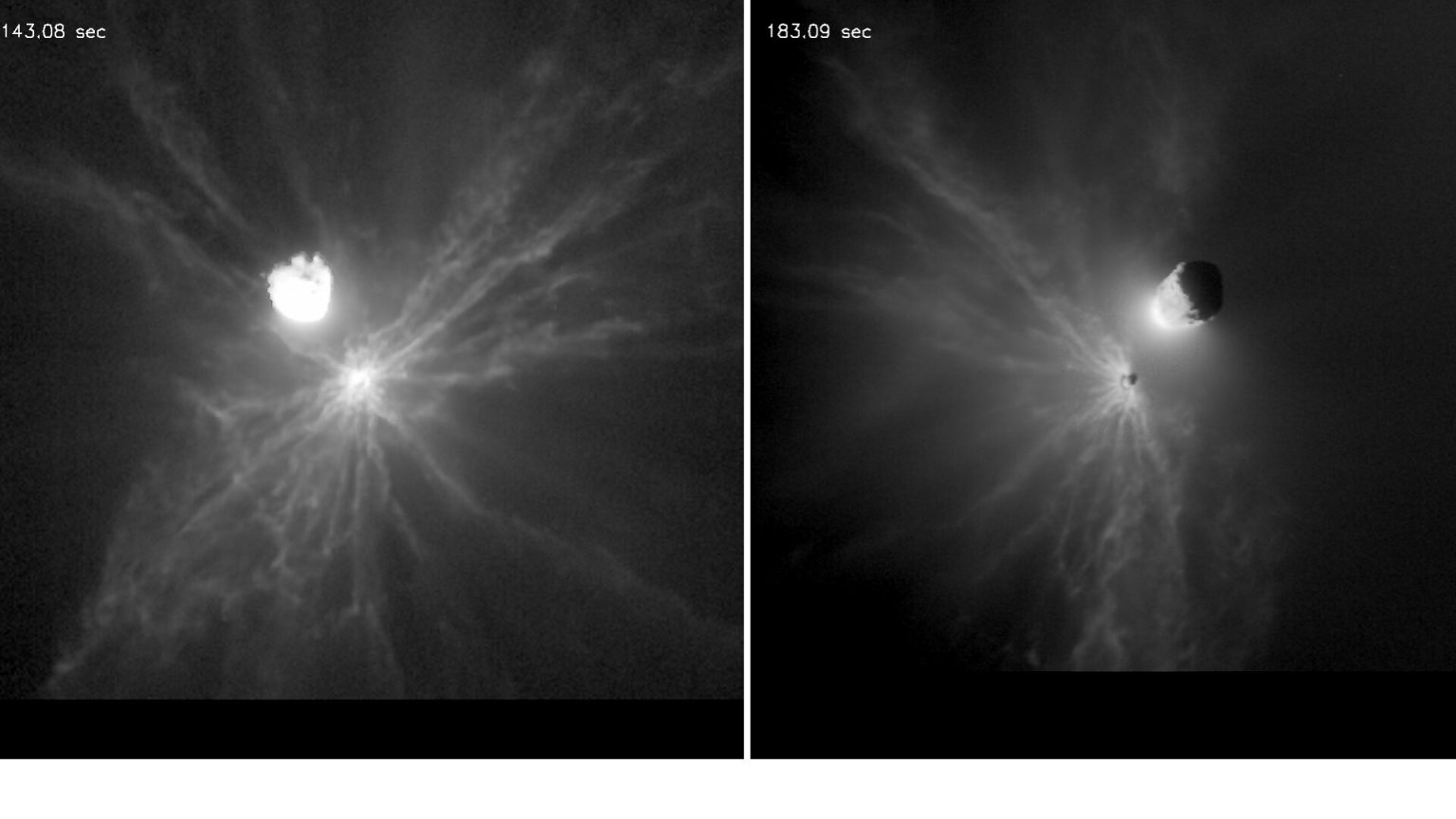
DART collision with asteroid
When NASA’s DART spacecraft crashed into the asteroid Dimorphos in September 2022, it not only changed the asteroid’s orbit as planned, but also released a huge amount of boulders, whose momentum was three times greater than that of the spacecraft.
A team of astronomers led by the University of Maryland found that, although the mission successfully proved that kinetic impactors such as the DART spacecraft can change the trajectory of an asteroid, the ejected boulders created forces in unexpected directions, which could complicate future deflection attempts.
“We succeeded in deflecting an asteroid, moving it from its orbit,” said Tony Farnham, lead author of the article and research associate in the Department of Astronomy at the University of Maryland. “Our research shows that while the direct impact of the DART spacecraft caused this change, the boulders ejected gave an additional kick that was almost as big. That additional factor changes the physics we need to consider when planning these types of missions.”
Origin of debris
Using images taken by LICIACube, a small Italian spacecraft that observed the aftermath of DART, astronomers tracked 104 boulders ranging from 0.2 to 3.6 meters in diameter that flew off Dimorphos at speeds of up to 52 meters per second (116 miles per hour). Based on these images, the team determined the three-dimensional location and velocity of the ejected rocks.
The largest group of debris, containing about 70% of the measured objects, was ejected southward at high speed and at a slight angle to the surface. The team believes that the ejected boulders probably came from specific sources, possibly larger boulders on Dimorphos that were broken up by DART’s solar panels just before the main part of the spacecraft crashed into the surface.
Comparison of the DART and Deep Impact missions
Jessica Sunshine, who was deputy principal investigator for NASA’s Deep Impact mission led by the University of Maryland, compared the results of DART with the results of Deep Impact, noting how surface features and target composition fundamentally influence collision results.
“Deep Impact hit a surface that was essentially very small, uniform particles, so its ejecta was relatively smooth and continuous,” Sunshine explained. “And here, we see that DART hit a surface that was rocky and full of large boulders, resulting in chaotic and filamentary structures in its ejecta patterns. Comparing these two missions side-by-side gives us this insight into how different types of celestial bodies respond to impacts, which is crucial to ensuring that a planetary defense mission is successful.”
Hera — future mission to the asteroid Dimorphos
The momentum from the boulders ejected by the DART impact was mostly perpendicular to the spacecraft’s trajectory, meaning that it could tilt Dimorphos’ orbital plane by one degree and possibly cause the asteroid to spin chaotically in space. The team’s research into understanding the impact of boulder debris will be key to the European Space Agency’s Hera mission, which will arrive at the Didymos-Dimorphos system in 2026.
“Data gathered from LICIACube provides additional perspectives on impact events, especially as DART was originally designed to solely rely on Earth-based observations,” Farnham said. “Hera will do the same by giving us another direct view of the impact’s aftermath, relying on the predictions we’ve made using data gathered from DART.”
Farnham noted that these different perspectives and close-up images obtained by LICIACube provided the DART team with information that would have been impossible to detect from Earth, including data on the asteroid debris. This new study highlights the importance of considering these variables when planning future asteroid deflection missions.
According to phys.org

