

The constellation Sagittarius does not contain any particularly notable stars that can be used to locate other celestial bodies in the sky. However, it is home to the winter solstice point. It also contains the most important object in the Milky Way galaxy.
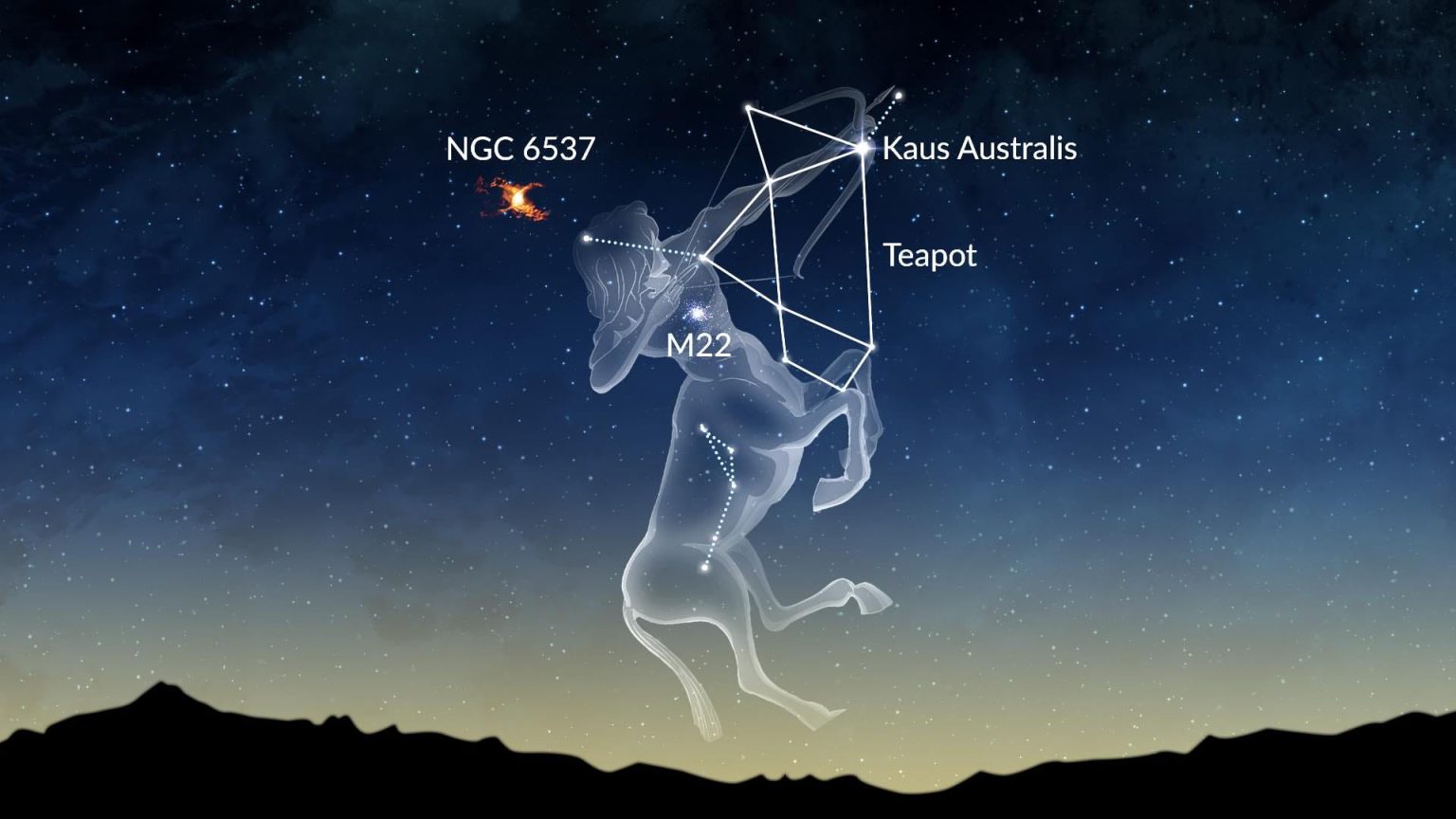
Sagittarius, who turned out to be a teapot
Astrologers claim that on December 22, the Sun will leave the constellation Sagittarius and enter Capricorn. As always, astronomers disagree with this because in reality, the Sun will only enter Capricorn on the 18th of this month. It can be stated that, at least in this case, there will be several days when the statements of those who try to predict human destiny by the stars will coincide with what can actually be seen in the sky.
In general, there are a number of reasons for the discrepancy between astronomers’ and astrologers’ ideas about which constellation the Sun should be in at a given moment in time, the most important of which is the precession of the Earth’s axis, which the latter forget to take into account. You can read more about this and other aspects of the problem in this article.
In the case of Sagittarius, this dispute is particularly relevant because it is in this constellation that the winter solstice point is currently located (for the northern hemisphere; for the southern hemisphere, it is the summer solstice). However, astrologers continue to argue that it is located in Capricorn.
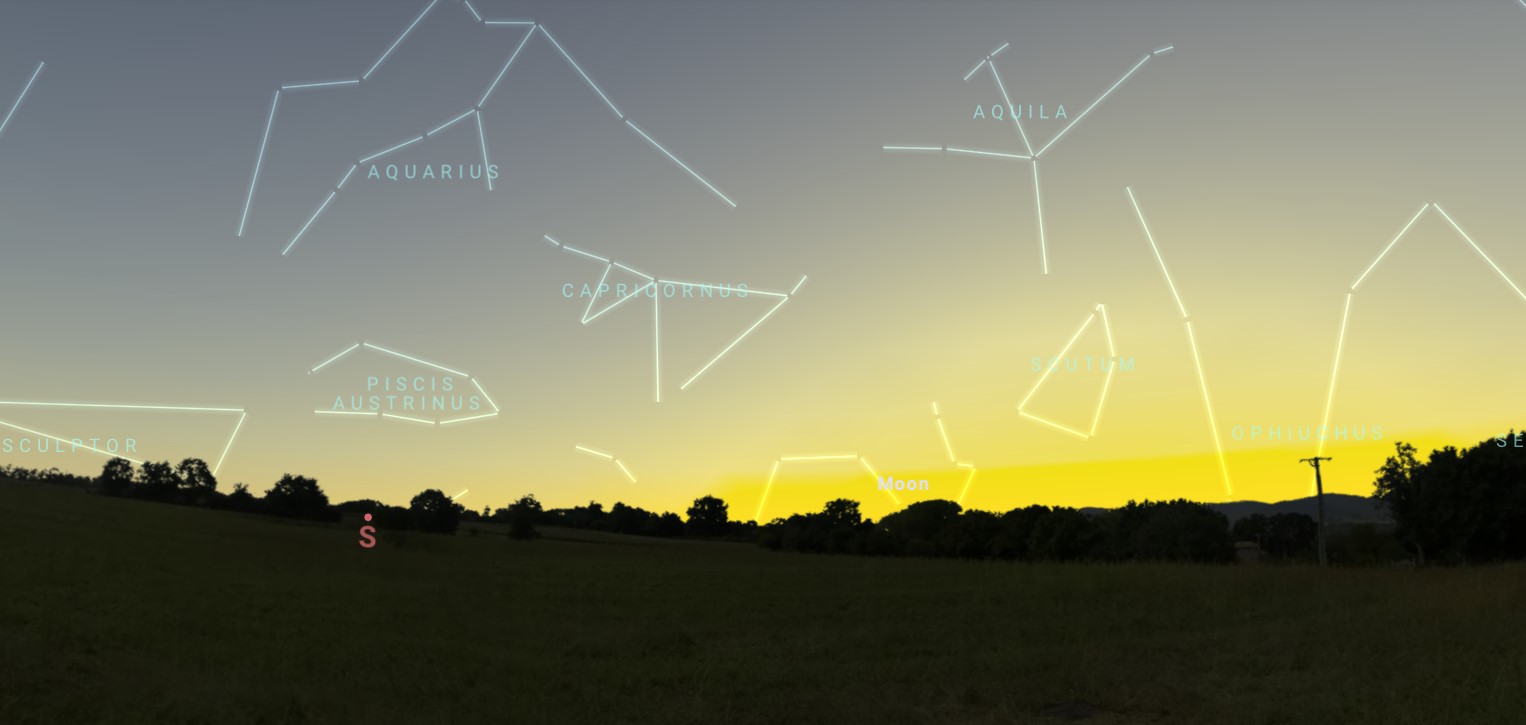
To prove them wrong, all you need to do is go outside on the evening of December 21, right after the sun sets and the longest night of the year begins, to a place with an open western horizon and see for yourself that Capricorn is still hanging above it, while Sagittarius has already gone to rest with our sun.
In general, winter is the worst time to observe the constellation Sagittarius. A much better option is to look for it in the sky in summer. To do this, start with Alpha Scorpii, Antares. At this time, this bright star hangs above the southern horizon. From it, follow the chain of stars that form the body of the celestial arthropod and find its tail. Sagittarius will be located next to it.
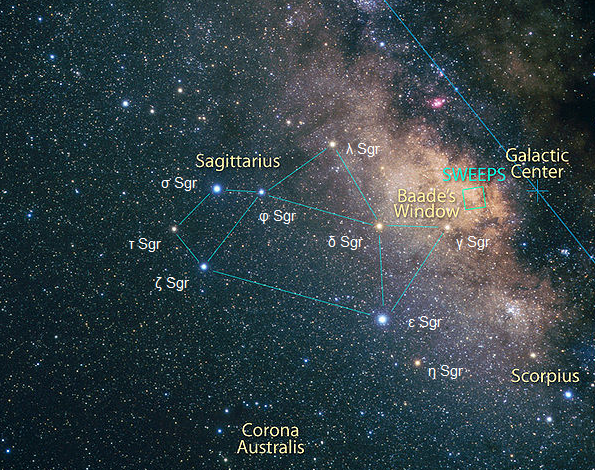
But here you may be in for quite a surprise. The fact is that Sagittarius is usually depicted on star charts as a centaur holding a bow. But in reality, if you go to the end of the scorpion’s tail, you will find something resembling a teapot next to it.
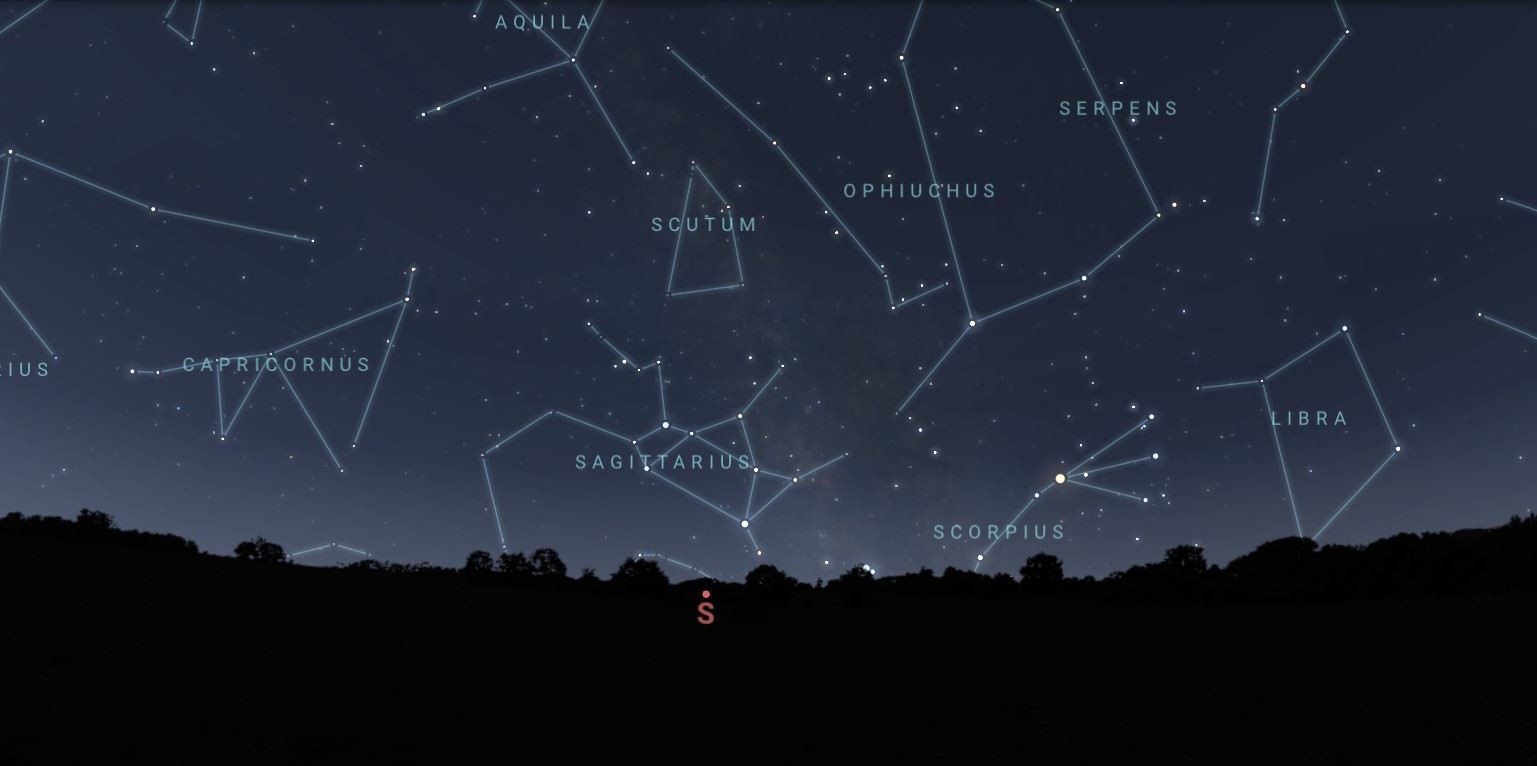
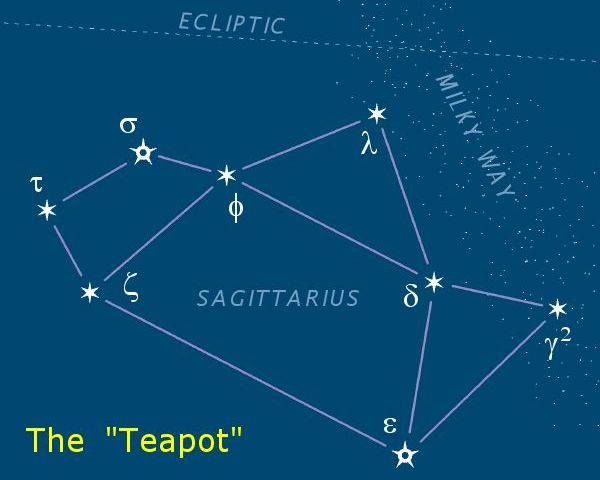
At least, the handle, spout, and lid in this group of stars are fairly easy to guess. In fact, this asterism is called the Teapot. There is another one in Sagittarius called Terebellum, but the rest of the stars in the constellation are much dimmer, and you need a lot of imagination to see the same figure with a bow in it.
Myths about Sagittarius
The constellation Sagittarius has been known since ancient times. More precisely, even the ancient Greeks inherited it from the Babylonians. The latter saw in this group of stars a figure with a human torso and four legs. It was associated with Nergal, a very strange god about whom not many legends have survived to this day.
In these myths, he is mainly portrayed as a cruel deity who truly enjoys shooting at them with his bow, bringing misfortune and suffering. It was Nergal who was responsible for wars among the Babylonians and was associated with the unbearable summer heat.
In ancient Greek mythology, there was a whole tribe of half-human, half-horse creatures called centaurs. And they decided that they saw one of them named Krotos. Not many legends about him have survived. Those that do exist say that he lived with the muses and was the inventor of applause.
Another Greek legend links Sagittarius with another mythical centaur, Chiron. However, he, the inventor of astronomy and teacher of Heracles, is much more often associated with another celestial figure, Centaurus.
The brightest stars
Theoretically, the brightest star in each constellation should be its Alpha. In practice, this principle is often violated, and in the case of Sagittarius, its Alpha is not even among the ten brightest stars.
The three most prominent stars in the constellation Sagittarius – Epsilon, Sigma, and Zeta – are part of the Teapot. The first of these, also known as Caudus Australis, meaning “southern part of the bow,” has a visible magnitude of 1.79. It is actually a double star system, located 145 light-years away from us.
The main component of the system is a hot blue star, whose mass is 3.8 times greater than that of the Sun. It rotates so quickly that it appears compressed: its polar radius is 6 times greater than that of our star, and its equatorial radius is 8.8 times greater. The second element of the system revolves around the main star at a distance of 106 AU from it. It is a yellow dwarf with a mass of 95% and a radius of 98% of the Sun.
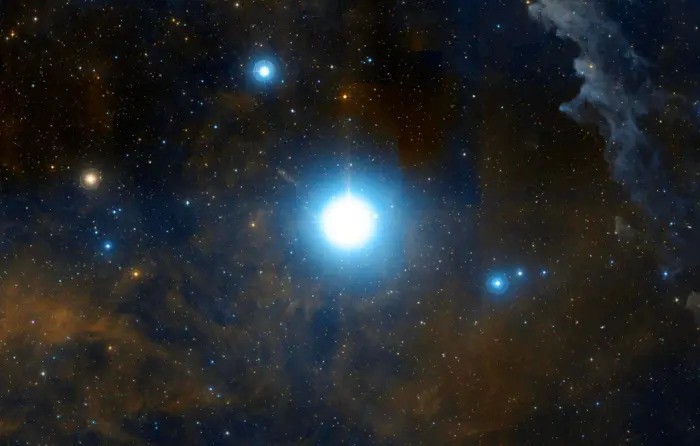
The second brightest star in Sagittarius is Sigma Sagittarii, also known as Nunki. This name comes from the Babylonians, making it one of the oldest names currently used for a specific star. It is located 228 light-years away from us and is one of the closest supernova candidates to the Sun.
In fact, this is not a single star, but a pair of blue stars with a surface temperature of 18,000 K. The mass of one of them is 6.5 times greater than that of the Sun, and the other is 6.3 times greater. They orbit each other at a distance of only 0.6 AU, completing one revolution in 50 Earth days. It is expected that in 20 million years, both will begin to turn into red giants, and mass transfer will begin from the smaller to the larger, accelerating its evolution and eventually causing it to explode as a supernova.
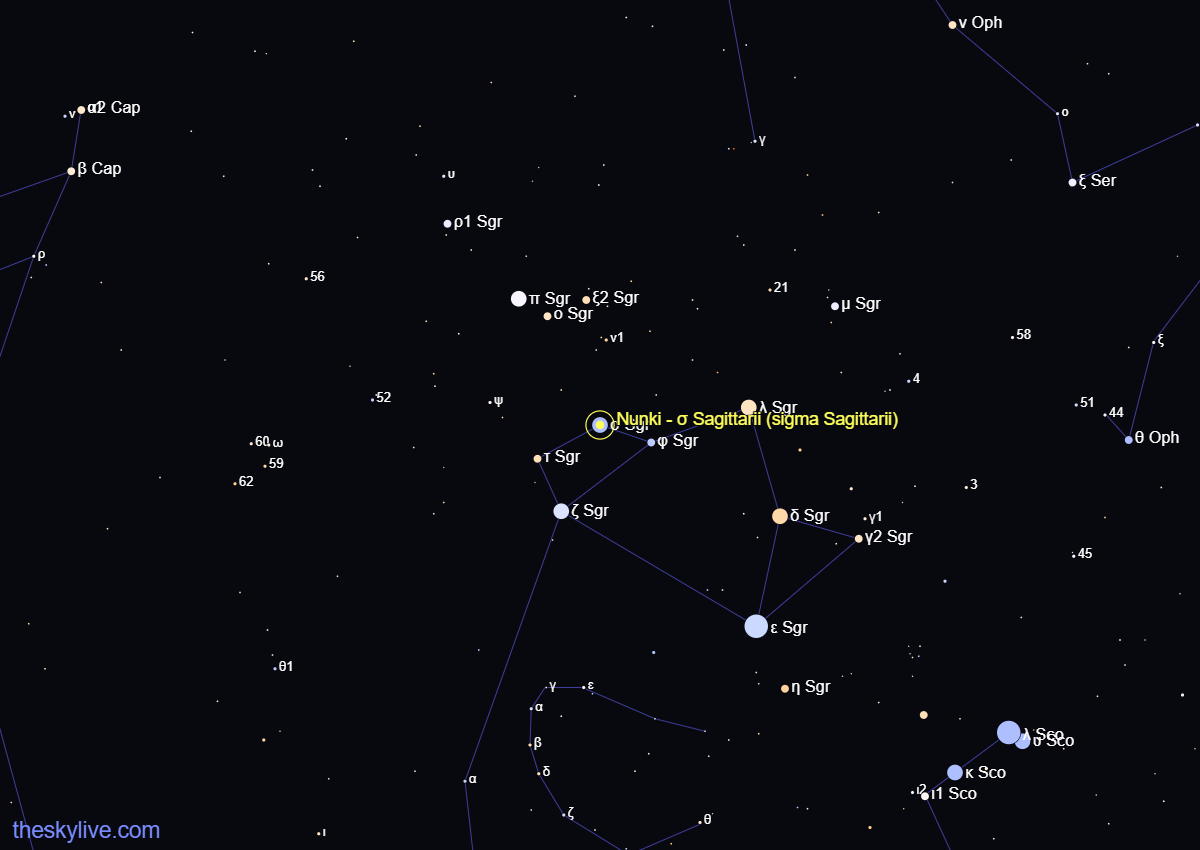
As for the third-brightest star, Zeta Sagittarii, or Ascella, it is a multiple-star system. At its center are two white stars with masses 1.8 and 1.9 times greater than the Sun. They orbit at a distance of only 0.3 AU from each other. Around them, at a distance of 13 AU and with a period of 21 Earth years, another white star with a mass of 2.03 times that of the Sun revolves.
The nearest stars
As for the stars closest to us in the constellation Sagittarius, there are not that many of them. First and foremost is the red dwarf Ross 154, located 9.69 light-years away from us. It has 17% of the Sun’s mass and 20% of its radius. No planets have been discovered yet, but this star belongs to the UV Ceti type of variable stars, which means that powerful explosions regularly occur on its surface.
The second closest star in Sagittarius is Gliese 783. It is a binary system located 19.9 light-years away from us, although it is expected that in 40,000 years it will approach us to a distance of only 6.7 light-years.
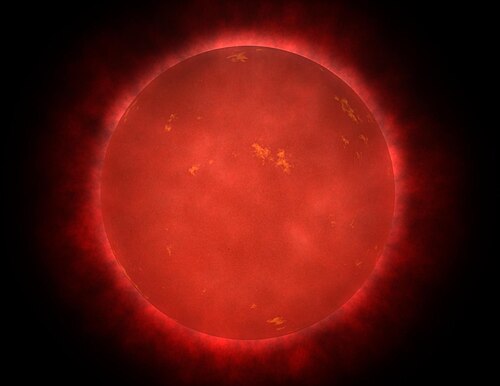
This is a very old system consisting of an orange and red dwarf, the distance between which is 43 AU, which is approximately the same as the distance from the Sun to Pluto. The first has a mass of 82% of the Sun’s, and the second has a mass of 20%. The age of this pair is 10 billion years.
The third most distant star from us is HD 172051. It is located 42 light-years away. It is almost an exact twin of our sun, not only in terms of mass and radius, but also in terms of age. However, no planets have been discovered around it.
Center of the Galaxy
However, the most interesting object in the constellation Sagittarius is not a star at all. It is in this direction that the center of the Milky Way galaxy is located. To be precise, it is located to the right of the Teapot, where the boundaries of Sagittarius, Scorpio, and Ophiuchus converge. In this place, the Milky Way is especially bright, but several dark clouds cross it. This is called the Great Sagittarius Star Cloud and is sometimes compared to steam escaping from his nose.

It is in them that the center of our Galaxy is hidden. That is why it was first discovered as the radio source Sagittarius A. Then it was divided into Sagittarius A East, which turned out to be the remnant of a supernova, and Sagittarius A West, which is a complex of stars and gas-dust nebulae. And at its very center is what our entire star system revolves around – the supermassive black hole Sagittarius A*. Many interesting things are happening around it, and you can read about them in this article.
Other interesting galactic objects
The constellation Sagittarius is extremely rich in various clusters. In addition to the Great Sagittarius Star Cloud, Sagittarius also has a Small Sagittarius Star Cloud, known as M24. This is a rather complex object, most of whose light is explained by the fact that it is a “window” in the dark gas and dust clouds that hide the center of the galaxy from us. If it were not for them, the entire Sagittarius-Scorpius region would shine like half the full Moon. As it is, we see only this small piece, which allows us to see how many stars there really are in the center of the Milky Way.
However, this “window” alone does not explain the brightness of M24. It also includes the scattered cluster NGC 6603 and a pair of planetary nebulae.
There are several other objects located very close to M24. To the west of it is another star cluster, M23, which is 2,150 light-years away. To the east is the open cluster M25, which contains the giant star U Sagittarii, a variable star known as a Cepheid.
North of the Small Sagittarius Star Cloud is another scattered star cluster, M18, and next to it are two nebulae: M17 or Omega and M16 or Eagle. The latter is known for being a star-forming region, part of which is captured in the Hubble Space Telescope image “Pillars of Creation.”
South of M24, there are three more objects from the Messier catalog: the open cluster M21 and a pair of nebulae: M20 (the Trifid Nebula) and M8 (the Lagoon Nebula). Both are regions of intense star formation.
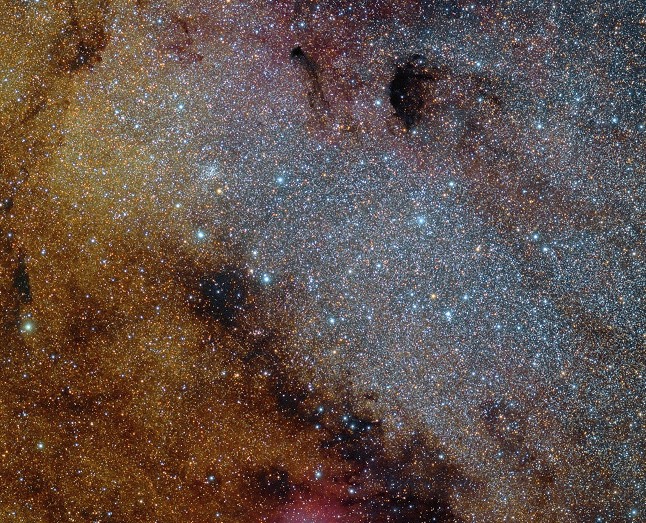
Sagittarius also contains the planetary nebula NGC 6445 and a pair of bright globular clusters, M22 and M28, which are accessible even to large amateur telescopes.
Extragalactic objects
Sagittarius also contains several interesting objects that are located outside our Solar System. First and foremost is the Sagittarius Dwarf Spheroidal Galaxy. It is the closest galaxy to the Milky Way and Earth.
This satellite of the Milky Way is 70,000 light-years away from us, and 50,000 light-years away from the black hole Sagittarius A*. This is comparable to the radius of the Galaxy, but in fact, this system, whose mass is 400 million times greater than that of the Sun, is located above the plane of the Galaxy and on the opposite side of the Solar System.
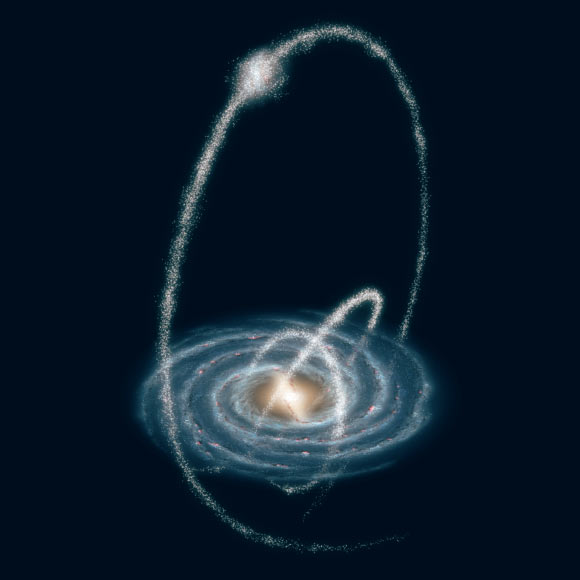
The galaxy in Sagittarius revolves around the Milky Way, and the tidal forces of the latter are destroying it, turning it into a ribbon of gas and stars. This process began about 900 million years ago and will end in the destruction of this small star system in the future.
However, the Sagittarius Dwarf Spheroidal Galaxy should not be confused with the dwarf irregular galaxy in Sagittarius. It is also a small member of the Local Group, but it is distant from the Milky Way and is not its companion.
Another interesting system located in Sagittarius, but outside the Milky Way, is NGC 6822, or Barnard’s Galaxy. It is located 1.63 million light-years away from us and really resembles an irregularly shaped cloud. At one time, it played an important role in determining the scale of the universe. In 1925, Edwin Hubble studied the Cepheids that make up the galaxy and proved that it is located far beyond the Milky Way. This means that the entire universe is not limited to it.

