

Scientists used X-rays to study what is happening to the Earth’s magnetic field far out in space. They concluded that its broken power lines quickly reconnected there.
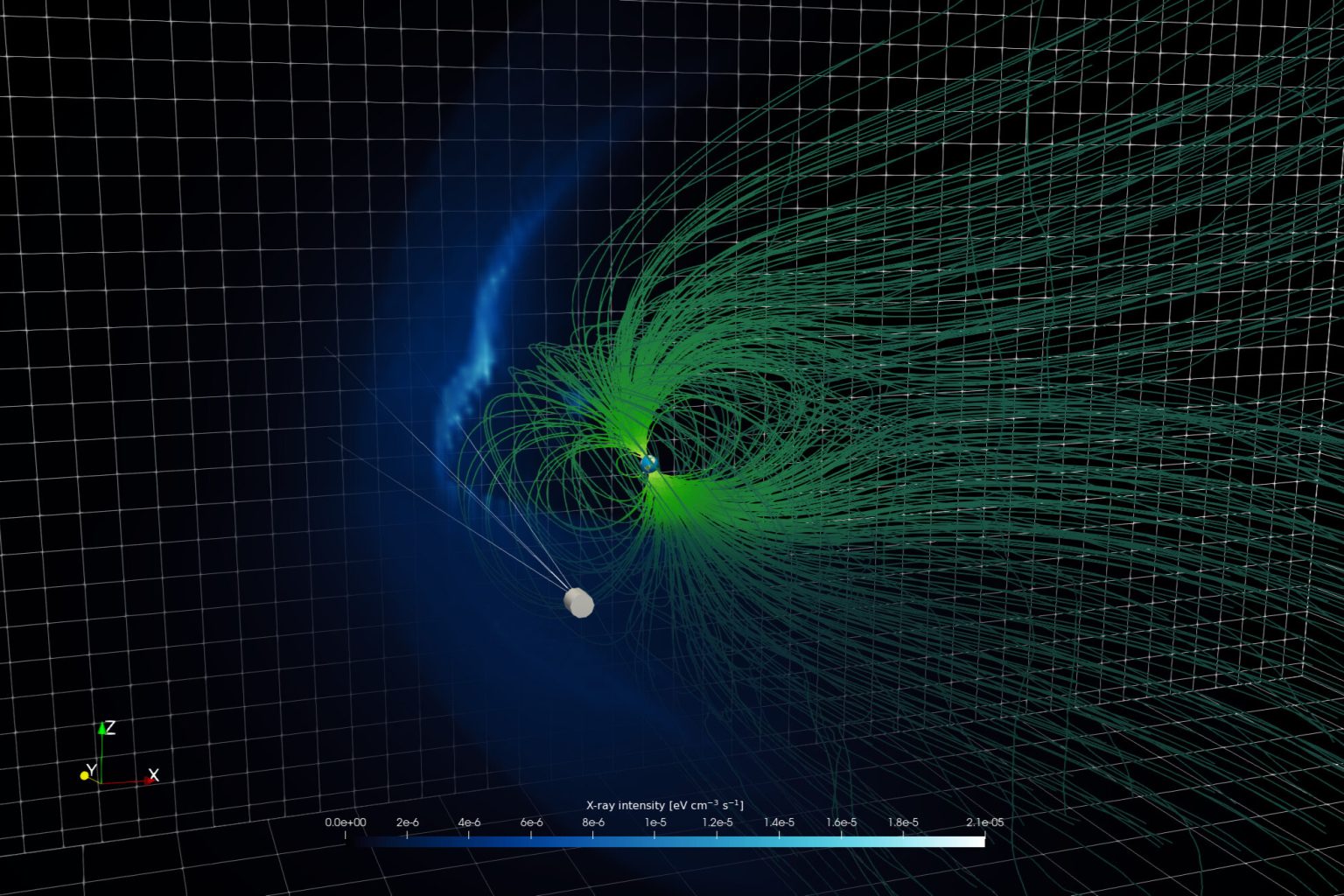
Reconnection processes in the Earth’s magnetosphere
The Earth’s magnetosphere acts as a protective shield, deflecting the solar wind — a stream of charged particles constantly flowing from the Sun to our planet. This magnetic barrier protects our atmosphere and the technologies we increasingly depend on in near-Earth space, such as communications satellites.
However, the magnetosphere is not impenetrable, as a fundamental process called “magnetic reconnection” can temporarily remove this barrier during intense solar winds and cause strong energy fluctuations in near-Earth space. As human activity in this region increases, understanding and predicting such space weather becomes critically important.
The key to understanding these disturbances lies in measuring the so-called reconnection rate, which quantitatively assesses the energy efficiency of magnetic reconnection processes. For decades, scientists have attempted to measure this speed using various methods, including spacecraft flying through reconnection zones and observing solar flares using remote imaging.
However, these traditional approaches only provide local images of the magnetic reconnection process or are limited to specific, often unstable conditions. Obtaining a comprehensive and consistent picture that bridges the gap between local and global reconnection rates remains a challenging task.
A new approach to studying the Earth’s magnetic field
Against this backdrop, a research team led by Associate Professor Yosuke Matsumoto of the Institute for Advanced Academic Research at Chiba University (Japan) is testing an innovative approach using soft X-ray imaging to measure reconnection rates.
Soft X-rays are produced by the exchange of charges between heavy ions in the solar wind and neutral hydrogen atoms originating from Earth. In this study, scientists propose using soft X-ray radiation, which is naturally emitted during the interaction of solar wind particles with the boundaries of the magnetosphere, to remotely measure reconnection rates in much larger regions than previously possible.
The team conducted advanced computer simulations on the Fugaku supercomputer, combining high-resolution global magnetohydrodynamic simulations of the Earth’s magnetosphere with a model of soft X-ray emission. Based on simulations, they analyzed how X-ray radiation associated with reconnection can be observed from a satellite located at the distance of the Moon under conditions of intense solar wind. This observation point roughly corresponds to the observation point of a future X-ray imaging satellite, such as GEO-X, which is scheduled to be launched in the near future.
Measurement of magnetic reconnection rate
Analyzing the simulation results, scientists discovered that bright X-ray emissions form clear angular patterns that directly reflect the structure of the magnetic field around the reconnection zones. After measuring the opening angle of these bright areas, they calculated that the global reconnection rate is 0.13, which is almost identical to theoretical predictions and preliminary laboratory measurements.
Consequently, the results show that the geometry of bright X-ray objects correlates with the reconnection rate, suggesting a new method for estimating this parameter.
Significance of the new measurement method
Thanks to this new method of measuring and understanding magnetic reconnection, this research directly contributes to improving space weather forecasting. The ability to predict how solar activity affects near-Earth space is vital for protecting astronauts and ensuring the reliability of communications systems and space missions, especially in the context of potentially destructive events such as magnetic storms.
As humanity prepares for an era of space exploration and commercial space activities, this new method could pave the way for accurate space weather forecasts, helping to ensure the safety and success of our endeavors beyond Earth’s atmosphere.
According to phys.org

