

Einstein cross is a phenomenon that occurs due to the gravitational lensing effect, when additional images of a distant object appear. Usually, there are four of them, but this time a fifth one appeared. And it was this fifth image that allowed us to learn more about dark matter.
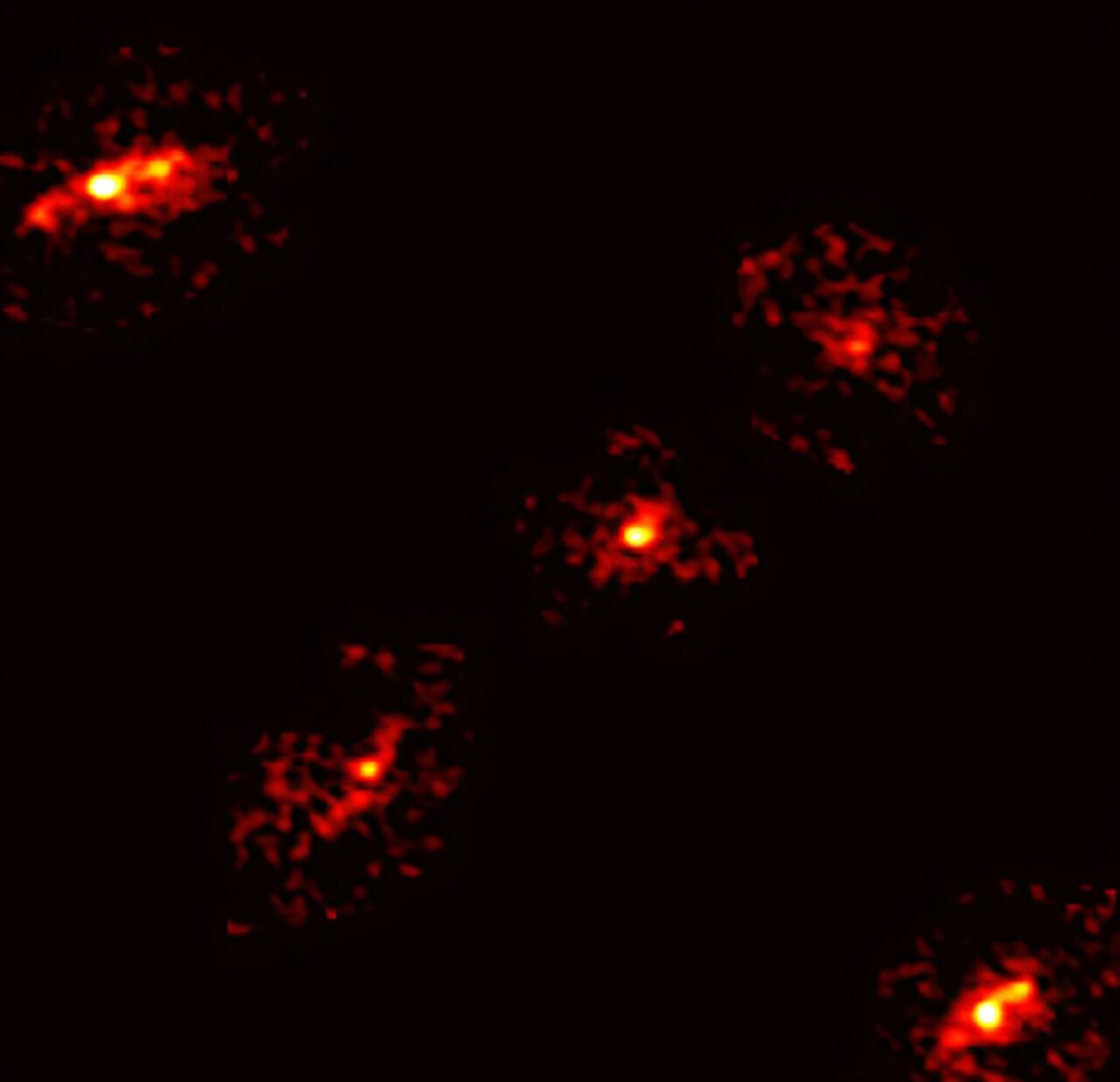
Impossible image
A recent image of galaxies obtained by the Hubble Space Telescope greatly surprised scientists: they say that this cannot be true.
An “Einstein Cross” is a rarely seen cosmic configuration in which the light from a distant galaxy is bent by the gravity of galaxies in front of it, creating four images. But the extra image in this Einstein Cross pointed to “something unusual,” which turned out to be a massive, hidden halo of dark matter. The existence of this invisible structure could only be inferred through careful computer modeling and analysis.
The discovery, made by an international team that includes Keeton, Baker, and Rutgers graduate student Lana Eid, has now been published in The Astrophysical Journal.
Dark matter makes up most of the matter in the universe, but it can’t be seen directly. “We only know it’s there because of how it affects the things we can see, like the way it bends light from distant galaxies,” said Baker, a Distinguished Professor in the Department of Physics and Astronomy in the School of Arts and Sciences and a co-author of the study. “This discovery gives us a rare chance to study that invisible structure in detail.”
Gravitational lens modeling
The first step toward that discovery was taken in France. The team was studying a distant, dusty galaxy called HerS-3. Using NOEMA and the Atacama Large Millimeter/submillimeter Array (ALMA) in Chile, they saw that the light from HerS-3 split into five rather than four images. At first, they thought it might be a glitch in the data. But the fifth image wouldn’t go away.
Computer modeling of the gravitational lens by Keeton and Eid showed that the four visible foreground galaxies causing the gravitational bending couldn’t explain the details of the five-image pattern. Only with the addition of a large, invisible mass, in this case, a dark matter halo, could the model match the observations.
“We tried every reasonable configuration using just the visible galaxies, and none of them worked,” said Keeton, also a professor in the Department of Physics and Astronomy and a co-author of the study. “The only way to make the math and the physics line up was to add a dark matter halo. That’s the power of modeling. It helps reveal what you can’t see.”
Natural laboratory
The unusual configuration doesn’t just look cool: the scientists said it’s scientifically valuable. The lensing effect magnifies the background galaxy, allowing astronomers to study its structure in greater detail than usual. It also offers a rare chance to learn about the dark matter that surrounds the foreground galaxies.
The team has even predicted that more features, such as outflowing gas from the galaxy, could be visible in future observations. If those predictions are confirmed, it would be a powerful validation of their models. If not, it would still teach them something new.
“This is a falsifiable prediction,” Keeton said. “If we look and don’t see it, we’ll have to go back to the drawing board. That’s how science works.”
Baker said the discovery was critically enabled by both international collaboration and U.S. federal support for science. “ALMA in Chile and the Very Large Array (VLA) in New Mexico are supported by the National Science Foundation, and the Hubble Space Telescope is supported by NASA; all played vital roles in this work,” he said. “We hope they will continue to enable such discoveries well into the future.”
Provided by: phys.org

