

Imagine the hero of the movie “U Are the Universe” looking at the starry sky and suddenly feeling that the universe is not something distant and abstract, but a living mechanism in which everything is connected. Spacecraft in real life also communicate with planets – but in the language of physics. One of the most sophisticated techniques is the gravitational maneuver: it allows probes to fly to distant worlds as if the universe itself were pushing them. Next, we will examine what this trick is, why it is needed, and how it can be explained almost as simply as scenes from a favorite movie.
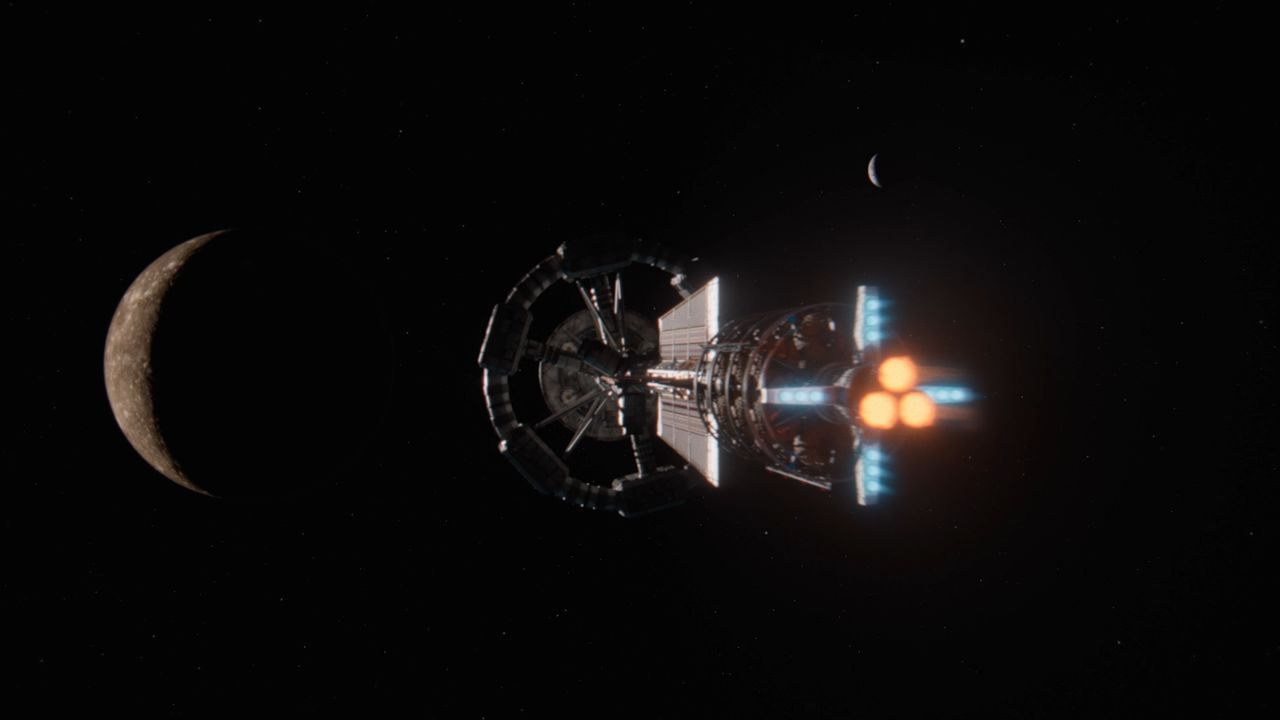
Scenes from science fiction films, where a spaceship accelerates around a planet, are not so fantastical after all. Gravity assist (also known as the slingshot effect) is a real trick that allows you to change the speed or direction of a spacecraft using the planet’s gravity without using fuel. In simple terms, a space probe flies close to a massive planet so that its gravity attracts the probe and bends its trajectory. As a result, the probe can either accelerate or decelerate – as if the planet gave it a push or, conversely, held it back. This maneuver allows the spacecraft to gain additional speed (or shed excess speed) and significantly save fuel when traveling to other worlds. It is not for nothing that this is called the slingshot effect: the planet actually acts as a giant slingshot that accelerates the spacecraft.
Why is it necessary? (Examples of missions)
Why resort to such tricks? The fact is that even the most powerful rockets have limited speed, and distances in space are simply immeasurable. Without gravitational tricks, flights to distant planets would take many years or even decades, or would require an incredible amount of fuel. Adding more fuel is also problematic – fuel has mass, which also needs to be accelerated, requiring even more fuel, and so on. This dilemma quickly makes direct flight unprofitable. Instead, gravitational maneuvering provides a free boost or deceleration, reducing travel time and allowing lighter rockets to reach destinations that would otherwise be inaccessible.
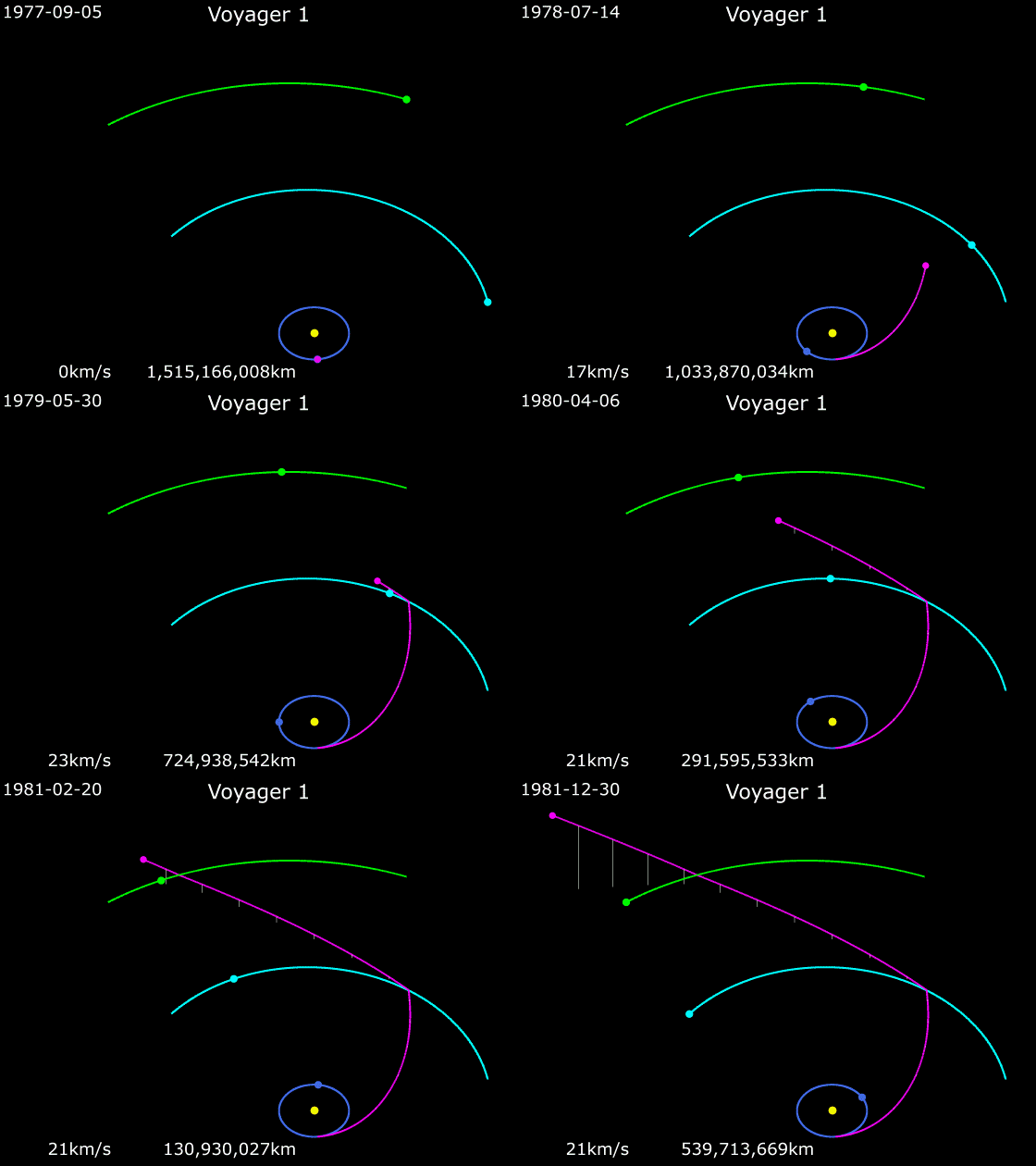
Examples? Almost all famous interplanetary missions have used gravitational maneuvers. For example, the Voyager 1 and 2 space probes (launched in 1977) were able to make an unprecedented tour of the Solar System – flying successively past Jupiter, Saturn, Uranus, and Neptune – thanks to a calculated chain of gravitational assists. They took advantage of a rare alignment of the planets (which occurs once every 175 years!) and used the gravity of each gas giant in turn to gain enough speed to fly to the next planet.
Another example is the Cassini spacecraft, launched in 1997 to Saturn. It was the size of a school bus and weighed several tons; a direct flight to Saturn on the rockets of that time would have taken practically forever. Therefore, engineers resorted to a series of gravitational maneuvers: first, they flew around Venus twice, then Earth, and later Jupiter – each time borrowing a little speed from the planets. This gave the probe the necessary acceleration, and as a result, Cassini successfully reached Saturn in 2004, saving years.
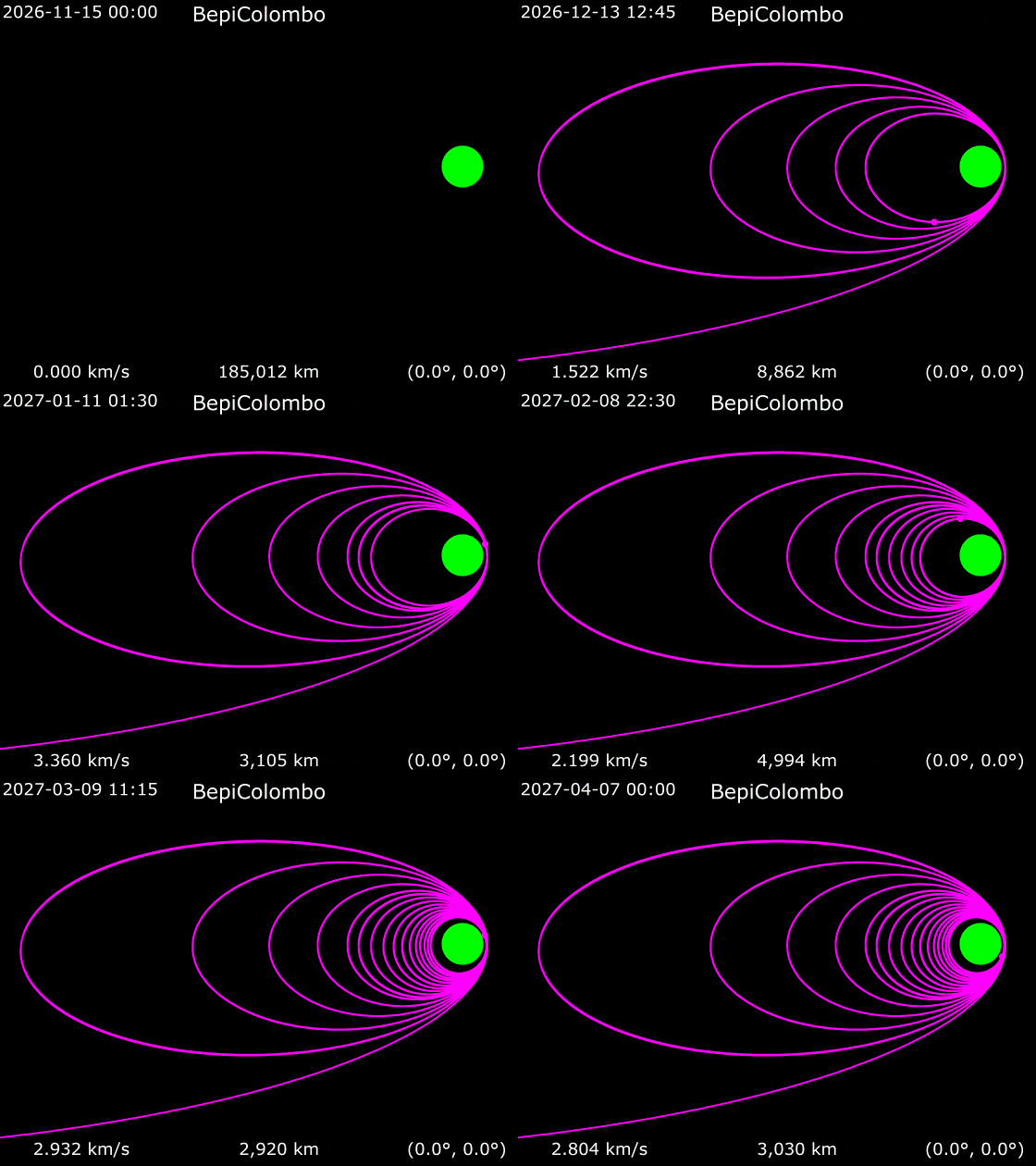
Gravity maneuvers are necessary not only for acceleration but also for deceleration. For example, in order for a spacecraft to enter Mercury’s orbit or approach the Sun, it must significantly reduce its speed (since Earth orbits the Sun at a speed of ~30 km/s, and everything launched from Earth also has this speed). Therefore, modern missions to the inner planets also perform several gravitational flybys. For example, the European probe BepiColombo planned nine gravitational maneuvers on its way to Mercury – one near Earth, two near Venus, and six near Mercury itself – to gradually slow down and enter the planet’s orbit. Without these flybys, the probe would simply not be able to slow down and would fly past Mercury. In 1970, the Apollo 13 spacecraft used a gravitational maneuver in an emergency: after an accident, the astronauts flew around the Moon on a free return trajectory, effectively using the Moon’s gravity as a slingshot to direct the ship back to Earth without additional fuel. This maneuver helped save the crew – gravity became the silent hero of a dramatic story.
Interestingly, the idea of a gravitational maneuver was first described in theory in 1918 by Ukrainian Yuri Kondratyuk. The maneuver was first used in practice by the Soviet probe Luna 3 in 1959, which orbited the Moon and photographed its far side.
How can we calculate this using a simple example?
Of course, accurately calculating the trajectory of a gravitational maneuver is a complex task of celestial mechanics, which is performed by a computer. But the principle can be understood intuitively through analogies. Imagine a game of billiards or a tennis ball and a train. You are standing on the platform and throw the ball at a speed of 30 km/h towards the locomotive rushing towards you at a speed of 50 km/h. For the train driver, the ball is flying at a speed of 80 km/h and bounces off the nose of the locomotive at a speed of 80 km/h. But for you, the observer on the ground, after bouncing, the ball will fly back at a speed of 130 km/h! It has gained speed, effectively adding the double speed of the train to its own speed.

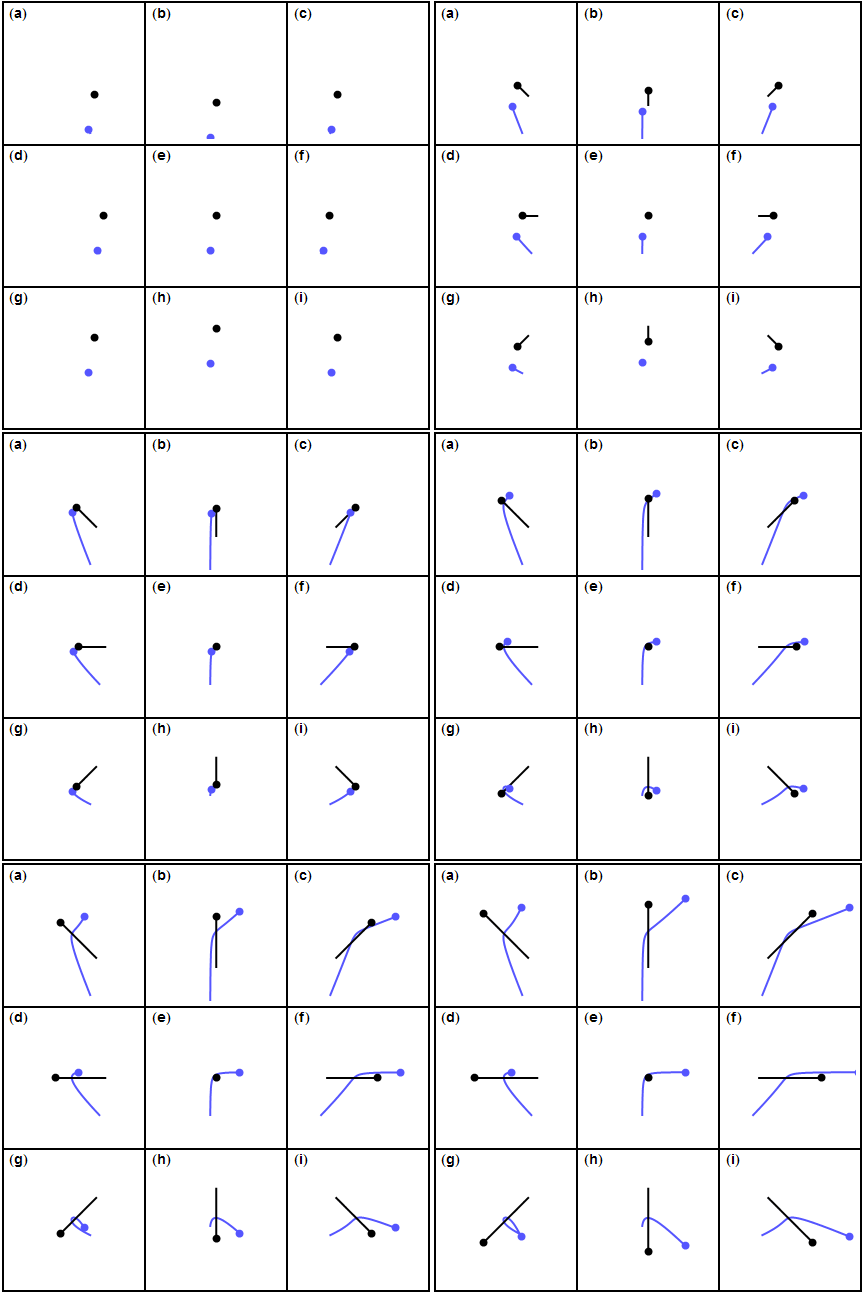
In space, the planet plays the role of the train, and the spacecraft plays the role of the ball. The probe approaches the planet and is attracted by its gravity. Like a ball that accelerates as it falls, the spacecraft gains speed as it falls toward the planet and then slows down as it flies away from it. Relative to the planet itself, the speed of the spacecraft before and after the maneuver will be the same – after all, it essentially “entered” and “exited” its gravitational field with the same energy. In our train example, it is like a ball that approached and rebounded at the same 80 km/h relative to the locomotive. The trick is that the planet itself moves in orbit around the Sun! Therefore, for an outside observer (the Sun), the probe receives an additional impulse after flying by – it flies forward with the planet, and its speed relative to the Sun increases. If the spacecraft flies behind the planet – that is, in the direction of its movement – the planet’s gravity attracts it and bends its trajectory so that the probe overtakes the planet. In essence, it jumps on the “space express” and, then breaking away from the planet, rushes forward faster than before the maneuver. Conversely, if you fly in front of the planet (towards its movement), you can take away some of the spacecraft’s speed by slowing down its flight.
And how much speed can be gained? It depends on the mass and speed of the planet and the trajectory of the approach. The greatest gain is achieved when flying past a very massive and fast planet. For example, Jupiter orbits the Sun at a speed of over 13 km/s. If a probe passes behind Jupiter along its orbit, it can gain several kilometers per second of speed. Thanks to such a maneuver near Jupiter, the famous Voyager 1 increased its speed by about 10 km/s, and after the next maneuver near Saturn, by another 5 km/s. This is a huge bonus, equivalent to the consumption of tons of rocket fuel! For comparison, 10 km/s is about 36,000 km/h, meaning that in one hour, the spacecraft could fly the distance from Earth to the Moon.
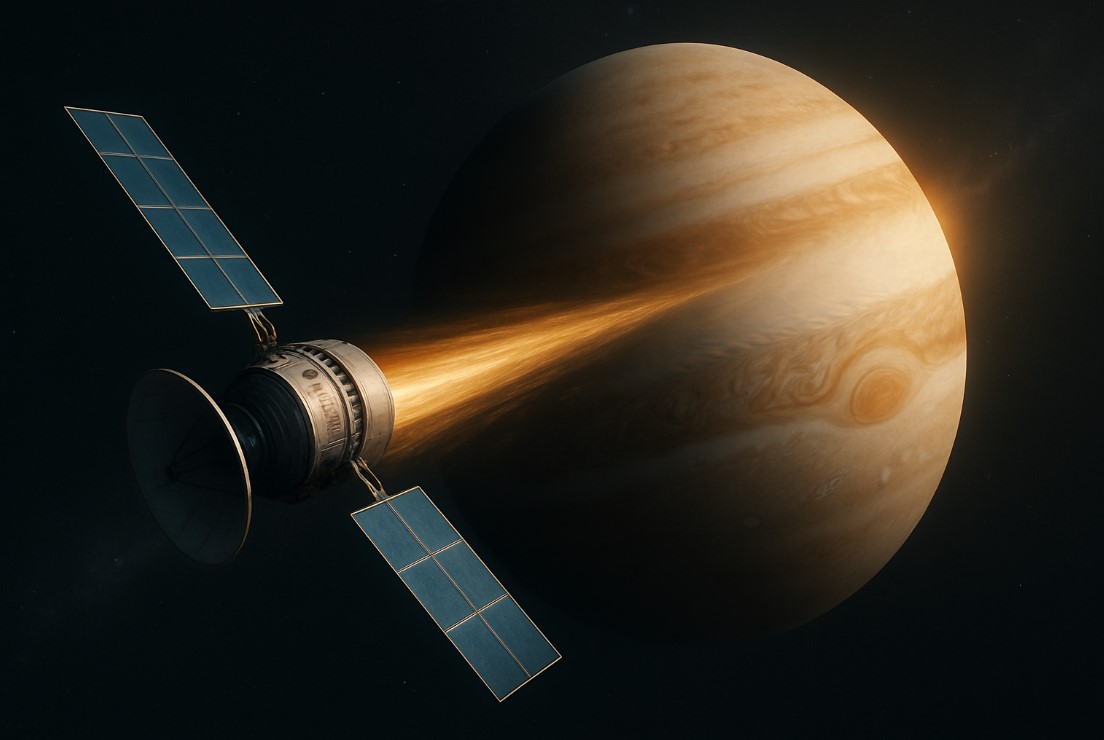
Where does this “free” energy come from? Obviously, we are not violating any laws of physics – the spacecraft simply slows down the planet a little, taking some of its kinetic energy for itself. According to the law of conservation of momentum, the planet loses exactly as much as the probe gains. But since the planet’s mass is enormous compared to the mass of the spacecraft, the planet slows down microscopically, so little that it is impossible to notice. For example, Jupiter is about a million billion times more massive than a typical probe, so even after several gravitational maneuvers, its speed will decrease by a mere fraction of a millimeter per second. For a spacecraft, however, the gain in speed is enormous and opens up new horizons. It is thanks to such calculated gravitational slingshots that humanity has sent probes to the farthest corners of the Solar System – and did so using the laws of celestial mechanics, without any science fiction.
A few figures
1. How much speed is needed to reach Jupiter?
Let’s imagine the simplest option – a flight along the Gomanov trajectory from Earth’s orbit (1 AU) to Jupiter’s orbit (≈5.2 AU).
Earth’s speed around the Sun: v_⊕ ≈ 29.8 km/s
To move to an elliptical orbit that touches Jupiter’s orbit, the probe in Earth’s orbit must have a higher speed – approximately: v_transfer ≈ 38.6 km/s
The difference between them is what the rocket or maneuver must provide:
Δv_required = v_transfer −v⊕ ≈ 38.6−29.8 ≈ 8.8 km/s
In other words, to simply “jump” from Earth’s orbit onto a trajectory to Jupiter, we need about 8.8 km/s of additional speed in the heliocentric system. Without gravitational assistance, all this has to be done by a rocket, and that means enormous fuel consumption.
2. What does a gravity assist maneuver near a planet achieve?
Let’s consider a gravitational maneuver near Earth (or another planet) in simplified terms. There is a convenient basic estimate:
Δv_gravitational ≈ 2*V_p*sin(2/δ), where
- V_p – orbital velocity of the planet around the Sun,
- δ – the angle at which the trajectory of the spacecraft “bends” in the planet’s reference frame (angle of rotation).
For Earth: V_p ≈ 29.8 km/s
Let’s take a very modest maneuver, when the trajectory of the probe “bends” only by: δ ≈ 10°.
Then: Δv_gravitational ≈ 2*29.8 km/s*sin(10°/2)
sin (5°) ≈ 0.087
Δv_gravitational ≈ 2⋅29.8⋅0.087 ≈ 5.2 km/s
That is, even a small flyby in terms of geometry, with a trajectory bend of about 10°, can give the probe an additional speed of ~5 km/s relative to the Sun.
3. How does this help the probe on its way to Jupiter?
We have already calculated that we need a total of: Δv_required ≈ 8.8 km/s
The gravitational maneuver gives: Δv_gravitational ≈ 5.2 km/s
Therefore, the rocket only needs to provide: Δv_rocket ≈ 8.8−5.2 ≈ 3.6 km/s
Instead of providing all 8.8 km/s with fuel, we rely on the planet’s gravity, which gives us most of the speed we need for free. For engineers, this is a fantastic fuel savings, and therefore a cheaper launch or greater payload.
4. What does this mean for the spacecraft?
Let us assume that the mass of the spacecraft from the film “U Are the Universe” is equal to the mass of the ISS.
The International Space Station has a mass of approximately: m_ISS ≈ 420 tons = 420,000 kg.
Additional velocity from the gravitational maneuver: Δv ≈ 5.2 km/s = 5,200 m/s
Typical average velocity in a heliocentric orbit: v_average ≈ 35,000 m/s
We roughly estimate the additional kinetic energy that the ISS would receive during such a maneuver:
ΔE ≈ m_ISS*v_average*Δv
ΔE ≈ 420,000*35,000*5,200 ≈ 7.6×10^13 J.
To get a sense of the scale, let’s convert this into TNT equivalent. 1 kiloton of TNT ≈ 4.2*10^12 J.
(7.6*10^13)/(4.2*10^12) ≈18 kilotons of TNT.
In other words, a gravitational maneuver for an object with a mass like that of the ISS provides an energy gain comparable to the explosion of dozens of kilotons in TNT equivalent. And all this without a single drop of additional fuel, simply by taking a tiny fraction of energy from the planet’s orbital motion.
For the planet, however, the effect is negligible. According to the law of conservation of momentum: m_ISS*Δv ≈ M_⊕*ΔV_⊕
where M_⊕ ≈ 6×10^24 kg is the mass of the Earth. Therefore, ΔV_⊕ ≈ (m_ISS/M_⊕) *Δv ≈ 10^-16 m/s.
It is so small that even in billions of years, we would not be able to measure it. For the planet, such a ship is a feather, but for the ship itself, the gravitational maneuver would mean a giant free acceleration, enough to break out far beyond Jupiter’s orbit.
In the film “U Are the Universe,” the main character rushes through the void, clinging to a thin thread of connection with another person somewhere near Jupiter. He is almost alone with the universe, but at the same time, he constantly relies on the technologies and calculations that we have just discussed in simplified form. Gravity assist is precisely the invisible tool that allows such long-range travelers to fly to the outskirts of Jupiter and beyond, using planets as space power stations. The next time you watch science fiction and see a ship flying through the darkness, remember that behind these beautiful images lies very elegant physics that allows ships to glide almost without fuel on the gravitational waves of planets. And even if we are not yet traveling to Jupiter ourselves, understanding such simple principles brings us a little closer to the universe in which the heroes of the film live every day.



