

Recently, the whole world’s attention has once again turned to our natural satellite. The Moon, which for decades was considered only a temporary stop on the way to distant worlds, suddenly found itself at the epicenter of global economic and technological strategies. Previously, mining minerals on another planet was considered science fiction, but today it is becoming a real business plan in which various companies are already investing.
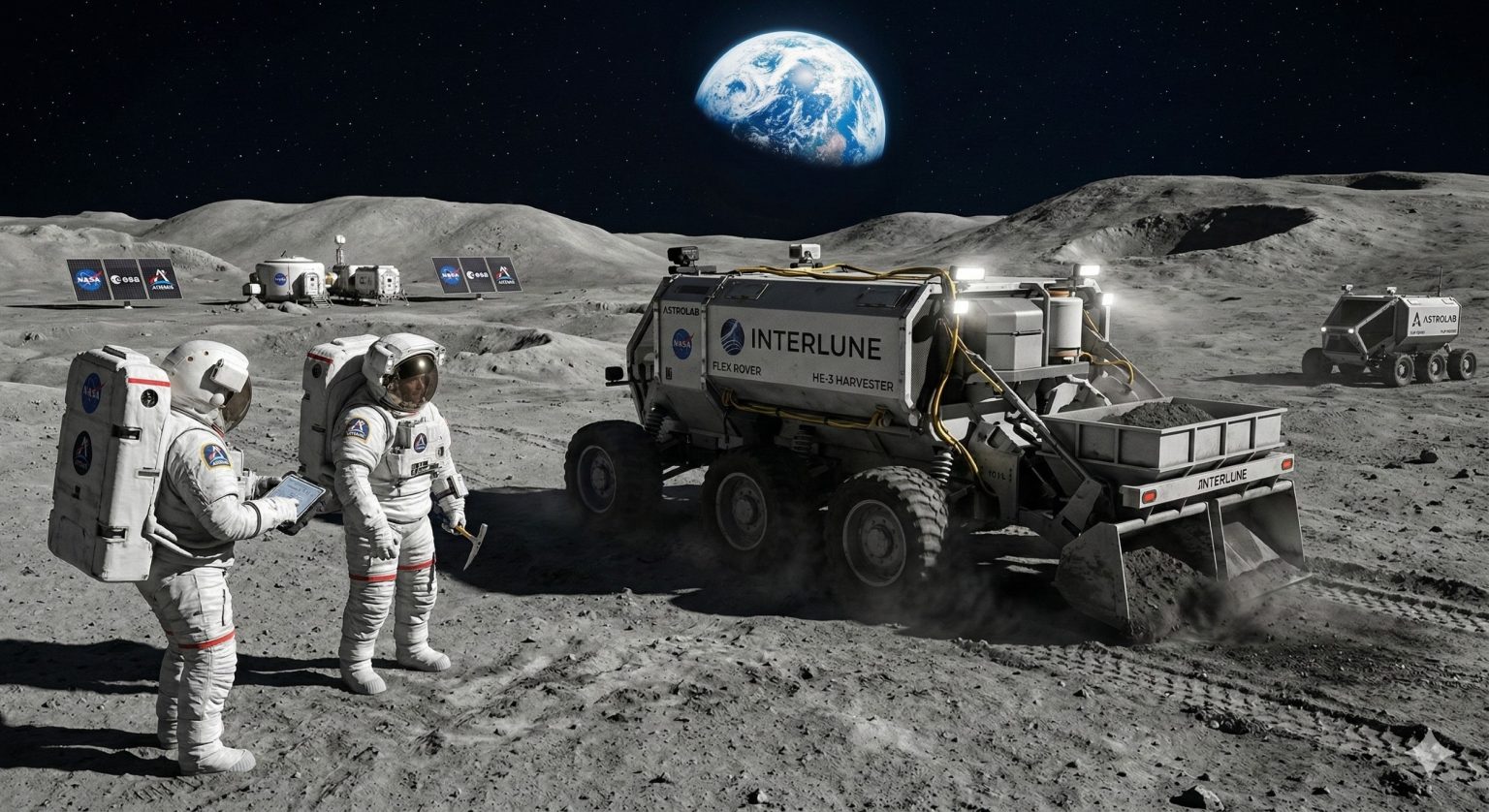
Over the past year, there has been a significant paradigm shift in space exploration. Elon Musk, whose ambitions to colonize Mars have dominated media headlines for decades, has shifted his focus somewhat. In the near term, SpaceX is increasingly focusing on activities on the lunar surface. The idea is simple but ingenious: use local resources (regolith, ice, and minerals) to build large satellites and bases directly in space, instead of overcoming Earth’s gravity with heavy cargo each time.
A similar shift has taken place within NASA. Whereas previously the focus was on the Gateway orbital station, which was to orbit the Moon, the agency is now increasingly talking about building stationary elements of the base directly on the surface. This “lunar alliance” between the state and private capital has created ideal conditions for the emergence of a new generation of startups.
Duet of dreamers
In March 2026, two ambitious lunar startups, Astrolab and Interlune, officially announced a strategic partnership. Their goal is not just research, but the creation of a full-fledged industrial infrastructure on the Moon.
Astrolab, led by Jarrett Matthews, is developing universal transport platforms (rovers) that are set to become the “workhorses” for NASA and commercial customers. Interlune, led by former Blue Origin president Rob Meyerson, has set itself an even more ambitious goal: to become the first company in the world to extract helium-3 on the Moon.
The fuel of the future and treasure in regolith
Why is helium-3 causing such a stir? This isotope is practically non-existent on Earth in its natural state. Humankind obtains it as a by-product of nuclear reactors or the decay of radioactive substances. However, it has been accumulating on the Moon for billions of years, carried there by solar wind.
Scientists consider helium-3 to be the ideal fuel for future thermonuclear reactors – it can provide clean energy without dangerous radioactive emissions. However, even before the advent of commercial fusion, this resource is critically important. It is indispensable in cryogenic technology and quantum computing, where cooling to temperatures close to absolute zero is required. Interlune already has preliminary contracts to sell thousands of liters of this gas. There is only one problem: it needs to be delivered from the Moon.
The evolution of lunar rovers
The companies’ collaboration will begin with a small but confident step – the FLIP (Flexible Logistics and Exploration) mission. This is a small rover, about the size of a go-kart, which is scheduled to be launched to the Moon at the end of this year aboard Astrobotic’s Griffin landing module.
FLIP will carry a multispectral camera from Interlune on board. Its task is to scan the lunar soil (regolith) and confirm the data on the concentration of helium-3, which scientists previously obtained only on the basis of samples from the Apollo program. This will be the first real “geological exploration” with a focus on industrial extraction.
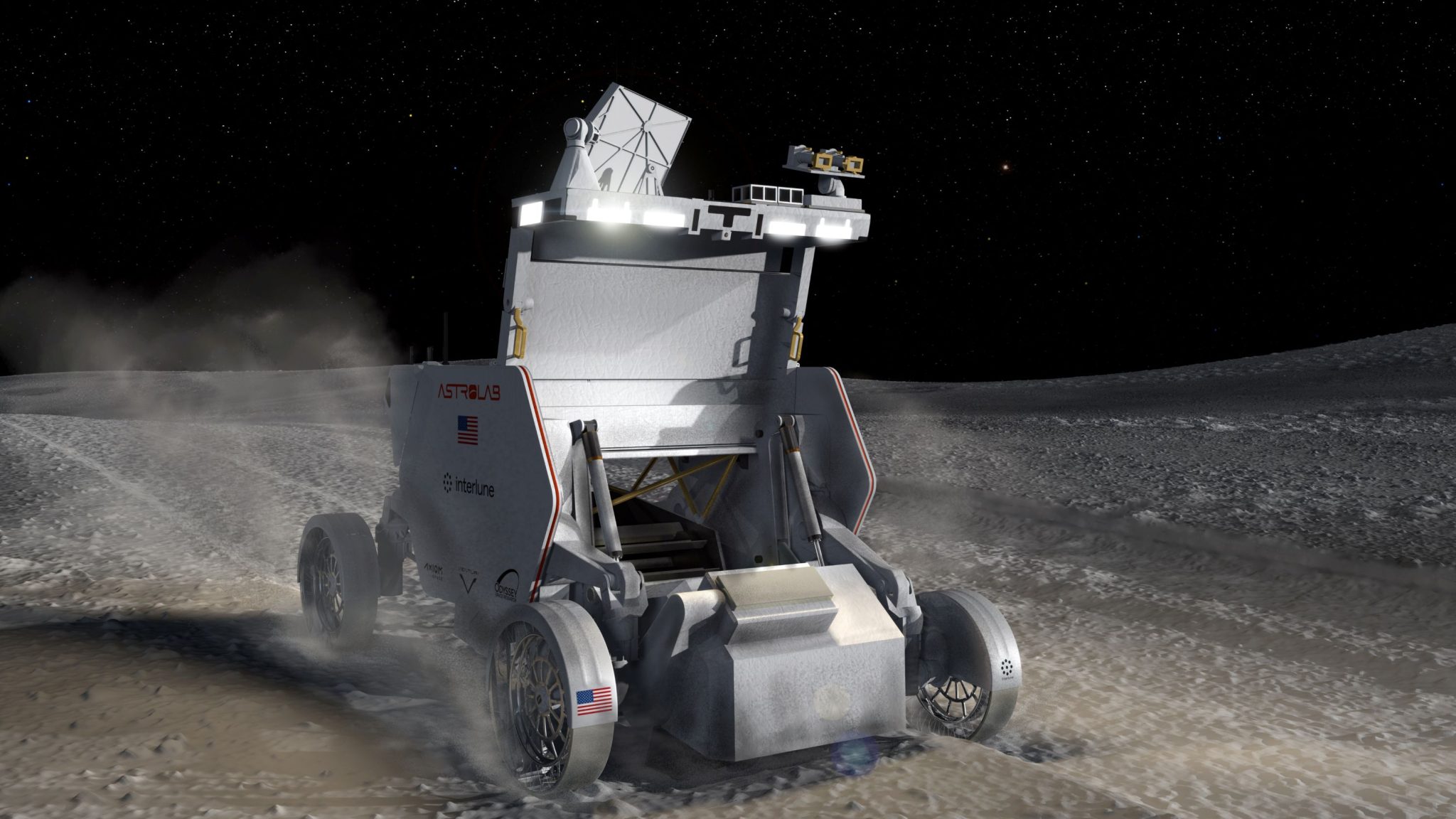
The next stage will be FLEX – a true giant among rovers. The size of a minivan, this rover has a unique horseshoe-shaped chassis. This design allows it to be the “Swiss Army knife” of space:
- Transport astronauts over long distances.
- Transport heavy equipment for base construction.
- Serve as a platform for the Interlune mobile harvester.
The versatility of FLEX lies in the fact that any payload can be placed under its body – from excavators to scientific laboratories.
Logistics and testing
The implementation of these plans is closely linked to the success of SpaceX Starship. The FLEX rover is expected to be part of one of Starship’s first unmanned missions to the Moon in 2027 or 2028. This will allow equipment of a size previously unimaginable to be delivered to the surface of the satellite.
In parallel with preparations for the flight, the companies have already begun ground tests. Prototype testing will take place at the new Space Institute at Texas A&M University in Houston. This facility, which is being built directly at the Johnson Space Center (NASA), will become the main testing ground for developing technologies for extracting resources in extraterrestrial conditions.
Why is this important for humanity?
The Astrolab and Interlune project is more than just another space mission. It marks the beginning of a transition from passive observation of space to active management of it. If humanity learns to extract energy and materials on the Moon, it will not only open the way to distant planets but also help solve energy and environmental problems on Earth itself.
Today, we are witnessing the birth of a new industry. Space harvesters are just around the corner, and the Moon seems ready to reveal its most precious secrets to those who dare to challenge the void.
We previously reported on how the prototype of a lunar excavator is ready to extract helium-3.
Provided by arstechnica.com

