

The Hubble mission support team has published a new image obtained by the space telescope. It shows a “tangled” spiral galaxy.
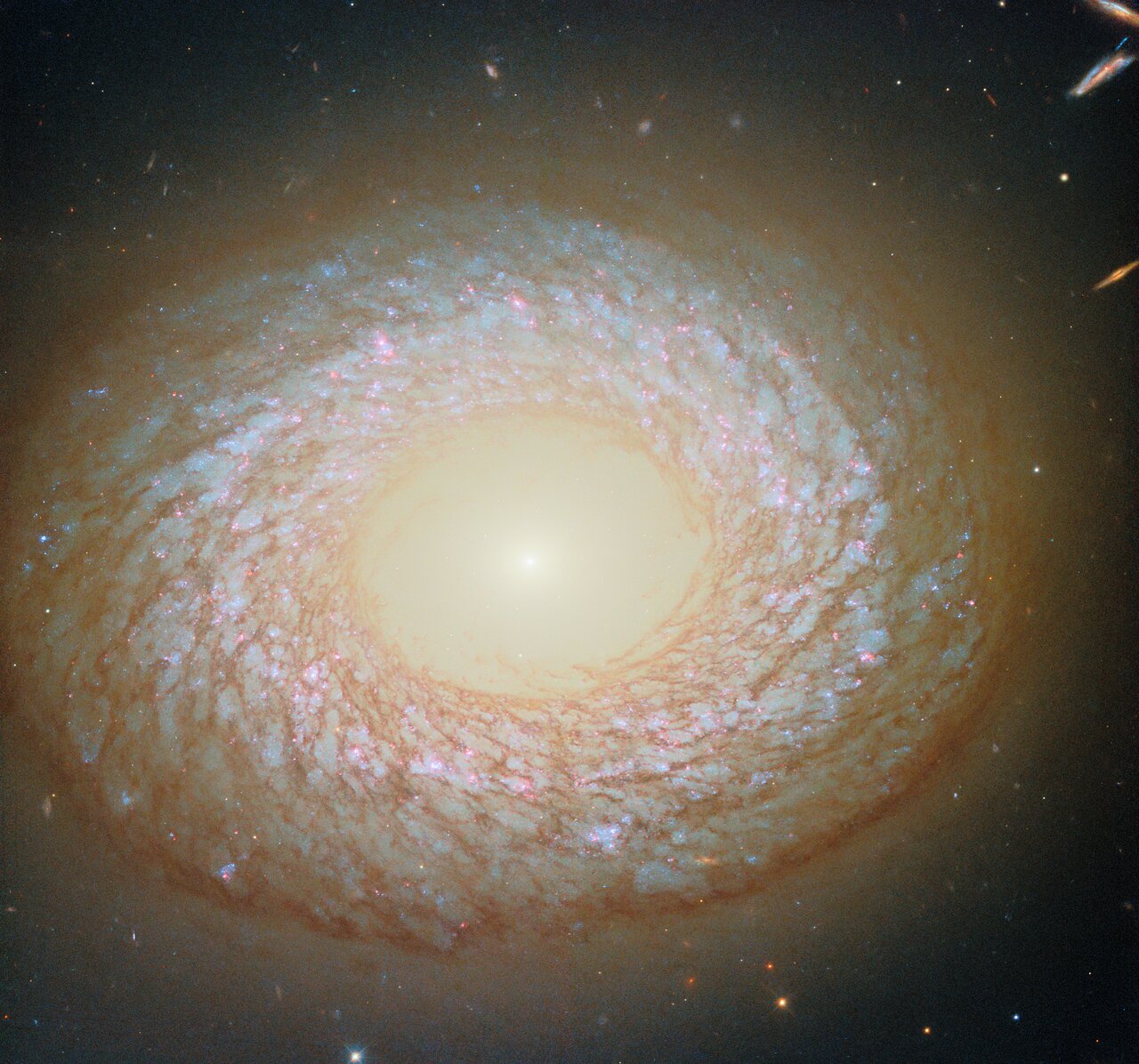
The Hubble image shows a galaxy that is difficult to classify. It is the star system NGC 2775, located 67 million light-years away in the direction of the constellation Cancer. It has a smooth, featureless center devoid of gas, resembling an elliptical galaxy. At the same time, NGC 2775 also has a dust ring with uneven clusters of stars, like a spiral galaxy. All this raises the question: what are we looking at – a spiral or elliptical galaxy – or neither?
Since we can only see NGC 2775 from one angle, it is difficult to say for sure. Some researchers have classified NGC 2775 as a spiral galaxy because of its rings of stars and dust, while others have classified it as a lenticular galaxy. Lenticular galaxies have features common to both spiral and elliptical galaxies.
It is not yet known exactly how lenticular galaxies arise and how they can form. Lenticular galaxies may be spiral galaxies that have merged with other galaxies or have almost completely exhausted the gas necessary for star formation and lost their visible spiral arms. They may also have originally been more similar to elliptical galaxies and then gathered gas into a disk around themselves.
Some evidence suggests that NGC 2775 merged with other galaxies in the past. Barely visible in this Hubble image, NGC 2775 has a tail of hydrogen gas that stretches nearly 100,000 light-years around it. It may be the remnant of one or more galaxies that came too close to NGC 2775 before being stretched and swallowed up. If NGC 2775 merged with other galaxies in the past, this could explain its strange appearance today.
Provided by: Esahubble

