

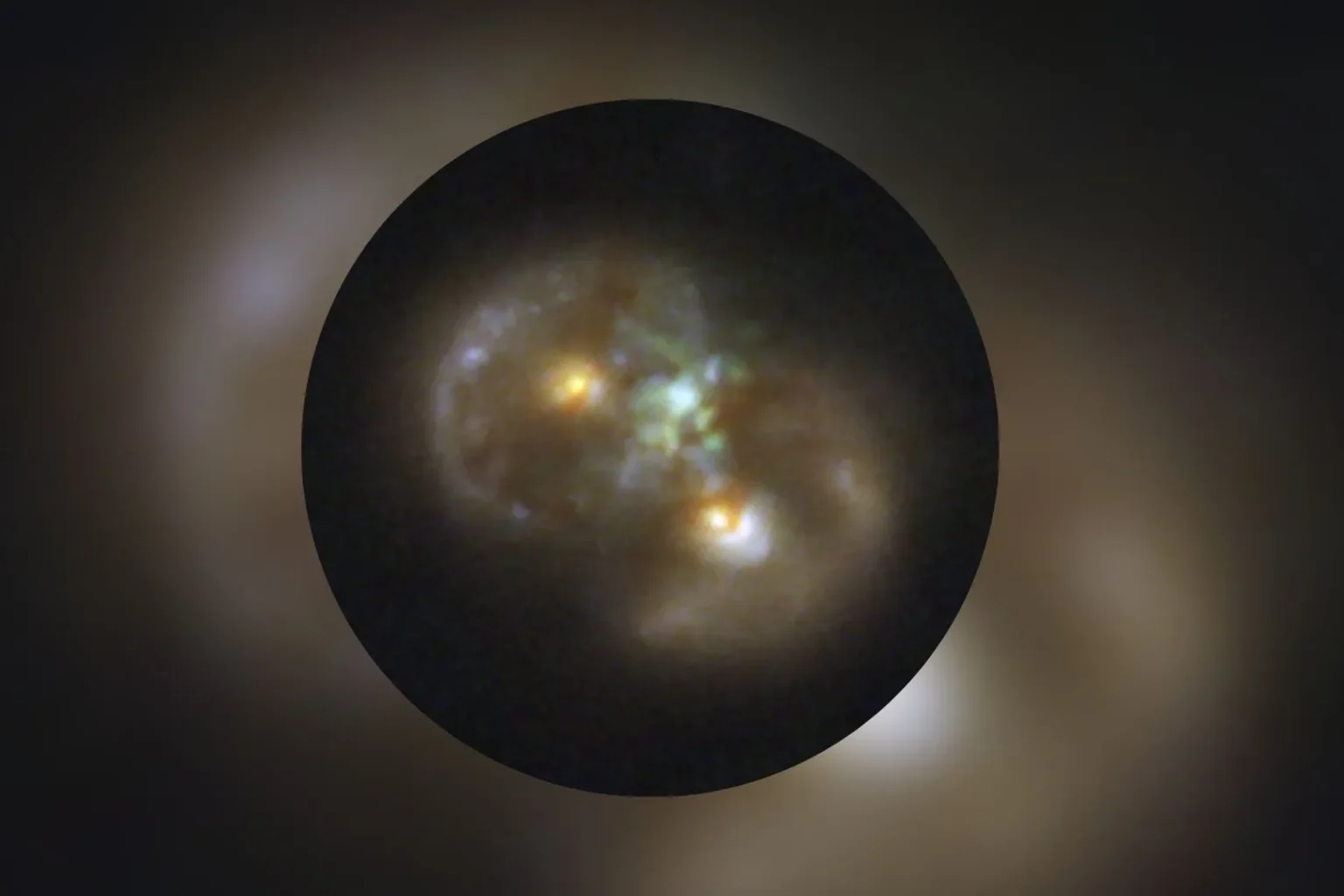
Astronomers from Yale and Copenhagen Universities have discovered an unusual system of colliding distant galaxies, which resembles the symbol ∞ in shape. It has been named “Infinity Galaxy” and may become the first direct evidence of the existence of so-called direct destruction black holes. The results of the study are published in Astrophysical Journal Letters.
Scientists obtained the image of the galaxy using the James Webb Space Telescope and supplemented it with data from the Chandra X-ray Observatory. The light from this system has been traveling toward us for more than 13.5 billion years, which means we see it as it was when the Universe was only about 470 million years old. Its structure features two bright galactic cores, where supermassive black holes are located. But the most interesting one is the third potential black hole at the point of their collision. It may be a newborn black hole formed in a completely different way than usual.
Black holes usually form when massive stars die and collapse under their own gravity. However, there is another hypothesis in astrophysics: black holes can form directly from giant clouds of gas — this is known as the direct collapse mechanism. This scenario would explain the appearance of supermassive black holes in the early Universe, when there was not yet enough time for stellar black holes to evolve and merge into supermassive cosmic giants.
“During the collision, the gas in these two galaxies is shocked and compressed. This compression may be sufficient to form a dense knot, which subsequently collapsed into a black hole,” explains Pieter van Dokkum, professor of astronomy and physics at Yale University. “Although such collisions are rare events, extreme gas density conditions like this were probably quite common in the early stages of the Universe, when the first galaxies were just beginning to form.”
However, scientists are considering other scenarios. Perhaps the mysterious “third black hole” is not a newborn black hole at all, but an object ejected from a neighboring galaxy. Another possibility is that astronomers are observing the collision of not two, but three galaxies, and the third is simply hidden from their view.
“We cannot say definitively that we have found a black hole of direct destruction. But we can say that these new data strengthen the arguments in favor of seeing a newly born black hole, while at the same time rejecting some alternative explanations,” van Dokkum concluded in a NASA blog post.
If the Infinity Galaxy really contains a black hole that originated directly from a gas cloud, this will be the first direct confirmation of the existence of “heavy seeds” of black holes. This discovery will help us understand how giants with masses billions of times greater than the Sun could have appeared in the first hundreds of millions of years after the Big Bang.

