

A new study of the South Pole-Aitken basin, the largest of the lunar craters, has shown that it may have been formed by a tangential impact that occurred in a completely different direction than previously thought. The study also helped to determine what the Moon was like at that time.
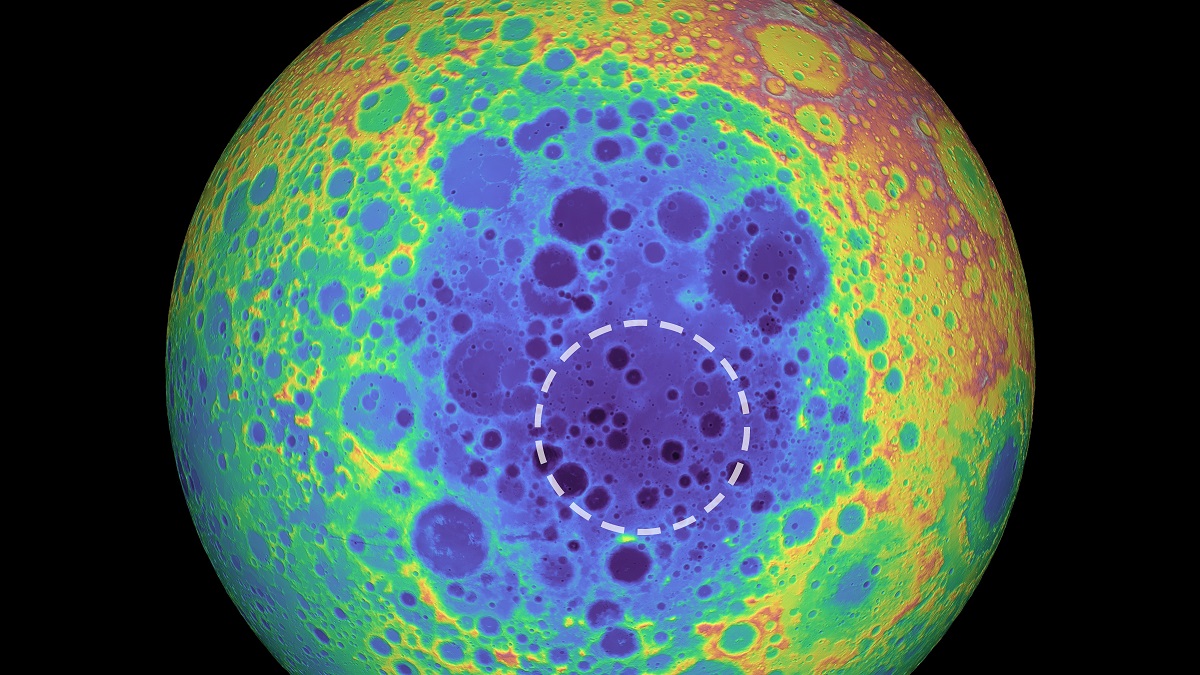
South Pole-Aitken
South Pole-Aitken is the most impact crater on the Moon. It stretches 1,900 km from north to south and 1,600 km from east to west. There are two reasons why most people have never seen it. First, it is mainly located on the far side of the Moon. Second, it is very old (4.3 billion years) and therefore partially destroyed by subsequent impacts.
However, researchers have recently been able to discover something interesting about it. It has been known for quite some time that the South Pole—Etkain was formed as a result of a tangential impact. That is, a giant asteroid crashed into its surface at a steep angle. For a long time, based on the shape of the crater, it was believed that the collision occurred from south to north.
In a new study, scientists compared the South Pole-Aitken with other large craters in the Solar System, analyzed the composition of the rocks comprising the areas surrounding it, and concluded that the asteroid really moved from north to south. This is indicated, in particular, by the thickness of the crust, which increases precisely in this direction.
Past of the Moon
For quite some time after its formation, the Moon remained covered by an ocean of liquid magma. However, over time, the heavy elements gradually sank to the bottom. Relatively light rocks remained on the surface. Among them, attention is drawn to the so-called KREEP – formations containing a relatively large proportion of potassium, phosphorus, and rare earth elements.
There is nothing surprising about their presence, except that they are concentrated mainly on the visible side of the Moon. Our moon has a significant surface asymmetry. Most of the dark volcanic plains that we are used to calling seas are located on the visible side.
And now, new research on the largest crater has helped to put all the pieces of the puzzle together. When a giant asteroid struck near the moon’s South Pole, the shock wave literally squeezed the remains of the magma ocean, along with KREEP rocks, onto its visible side. On the invisible side, a particularly thick crust formed in the absence of magma.
Of course, all this is still mostly speculation. However, we will soon be able to find out more. The fact is that the Artemis III mission program envisages landing on the Moon precisely in the area of its South Pole.
According to phys.org

