

The results of computer simulations conducted by astronomers from the University of Groningen in collaboration with researchers from Europe show that most of the mysterious dark matter outside the Local Group of galaxies (which includes our Milky Way) forms a kind of “sheet.” Above and below this plane are large voids.
Mystery of the Local Group’s movement
Almost a century ago, astronomer Edwin Hubble discovered that virtually all galaxies are moving away from the Milky Way. This is important evidence for the expansion of the Universe and the Big Bang. But even in Hubble’s time, it was clear that there were exceptions. For example, our neighboring galaxy, Andromeda, is moving toward us at a speed of about 100 km/s.
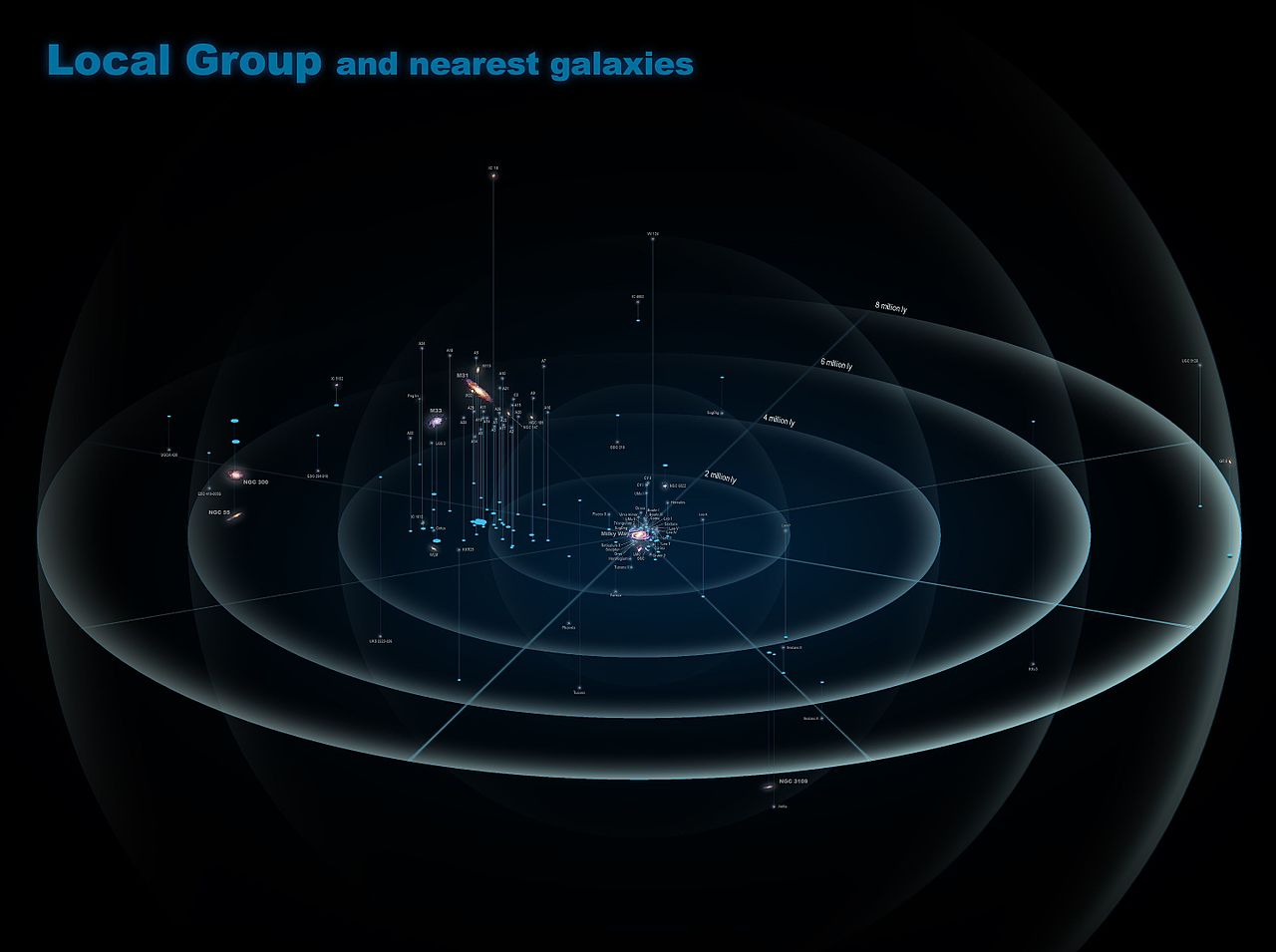
For half a century, astronomers have wondered why most large nearby galaxies (with the exception of Andromeda) are moving away from us and do not appear to be affected by the mass and gravity of the so-called Local Group. In addition to our Milky Way and Andromeda, it includes the Triangulum Galaxy and more than a hundred smaller galaxies.
An international group of scientists has found the solution to this mystery. Computer simulation shows that the distribution of mass just outside the Local Group, including the invisible dark matter surrounding galaxies, is organized into a flat structure stretching tens of millions of light-years. Above and below this plane are large voids. This solution accurately reproduces the distribution and velocities of observable galaxies around us.
“Virtual twin” of the Local Group
Scientists began with a model of regions of the early Universe with a mass distribution based on observations of the cosmic microwave background. It was then refined using a powerful computer to reproduce the modern characteristics of the Local Group with the mass, position, and velocity of the Milky Way, the Andromeda Galaxy, and 31 galaxies located just outside the Local Group. As a result, simulations were created that can be considered “virtual twins” of our space environment.
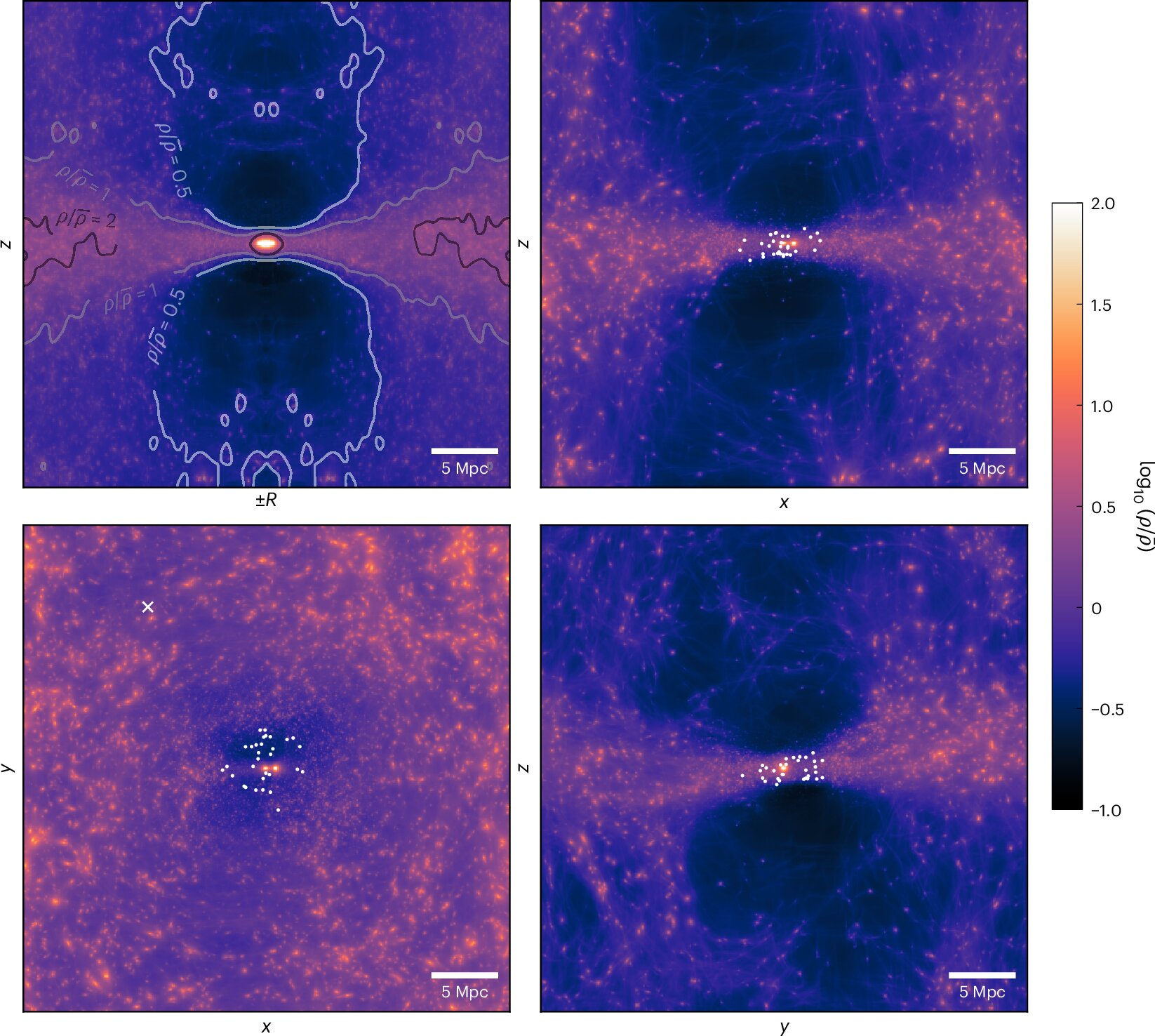
These simulations accurately reproduced the observed velocities of 31 surrounding galaxies, which are moving away from us and precisely follow Hubble’s law, despite the large mass of the Local Group. It is also found that they are embedded in a large-scale layer of dark matter.
There are two main reasons why there are so few deviations from Hubble’s law in the local Universe. For nearby galaxies, the gravitational pull of the Local Group is balanced by the mass further away in the plane. And the places where one would expect matter to be moving toward us (in voids) are actually “invisible” because no galaxies are present there.
According to lead researcher Ewoud Wempe, this is the first assessment of the distribution and velocity of dark matter in the region surrounding the Milky Way and the Andromeda Galaxy. “We are exploring all possible local configurations of the early universe that ultimately could lead to the Local Group. It is great that we now have a model that is consistent with the current cosmological model on the one hand, and with the dynamics of our local environment on the other.”
Earlier, we reported on how scientists used the James Webb Telescope to create a detailed map of dark matter.
According to Phys.org

