

Scientists are trying to explain a mystery known as “Hubble tension.” One answer to this question could be that Earth and the entire Milky Way are located on the edge of a giant void.
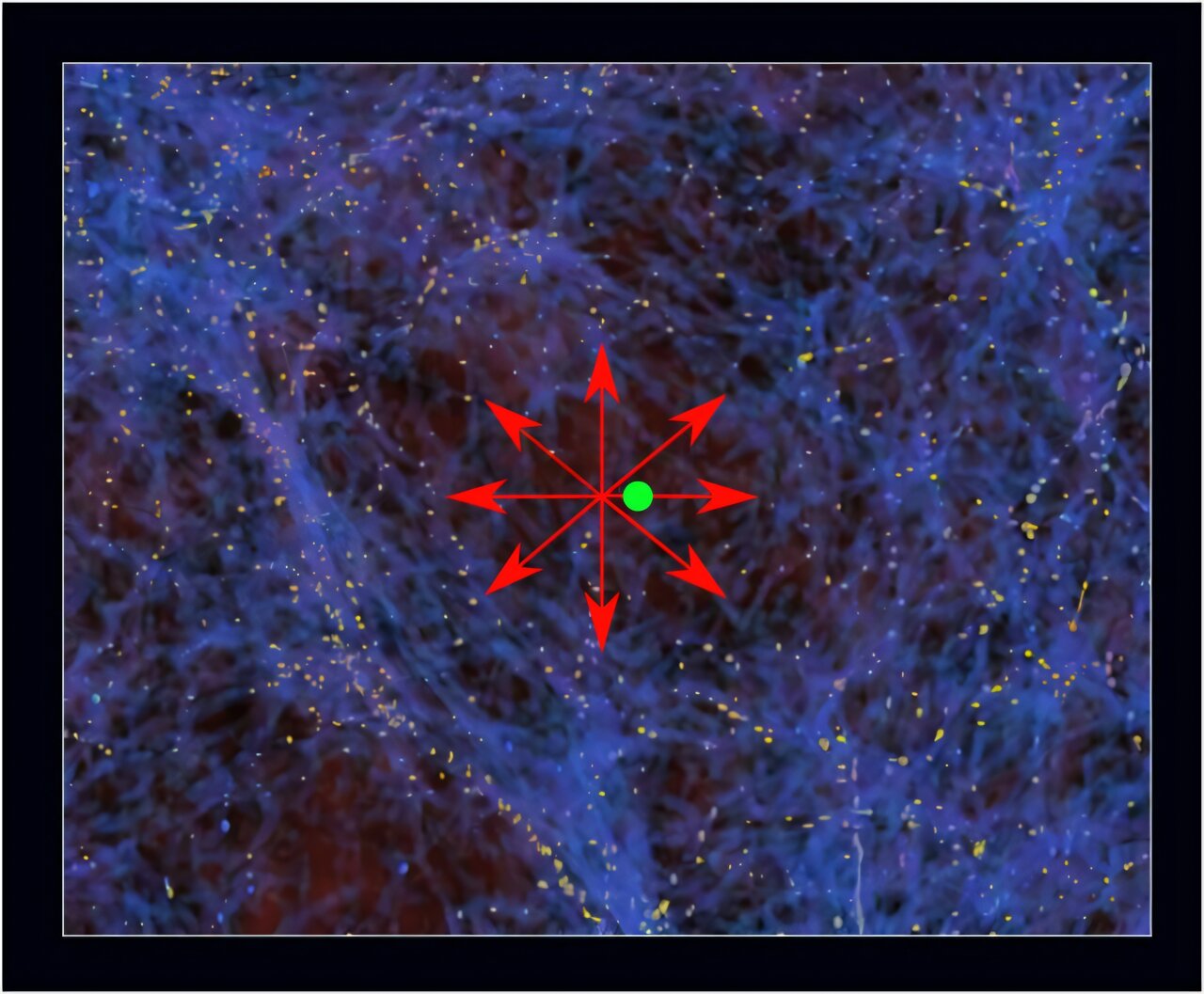
Hubble tension
A recent report presented at a meeting of the British Royal Astronomical Society has given the astronomical community a new hypothesis to explain the “Hubble tension.” This may be a purely local effect.
The “Hubble tension” refers to the situation that has arisen around the measurement of the Hubble constant. Essentially, it is a coefficient that shows how quickly galaxies are moving away from us, and therefore how quickly the Universe is expanding.
The problem is that the figures obtained from observing the star systems and the relic radiation differ slightly, but significantly. And this is precisely what causes scientists to argue that something is wrong with the Universe.
Void
A new study suggests that the universe is alright, but Earth, the entire Milky Way, and the Local Group of galaxies are on the edge of a void. Areas where the density of galaxies is 20% lower than the average in the Universe.
Such areas are well known to astronomers and are called voids. Their distinctive feature is that gravity acts in the direction of the “wall.” Accordingly, galaxies shift in this direction and the void grows over time.
The void should be about 1 billion km in size. And then the movement of the galaxies towards its edge could really explain the discrepancy between the results of measuring the Hubble constant, everything would be fine with the Universe and it would be purely our local phenomenon.
Evidence of the existence of void
Determining whether there is a void near us is not such an easy task. Direct measurements of the coordinates of galaxies around us seem to have shown that there are indeed slightly fewer of them than there should be, but the discussion has not yet been resolved.
The authors of a new study say they have found further evidence that there is a void around us. They consist in the fact that baryon acoustic oscillations, which arose during the Big Bang and still reach us from a great distance around the Milky Way, move at a slightly different angular velocity than they should.
According to phys.org

