
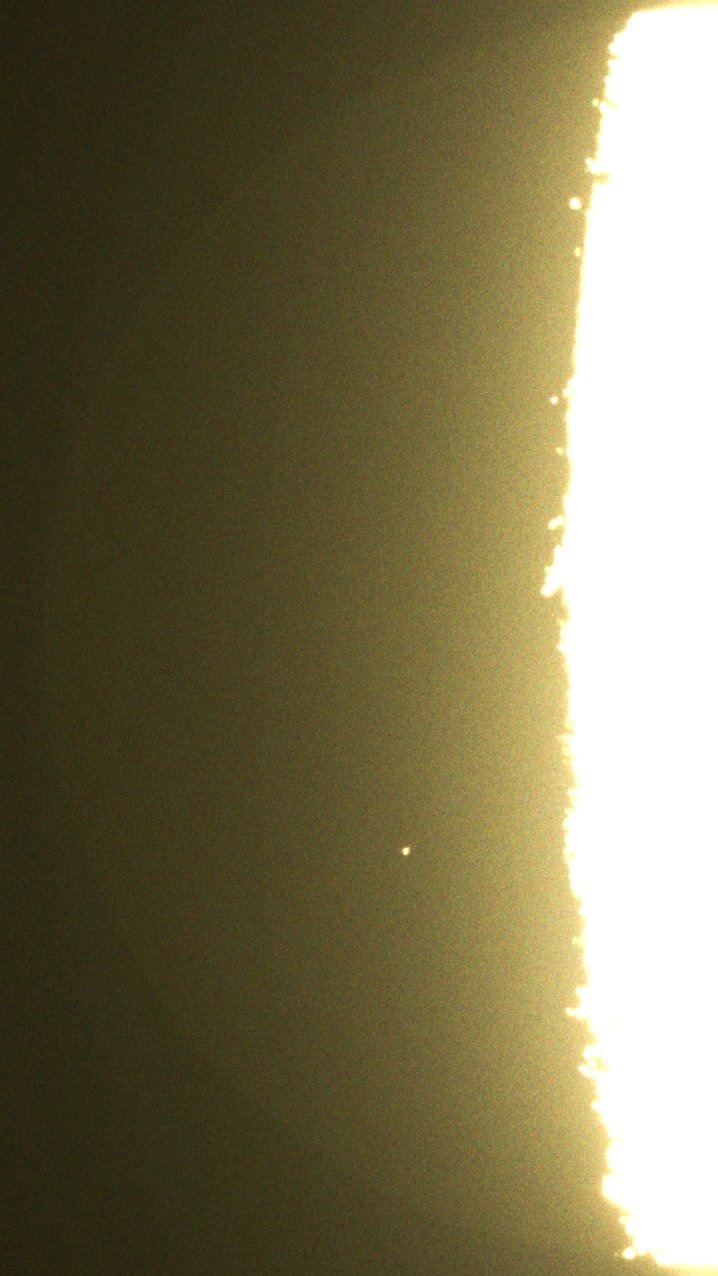
Last week, the Moon experienced a veritable cosmic bombardment. Japanese amateur astronomer Daichi Fujii from Hiratsuka recorded two powerful flashes on the surface of our moon using his own telescopes. The first incident occurred on 30 October, and just two days later, a second strike took place. These events serve as a reminder that the seemingly tranquil Moon is actually a place of constant cosmic attacks, and its surface is gradually being covered with new craters.
Daichi Fujii is a museum curator and astronomy enthusiast. In 2011, he created a special installation with several telescopes that automatically tracks flashes on the Moon. Thanks to this system, he has already documented about 60 strikes. But two in a row is an extremely rare phenomenon.
“I want the public to enjoy science,” says Fujii. He believes that demonstrating the reality of lunar collisions is the best way to get people interested in space.
Space impact strength
昨夜は、上弦の月の夜側に月面衝突閃光が出現しました!2025年10月30日20時33分13.4秒の閃光です(270fps,0.03倍速再生)。月は大気がないため流星は見られず、クレーターができる瞬間に光ります。衝突領域から考えると、現在ピークを迎えている、おうし座南流星群や北流星群由来の可能性があります。 pic.twitter.com/MM3xleCZSJ
— 藤井大地 (@dfuji1) October 30, 2025
What exactly happened? Both flashes were the result of asteroids colliding with the Moon. Since the moon has no atmosphere to slow down such objects, the space rocks hit the surface at incredible speeds of up to 96,560 km/h. Even a small asteroid measuring 1 metre in diameter releases energy equivalent to approximately 0.3-1 kilotons of TNT at such speeds.
昨夜も月面衝突閃光が出現しました!2025年11月1日20時49分19.4秒の閃光です(270fps,0.03倍速再生)。月は大気がないため流星は見られず、クレーターができる瞬間に光ります。おうし座南流星群や北群由来の可能性があります。輝面比は78%もありましたが、太い月は観測時間を稼げるメリットもあります。 pic.twitter.com/HRLzSnke4h
— 藤井大地 (@dfuji1) November 1, 2025
Recording such impacts is of great importance to science. Astronomers use this data to determine the frequency of small asteroid impacts on the Moon. This allows them to refine the risks to our planet: to calculate how often larger objects can penetrate the Earth’s atmosphere and cause potentially devastating consequences.
Are the flashes real?
The public wondered whether the flashes were an illusion, caused by cosmic rays, for example. However, several telescopes in Japan recorded them from different angles. Juan Luis Cano of the European Space Agency confirmed: “These flashes from impacts appear to be real.” He also noted that they were larger than average, indicating their high energy.
The most likely source of these asteroids is the Taurid meteor shower, originating from Comet Encke. It is active this month and is known for its large and fast meteors.
The amateur astronomer believes that his observations will be helpful in the future. As space agencies and private companies plan to build lunar bases, understanding the frequency and force of impacts will be key to ensuring the safety of future inhabitants of the Moon.
“Understanding these processes can be used to design and operate lunar bases,” concludes the enthusiast.
Earlier, we reported on how a pair of stars is preparing to explode brighter than the full moon.
According to Space

