

Scientists dedicated to unraveling the mysteries of elusive neutrinos have released the first scientific results from a new underground facility in China. These data represent the most precise measurements ever recorded of the specific properties of these elusive subatomic particles.
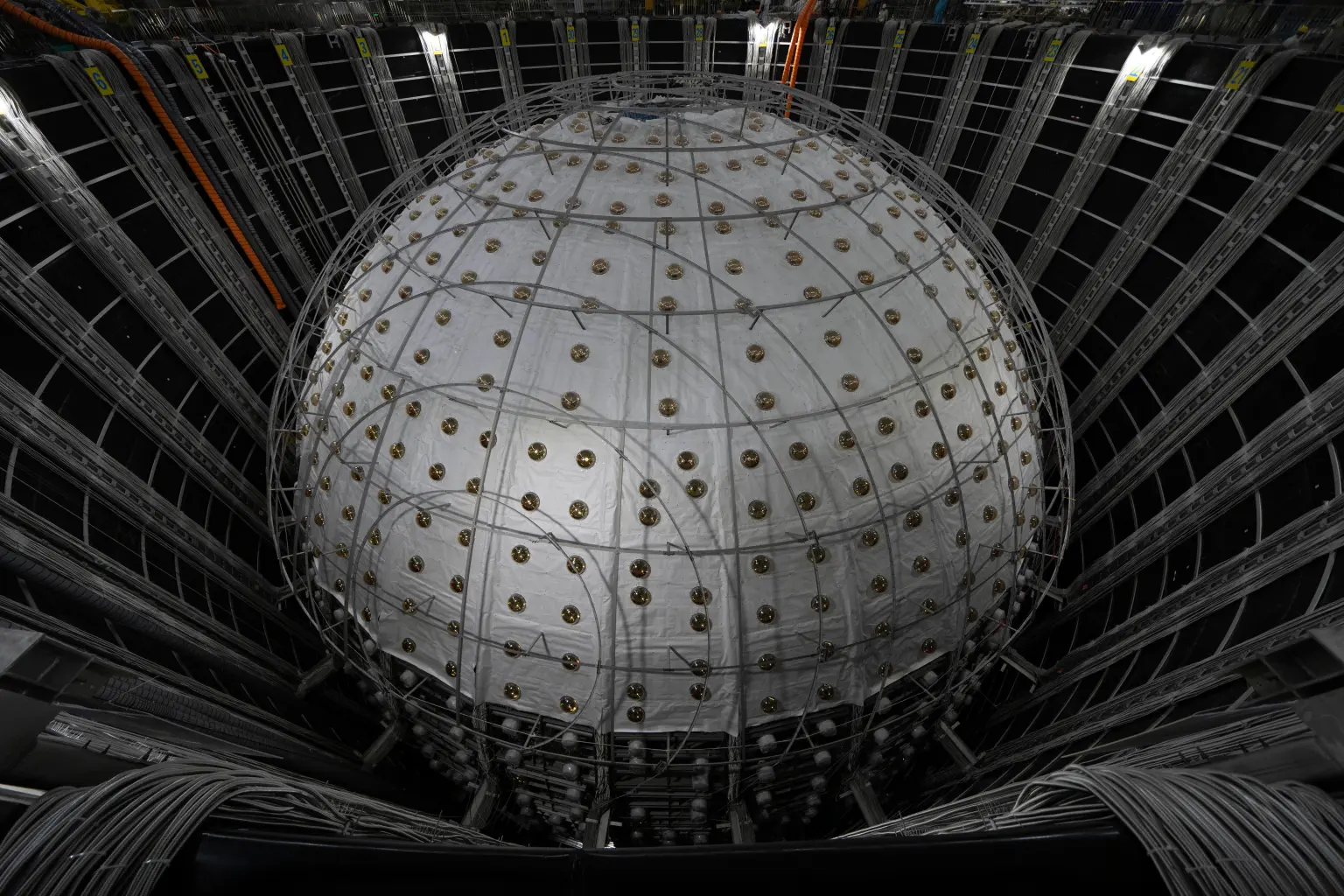
The research is being conducted at the JUNO (Jiangmen Underground Neutrino Observatory) facility. It is a massive particle detector built at a depth of about 650 meters beneath a rock mass near the city of Kaiping in the southern Chinese province of Guangdong.
The researchers published the detailed results of their work in the scientific journal Nature. The article is based on data collected during the detector’s first 59 days of operation, immediately following its completion last year.
According to Yifang Wang, a physicist at the Institute of High Energy Physics of the Chinese Academy of Sciences and a spokesperson for the JUNO collaboration, the results are not only of immense value to neutrino physics, but also demonstrate the exceptional performance of the new large-scale detector.
Mystery of “ghost particles”
Neutrinos are fundamental elementary particles. There are an enormous number of them in the universe, yet they remain the least understood. The fact is that they are electrically neutral, so they are not affected by magnetic fields, and they are capable of passing through any matter—stars, planets, and our bodies—with almost no interaction. Every second, trillions of neutrinos pass through us, and we don’t even feel it.
These particles are produced under extreme conditions: in the cores of stars like our Sun, or during supernova explosions. Scientists distinguish between three types (or “flavors”) of neutrinos. As they travel through space, they can transform from one type to another—a process known as oscillation.
Scientists are now certain that neutrinos have mass. But one of the main unresolved questions is the so-called “mass order”—determining which of the neutrino states is the lightest and which is the heaviest. Although the initial results from JUNO have not yet provided a definitive answer to this question, they have allowed for the measurement of two of the six fundamental oscillation parameters with record-breaking precision—approximately 1.6 times better than in previous studies.
How does a $300 million detector work?
Every particle of matter has a “twin”—an antiparticle with the opposite charge. That is why antineutrinos exist. JUNO detects their oscillations. The source of antineutrino radiation is the Yangjiang and Taishan nuclear power plants, located 52.5 km from the laboratory.
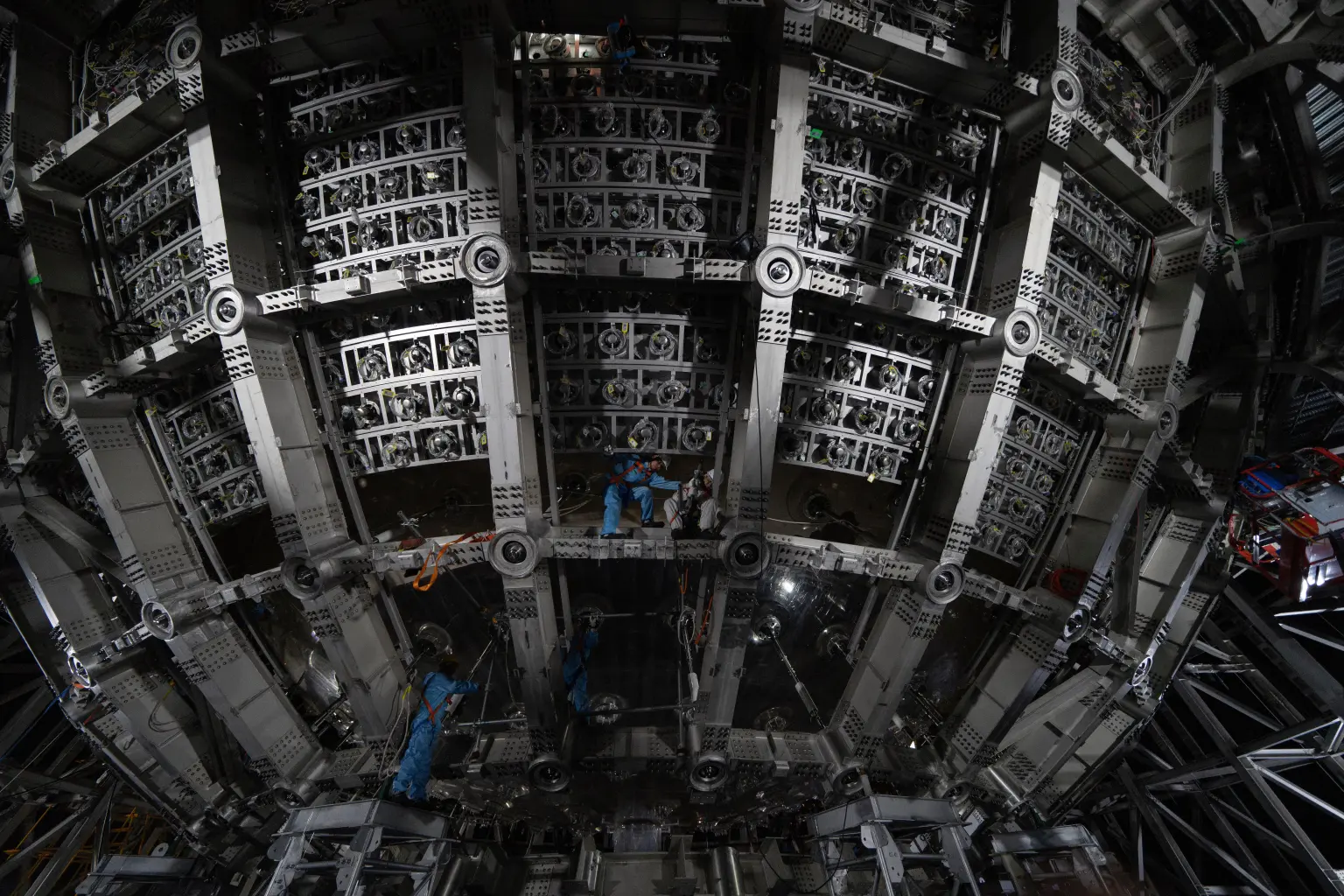
The detector itself is a massive spherical tank filled with 20,000 tons of organic liquid. In complete darkness, this liquid glows when an antineutrino passes through it.
Studying neutrinos is extremely difficult: countless neutrinos pass through the Earth every minute, but only a tiny fraction of them interact with matter. That is why such experiments require massive tanks, deep underground locations to shield against from streams of other particles, and stable, long-term operation.
Key to the evolution of the Universe
By tracing neutrinos back to their source, astrophysicists can study the most powerful processes in the cosmos. In the future, JUNO will detect particles from the Sun and supernova explosions. This data could be key to understanding why matter predominates over antimatter in the universe, and could also help reveal the nature of dark matter and dark energy.
A massive star in the final stages of its life undergoes a core collapse, accompanied by a powerful neutrino burst—the first signs of an impending supernova explosion.
An artist’s impression of the final moments in the life of a massive star (whose mass is eight times that of our Sun). At the end of its life cycle, the star has exhausted a significant portion of the material needed to generate energy in its core. Without this energy, the star’s core is no longer able to support the upper layers of the star and collapses under their weight. The collapse of the core triggers complex physical processes inside the star, which produce a large number of neutrinos, some of which escape from the star and are emitted into the surrounding space. They are the first harbingers of a supernova and precede the explosion by several hours. The enormous amount of energy generated by the core collapse triggers a shock wave that propagates outward through the star’s layers. In a short time, the shock wave reaches the star’s surface: a supernova erupts in the sky. The image shows the moment just before the shock wave passes over the star’s surface. The neutrinos escaping outward are depicted as rays of light emanating from the star.
The JUNO project, with a budget exceeding $300 million, is part of an international collaboration. It ranks among the world’s top three flagship projects in neutrino physics, alongside the DUNE detectors in the United States and Hyper-Kamiokande in Japan. According to Yifang Wang, these three projects complement each other perfectly: they use different technologies and particle sources, and thus, through joint efforts, will provide humanity with the most comprehensive understanding of the fundamental properties of neutrinos.
We have previously explained that neutrinos hold the key to solving the cosmological puzzle of why some stars explode while others do not.
According to Reuters

