For anyone who loves the starry sky, August is mainly about the incredible Perseid meteor shower, which peaks around the 12th. However, in 2025, we will not be as lucky: the nearly full moon will reduce the number of shooting stars visible at night.
However, the second half of August night will delight us with something else. First of all, almost all planets will be visible in the pre-dawn sky; this phenomenon is commonly referred to as an “appulse”. Only Mars will remain low above the western horizon in the evening.
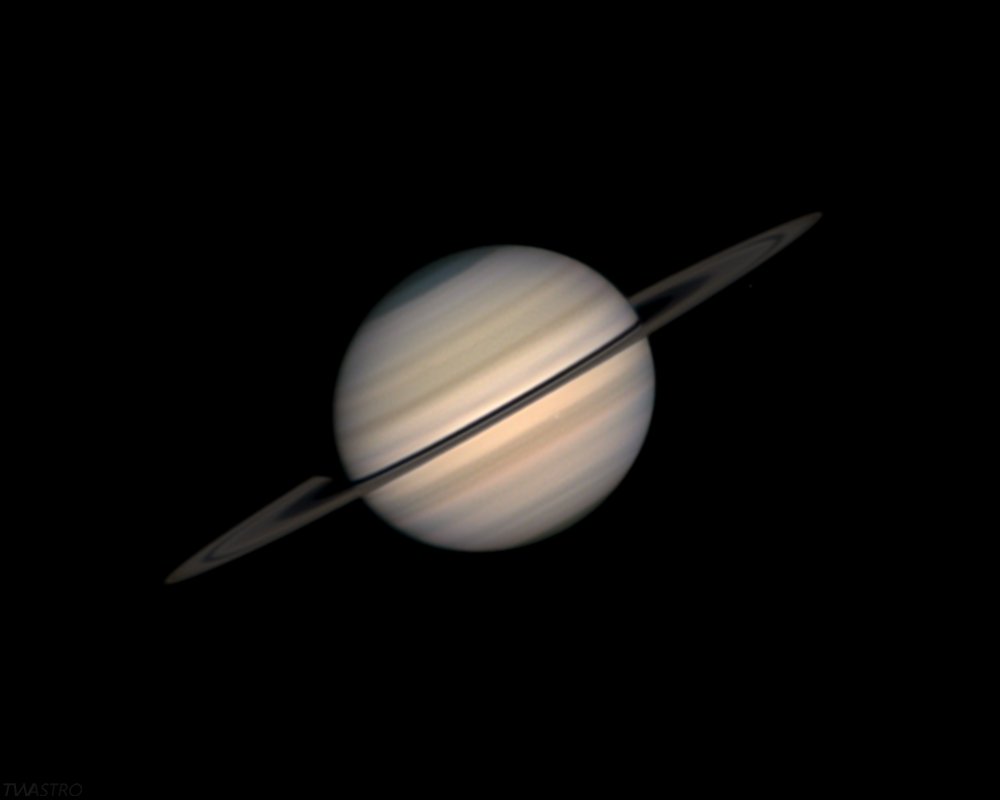
Saturn’s visibility is improving – in August, it can be observed throughout the second half of the night. It is worth taking a look at it, if only to see how much the planet’s real appearance differs from the images published by astrophotographers.
This month will be the best time of the year for morning observations of the elusive planet Mercury. The main event can be considered the conjunction of Venus and Jupiter – the two brightest planets, which will meet in the sky on August 12 and serve as a kind of “compensation” for the not-so-spectacular Perseids.
At the end of the month, just before dawn, you can see more than just bright planets. Shortly before sunrise, constellations traditionally associated with winter appear in the sky: Orion, Auriga, and Gemini. And in the last days of summer, you can even catch a glimpse of Sirius, the brightest star in our sky, low above the horizon.
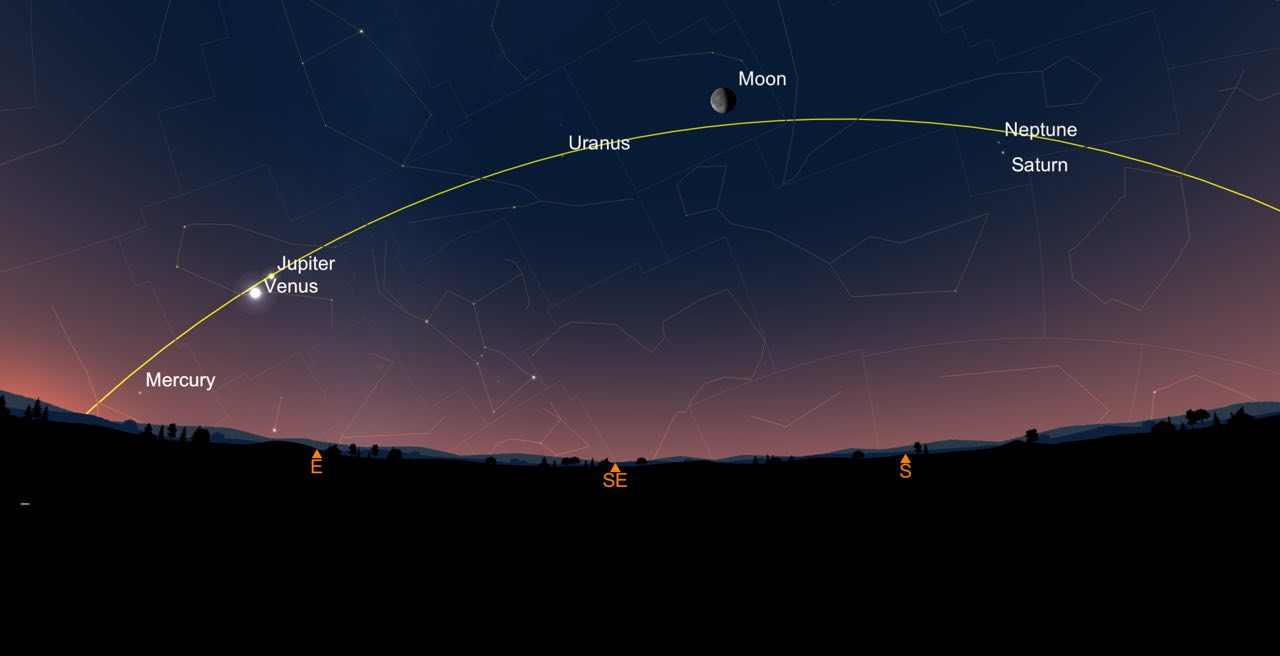
Source: SkySafari virtual planetarium
List of events
August 6 – the conjunction of Saturn (+0.6m) and Neptune (+7.8m) in the constellation Pisces, with an angular distance between the cosmic bodies of only 1° 8′. This is a good chance to see both planets in the field of view of a small telescope or binoculars. It can be observed in the second half of the night.
August 7 – Venus (-4.0m) at its highest point in the pre-dawn sky.
August 9 – full moon, at exactly 10:54 a.m. Kyiv time (07:54 a.m. UTC), so both August 8 and 9 are acceptable for observation.
August 12 – the peak of the Perseid meteor shower. Due to the large phase of the Moon (~90% on the night of August 11-12 and ~84% on the night of August 12-13), the number of meteors that can be seen will be significantly lower than usual.
August 12 – the conjunction of Venus (-4.0m) and Jupiter (-1.9m). Venus will be located 0.9° south of Jupiter.
August 12 and 13 – the Moon will pass close to Saturn (+0.6m) and Neptune (+7.8m), a phenomenon that can be observed in the second half of the night.
August 19 – Mercury (-0.2m) is at its greatest western elongation. Before dawn, it will be at an angular distance of 18.6° from the Sun.
August 20 – the waning crescent in the pre-dawn sky (11%) will be 5° from Jupiter and 6.5° from Venus.
August 23 – new moon, exact time 09:06 a.m. Kyiv time (06:06 a.m. UTC). This new moon is considered a “Seasonal Black Moon” because it is the third in the summer astronomical season, which has four new moons.
A detailed overview of the most interesting events
August 12: the peak of the Perseid meteor shower
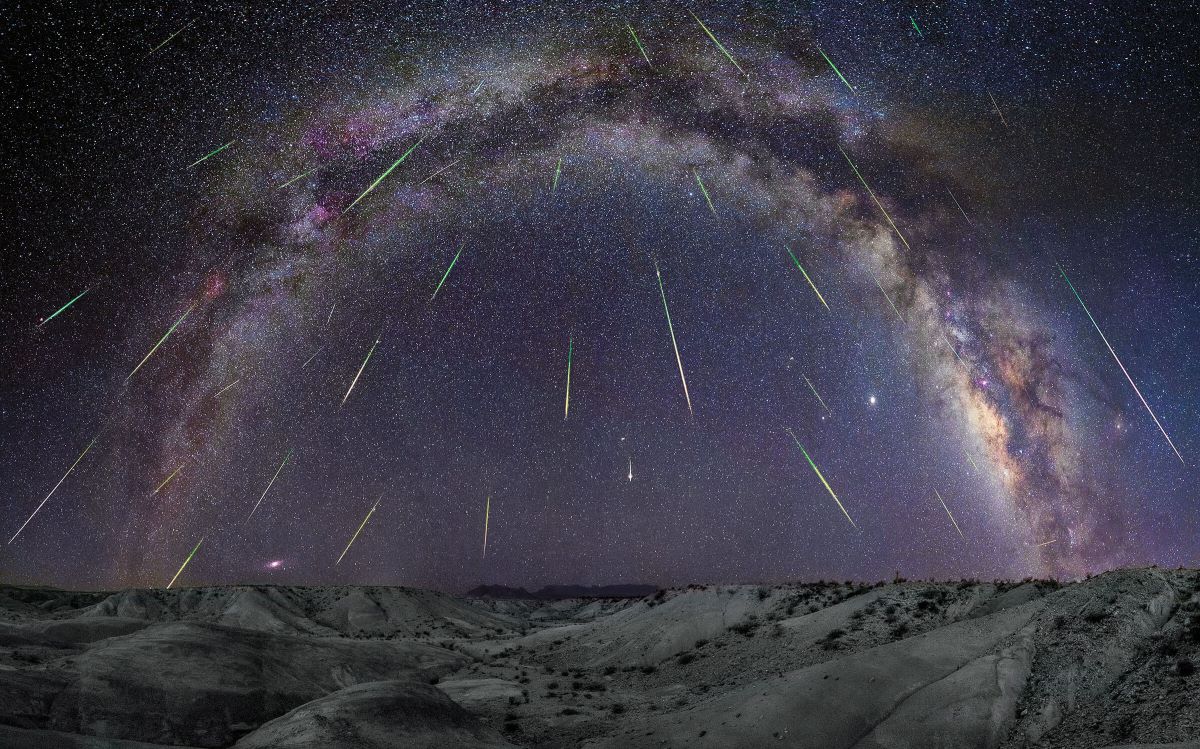
The Perseids are one of the most spectacular annual astronomical phenomena. From July 17 to August 24, Earth crosses a wide stream of particles left behind by the comet 109P/Swift-Tuttle, which returns to the Sun approximately every 133 years. As they collide with the atmosphere, the particles heat up and burn up completely in the form of “shooting stars”, often leaving behind an ionized trail. The zenith hourly rate (ZHR) of the stream at its peak activity is about 100. However, this estimate is for a completely open sky and with the radiant located at the zenith. In practice, one observer can usually see about 50 meteors per hour.
Unfortunately, this year, shortly after the radiant rises above the horizon, an almost full moon will appear. This means that our satellite will remain in the sky for the entire second half of the night and will only set below the horizon after dawn.
Due to the scattering of moonlight in the atmosphere, particularly on tiny water droplets, the background of the sky becomes significantly brighter. From an observational point of view, this means that it will be impossible to see faint meteors. However, there are often quite bright ones among the Perseids, so you are guaranteed to see 10-20 meteors per hour (depending on whether you are observing in the city or far from urban light pollution). To increase your chances, try to choose an observation site in advance so that the Moon is hidden from you by a building or dense trees. In addition, it is not worth looking at the radiant itself: the further the meteor is from the radiant, the longer its track will be on average.
And do not be disappointed by the unfavorable conditions of 2025: next year, on the same days, the Moon will be in its new phase, so the Perseids will once again provide us with true aesthetic pleasure.
August 12: the conjunction of Venus and Jupiter
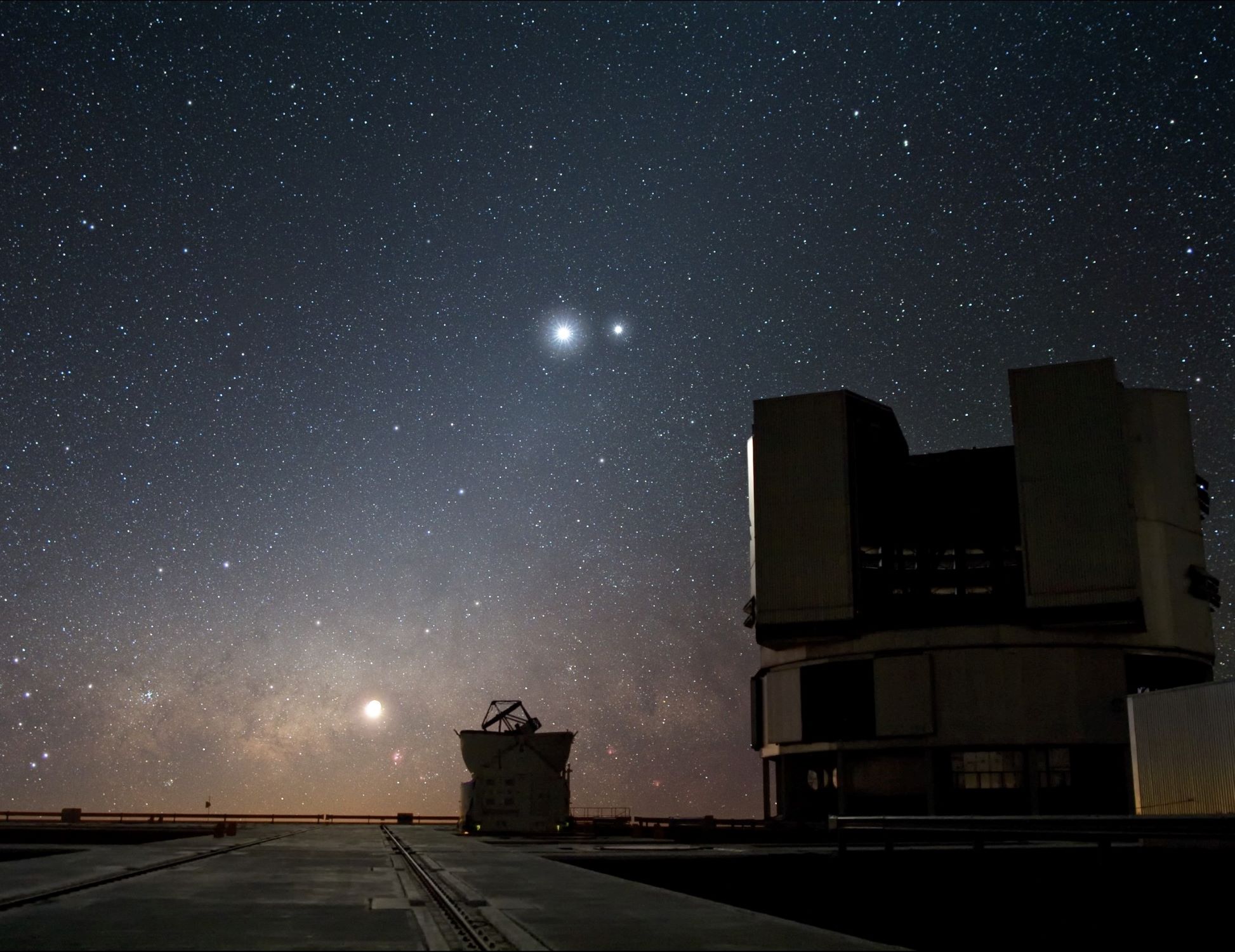
This is definitely an event worth waking up before dawn for. The two brightest planets will come together in the sky in an amazing spectacle! Venus (-4.0m) and Jupiter (-1.9m) will be only 51′ apart, which is less than twice the diameter of the lunar disk. With this configuration, both planets can easily be seen in the field of view of binoculars or a small telescope. This is also a good opportunity to see the planets in the daytime sky. Venus is fairly easy to find, and Jupiter will be nearby.
Keep in mind that Venus moves across the sky quite quickly. Therefore, if you look at the planets even a day earlier or later, you will already be able to see a change in their relative positions. On the other hand, this is a great opportunity to capture an incredible time-lapse.
How rare is this phenomenon? It occurs approximately once a year, but the conditions are different each time. For example, the next one will be in June 2026, but not in the morning sky, but in the evening, and the angular distance between the planets will be approximately twice as large. And in 2027, there will be no luck at all: the planets will be too close to the Sun, so it will be impossible to see the conjunction. However, in 2028, Venus will come even closer to Jupiter than this year.
August 19: the best time for Mercury
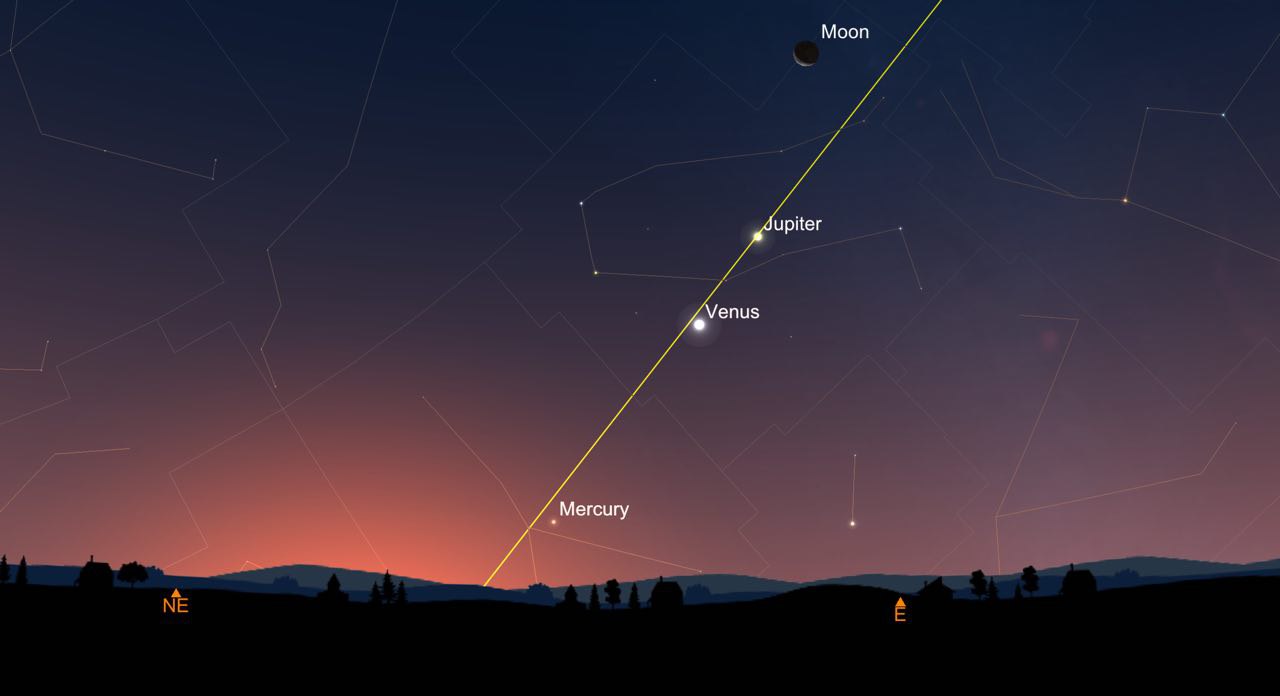
On this day, at 12:25 UTC, Mercury will be at its greatest western elongation, 18.6° away from the Sun. For about a week before and after this event, the planet will be relatively easy to find in the predawn sky, and this is the best period for morning visibility of Mercury in 2025. In Kyiv, the best time for observation will be between 5:00 and 5:10 a.m. For more eastern regions, it will be slightly earlier, and for more western regions, it will be later. The difference can be up to about 30 minutes, so when planning your observations, it is best to check with a virtual planetarium. Choose the optimal time so that the planet is at least 6° above the horizon and the Sun is at least 6°-7° below the horizon.
With the naked eye, Mercury will resemble a bright yellow star low above the horizon. But be careful: higher and further south, directly below the Moon, are the distinct Venus and Jupiter. Mercury is significantly dimmer than them. To make sure that this is the planet you are looking for, it is better to use a telescope. Mercury will resemble a tiny Moon, illuminated by 42%.
August 23: Black Moon – the best time for deep-sky objects
During the year, the Moon is in its new phase 12 or 13 times. If there are four new moons in an astronomical season (the period between the solstice and the equinox), the third one is traditionally called the Seasonal Black Moon. For example, the fourth new moon of this year’s summer astronomical season will be on September 21 at 22:56 (Kyiv time), and the autumn equinox, which marks the end of astronomical summer, will be on September 22.
Visually, the Black Moon does not stand out in any way, and it is fundamentally impossible to see the Moon in the 0% phase (except for solar eclipses) due to its proximity to the Sun.
However, when the Moon is in its new phase, it opens up wonderful opportunities for observing deep-sky objects. In the first half of the night, it is worth paying attention to various objects in the Milky Way. Among them, for example, there may be such scattered star clusters as M11, M18, M23, M25, M26, M29, and M39, as well as globular clusters M2, M15, M71, and M72. In the second half of the night, you can pay attention to galaxies – here you will be delighted by the Andromeda Galaxy (M31) and the Triangulum Galaxy (M33).